


Orders
.png&w=48&q=75 "login")
Profile


Wallet

What Is Effacement? Meaning, How It Is Measured, and Effacement vs Dilation


BDS (Gold Medalist), Certified Lactation Consultant – BPNI Delhi, Maternal & Infant Nutrition Expert · 15 years experience
 7 min
7 minAs your due date nears, your doctor may say your cervix is "50% effaced" or "fully effaced", and it is natural to wonder what that means. Effacement is one of the key signs your body is getting ready for labour, and it works hand in hand with dilation. It is measured as a percentage, and understanding it helps you make sense of what your doctor tells you in those final weeks. Here is what effacement means and why it matters.
Quick Answer
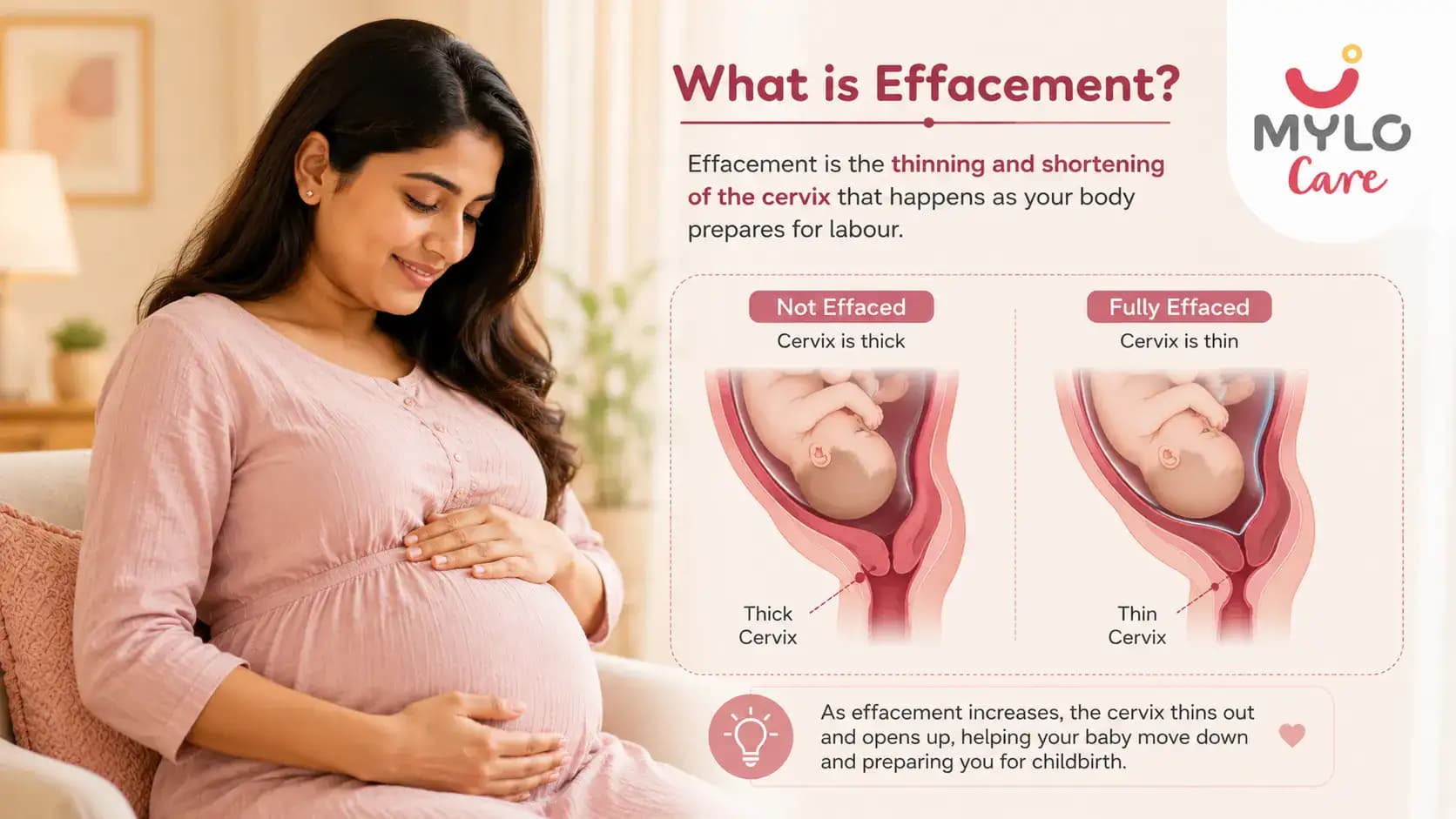
Effacement is the thinning and shortening of the cervix as your body prepares for labour. It is measured as a percentage from 0% (thick and uneffaced) to 100% (fully thinned, or paper-thin). Effacement works alongside dilation, the opening of the cervix, to let your baby move down and be born. It can begin days or weeks before labour, or during it, and is checked by an internal (vaginal) examination.
Medically reviewed against: NHS, ACOG and Cleveland Clinic guidance
Medical Disclaimer: This article is for general information and is not a substitute for professional medical advice. If you have regular contractions, your waters break, or you have any bleeding or concern near your due date, contact your doctor or maternity unit.
What Is Effacement?
Before pregnancy ends, the cervix, the lower opening of the uterus, is normally long, thick and firm, around 3 to 4 cm in length. Effacement is the process by which this cervix thins out and shortens so it can eventually stretch open. As labour approaches, hormones and the pressure of the baby's head cause the cervix to soften and gradually flatten until it is paper-thin. Effacement is one of the natural changes that prepares your body to give birth.
Why Does Effacement Matter?
Effacement matters because it is one of the main signs that your body is getting ready for labour (Cleveland Clinic). Along with dilation, it tells your doctor:
How far along your body is in preparing for birth
How labour is progressing once it begins
When your baby may be able to move down through the birth canal
It is part of the picture your doctor uses, together with dilation and the baby's position, to understand where you are in the process. On its own it does not pinpoint the exact hour labour will start, but it is a meaningful signal.
How Is Effacement Measured?
Effacement is measured as a percentage from 0% to 100%, based on how thin the cervix has become (Cleveland Clinic):
Effacement | What It Means |
|---|---|
0% | The cervix is still long and thick (not effaced) |
50% | The cervix has thinned to about half its normal length |
100% | The cervix is fully thinned, or paper-thin (fully effaced) |
So if your doctor says you are "50% effaced", your cervix is about half as thick as it normally is. At 100% effaced, it has thinned out completely, which usually needs to happen before or around the time the cervix is fully open for birth. Your doctor checks effacement through an internal (vaginal) examination, feeling the length and thickness of the cervix. It is not something you can measure or feel yourself.
Effacement vs Dilation: What Is the Difference?
These two words are often used together but mean different things:
Effacement is the thinning of the cervix, measured in percentages (0 to 100%).
Dilation is the opening of the cervix, measured in centimetres (0 to 10 cm), with 10 cm being fully open.
Think of it this way: effacement is the cervix getting thinner, and dilation is it getting wider. They usually happen together, but not always at the same pace. In first pregnancies, the cervix often effaces first and dilates afterwards. In later pregnancies, effacement and dilation frequently happen at the same time. You can be significantly effaced with little dilation, or vice versa, both are normal.
When Does Effacement Happen, and Can You Feel It?
Effacement can begin days or even weeks before labour, especially in first pregnancies, or it may happen mostly during labour itself. There is no single "right" time, every pregnancy is different.
You cannot directly feel effacement happening. However, it often occurs alongside other late-pregnancy signs you may notice, such as losing your mucus plug or having a "show" (blood-tinged mucus), more frequent Braxton Hicks tightenings, or increased pelvic pressure. These are clues your body is preparing, but only an internal exam confirms effacement.
Expert Insight: Effacement Does Not Predict the Exact Start of Labour
It is easy to read a lot into "you are 70% effaced", but effacement alone does not tell you exactly when labour will begin. Some women walk around effaced and slightly dilated for weeks; others go from barely effaced to active labour quickly. This is why doctors look at effacement together with dilation, contractions and the baby's position, rather than treating one number as a countdown. If you are effaced but not in labour, that is completely normal, your body is simply getting ready in its own time.
FAQs
What does 50% effaced mean?
It means your cervix has thinned to about half its normal thickness. You are partway through effacement, but not yet fully thinned. Your doctor tracks this alongside dilation to understand how your body is preparing for labour.
Can you be effaced without being dilated?
Yes. Especially in a first pregnancy, the cervix often thins (effaces) before it opens (dilates). You can be significantly effaced with little or no dilation, and it is completely normal.
Does effacement mean labour is starting soon?
Not necessarily. Effacement is a sign your body is preparing for labour, but it does not predict the exact timing. Some women are effaced for days or weeks before labour begins.
How is effacement checked?
Through an internal (vaginal) examination, where your doctor or midwife feels the length and thickness of the cervix. It is not something you can measure yourself, and it is only checked when clinically useful.
Summary
Effacement is the thinning and shortening of the cervix, measured from 0% to 100%, as your body prepares for labour. It works alongside dilation, the opening of the cervix, and both are signs of how your body is progressing towards birth. Effacement can begin before or during labour, you cannot feel it directly, and it does not predict the exact moment labour will start, so trust your doctor to read it together with your other signs.
References
Cleveland Clinic. "Cervical Effacement and Dilation." https://my.clevelandclinic.org/health/articles/9676-cervical-effacement-and-dilation
NHS UK. "Signs That Labour Has Begun." https://www.nhs.uk/pregnancy/labour-and-birth/signs-of-labour/signs-that-labour-has-begun/
ACOG (American College of Obstetricians and Gynecologists). https://www.acog.org/

MYLO CARE MamaGro™ Protein Diskettes
MYLO CARE MamaGro™ Protein Diskettes

MamaGro™ Protein Diskettes (100 Vanilla + 100 Jeera Diskettes)
High Protein Pregnancy Biscuits | Fortified Nutrition | No Added Sugar | Easy To Digest




MamaGro™ Protein Diskettes - 750gm Chocolate
Supports Healthy Placenta | Supports Fetal Development



MamaGro™ Protein Diskettes - 500gm Chocolate
Supports Healthy Placenta | Supports Fetal Development
Article Posted Under
Related Articles
BPD in Pregnancy: A Key Factor in Estimating Fetal Weight and Gestational Age
 7·
7· 10 min
 Normal Delivery Tips: An Expecting Mother's Guide to a Smooth Childbirth Experience
 23·6 min
 Crown Rump Length (CRL) on Ultrasound: What It Means and CRL by Week (2026 Guide)
 10·11 min
 Apple Cider Vinegar Tablets vs Liquid: Are the Pills as Effective as the Juice?
 2·9 min
Related Topics
.webp&w=32&q=75)
Medical Disclaimer
This content is for informational purposes only and should not replace professional medical advice. Consult with a physician or other health care professional if you have any concerns or questions about your health. If you rely on the information provided here, you do so solely at your own risk.


AWARDS AND RECOGNITION

Mylo wins Forbes D2C Disruptor award

Mylo wins The Economic Times Promising Brands 2022
AS SEEN IN













- Mylo Care: Effective and science-backed personal care and wellness solutions for a joyful you.
- Mylo Baby: Science-backed, gentle and effective personal care & hygiene range for your little one.
- Mylo Community: Trusted and empathetic community of 10mn+ parents and experts.


Product Categories
Baby Carrier | Baby Soap | Baby Wipes | Stretch Marks Cream | Baby Cream | Baby Shampoo | Baby Massage Oil | Baby Hair Oil | Stretch Marks Oil | Baby Body Wash | Baby Powder | Baby Lotion | Diaper Rash Cream | Newborn Diapers | Teether | Baby Kajal | Baby Diapers Pants | Cloth Diapers | Laundry Detergent | Lactation Granules |