


Orders
.png&w=48&q=75 "login")
Profile


Wallet

Toddler Drawing Stages by Age: When Will My Child Scribble, Draw a Circle and Draw a Person? A Guide for Indian Parents (2026)
 21 min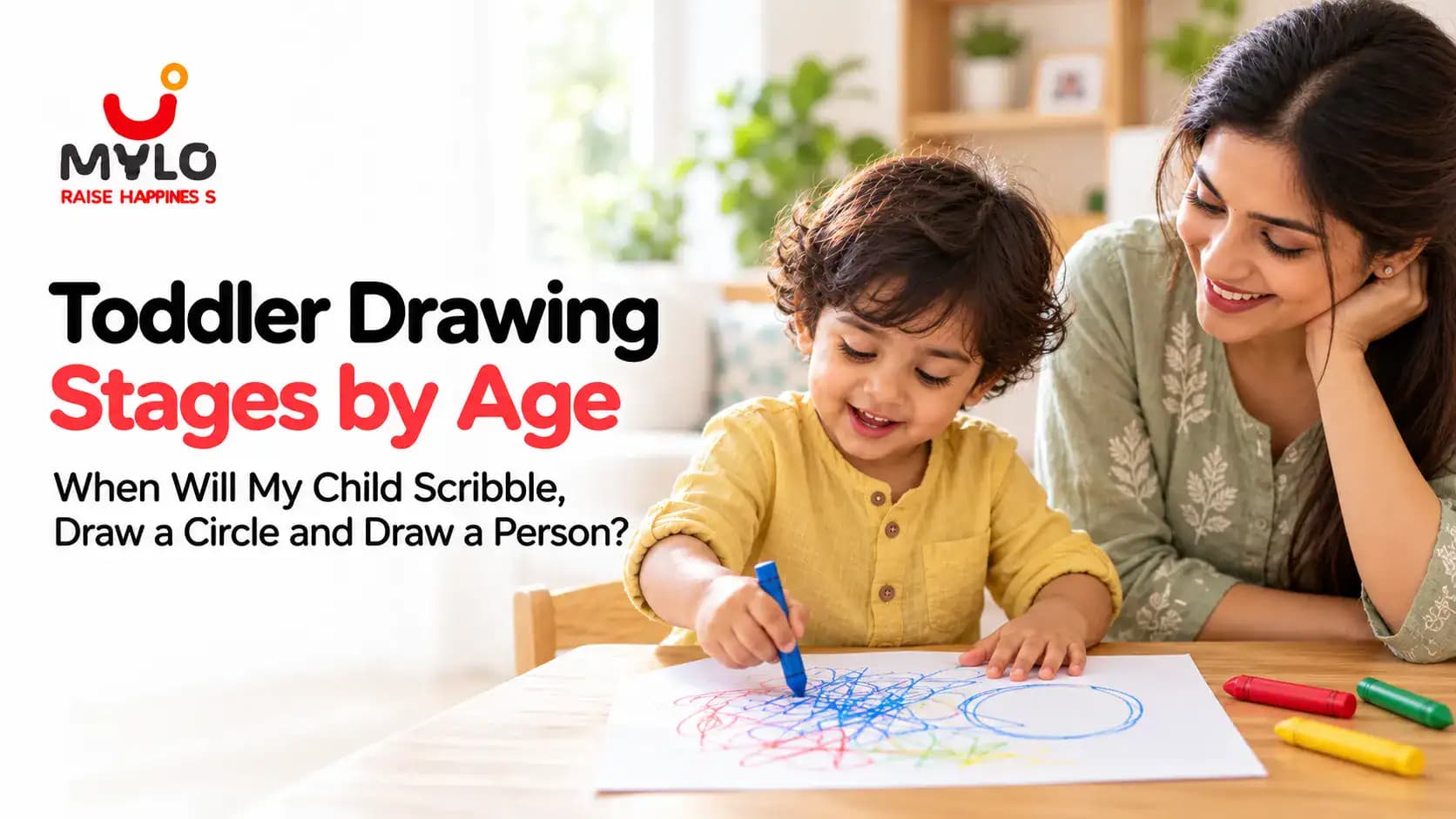
Quick Answer
Toddler drawing stages are the steps children go through as their drawings grow from random scribbles into real pictures. Most toddlers scribble by 18 months, draw a circle around 3 years, and draw a simple "tadpole" person (a big head with legs) between 3 and 4 years. By 5, most draw a person with a body, arms and legs.
Drawing Stages at a Glance
Age | Drawing Stage | What You'll See | Talk to a Doctor If |
|---|---|---|---|
12 to 18 months | Random scribbling | Marks and dots made with the whole arm, often off the paper | Not interested in making any marks by 2 years |
18 months to 2 years | Random scribbling | Back-and-forth lines, enjoys the movement more than the result | Doesn't scribble at all by 2 years |
2 to 3 years | Controlled scribbling | Repeated lines, loops and circles; watches the marks closely | Can't copy a straight line by 3 years |
3 to 3.5 years | Naming the scribble | Says "this is papa" or "this is a car" after drawing | Can't draw a circle by 4 years |
3.5 to 4 years | First pictures | Tadpole people (head with legs), suns with rays, simple shapes | Doesn't try to draw a person by 4 to 5 years |
4 to 5 years | Early pictures | People with a body, houses, trees; objects float on the page | Can't copy a cross or square by 5 years |
5 to 7 years | Picture-making | Ground line at the bottom, sky at the top, people with clothes and details | Drawing skills go backwards, or your child avoids drawing completely |
Ages are typical ranges. Every child moves through the stages at their own pace.
Key Facts Every Parent Should Know
By 18 months: Most toddlers scribble (CDC)
By 3 years: Most children draw a circle when you show them how (CDC)
By 4 years: Most children draw a person with 3 or more body parts (CDC)
Around 5 years: Most children draw a person with a head, body, arms and legs
Same order, different speed: All children pass through the same drawing stages, but some move faster than others
Ask, don't guess: "Tell me about your drawing" works better than "What is it?"
Why Is Drawing Important for Toddlers?
Short answer: Drawing helps toddlers build hand control, express feelings, learn shapes and colours, and get ready for writing. Scribbles may look random, but they are an important part of learning.
Skill | How Drawing Helps |
|---|---|
Hand control | Strengthens fingers and wrist, and prepares for holding a pencil |
Thinking | Children plan, remember shapes and learn that marks can stand for real things |
Language | Children talk about their drawings and learn new words |
Feelings | Gives toddlers a way to show feelings they can't yet say in words |
Creativity | Encourages imagination and problem-solving |
Writing readiness | Lines and circles in drawings later become letters and numbers |
Stage 1: Random Scribbling (12 Months to 2 Years)
Short answer: Your toddler's first scribbles are about movement, not pictures. They move the whole arm from the shoulder and enjoy the feeling of making marks.
What you'll see:
Dots, dashes and zig-zag lines all over the page (and often off it)
The crayon held in a fist
Looking away while scribbling, or banging the crayon on the paper
Big, fast movements
How to help: Tape a big sheet of paper (or old newspaper) to the floor or table so it doesn't slide. Give fat crayons that are easy to grip. Sit with your child and scribble together.
Stage 2: Controlled Scribbling (2 to 3 Years)
Short answer: Around 2 years, toddlers start watching their marks and controlling them. Scribbles become repeated lines, loops and circles, and the drawing stays more on the paper.
What you'll see:
Lines going up and down or side to side, over and over
Circles and loops (round scribbles)
More interest in colours, and switching crayons on purpose
Drawing for longer, and stopping to look at the result
How to help: Draw a line or circle and ask your child to copy it. Give washable markers, chalk and a slate, or paint with a thick brush. For the hand skills behind this stage, see our guide on the pincer grasp and pre-writing skills.
Stage 3: Naming the Scribble (3 to 3.5 Years)
Short answer: This is a big step. Your child starts giving names to their scribbles, like "this is mumma" or "this is a dog". The drawing may not look like the thing yet, but your child now knows that marks can stand for real things.
What you'll see:
Telling you what the drawing is, often after finishing it
Changing the name halfway ("it was a car, now it's a train")
Talking or telling a story while drawing
First real circles and simple shapes
How to help: Say "Tell me about your drawing" instead of "What is it?". Write the name your child gives on the back of the page to show that their ideas matter.
Stage 4: First Pictures and Tadpole People (3.5 to 5 Years)
Short answer: Children start drawing on purpose, deciding what to draw before they begin. The first person they draw is usually a "tadpole person": a big round head with legs (and sometimes arms) coming straight out of it.
What you'll see:
Tadpole people, then people with a body
Suns with rays, flowers and simple houses
Objects floating around the page, not standing on the ground
Important people drawn bigger (mumma may be bigger than the house)
Colours chosen because your child likes them, so a purple elephant or a green sun is normal
How a child's drawing of a person develops
Age | What the Person Usually Looks Like |
|---|---|
About 3 years | A circle with eyes, sometimes with lines coming out |
3.5 to 4 years | Tadpole person: a head with legs, arms sometimes coming from the head (3 or more body parts) |
4.5 to 5 years | A head and body with arms and legs, eyes and a mouth |
5 to 6 years | Adds hair, hands, feet and clothes |
6 years and older | Adds a neck, fingers, more details, and people of different sizes |
How to help: Ask questions that add details without correcting your child, like "Where are papa's hands?" or "What is the girl wearing?" Let your child choose the colours.
Stage 5: Picture-Making (5 to 7 Years)
Short answer: By school age, drawings start to show whole scenes, with a line for the ground at the bottom of the page and a strip of sky at the top. Children repeat favourite symbols, like the same house or tree, again and again.
What you'll see:
A ground line with people and houses standing on it
Sky at the top, often with a sun in the corner
The same "house" and "tree" shapes repeated in many drawings
More realistic colours (green grass, blue sky)
Drawings that tell a story, like a family trip or a birthday party
How Do Drawing and Pre-Writing Skills Connect?
Short answer: The lines and shapes in your child's drawings are the same strokes they'll later use to write letters. A child who can draw a circle, a cross and diagonal lines is getting ready to write.
Shape | Typical Age Children Copy It | Letters That Use It |
|---|---|---|
Vertical line ( | ) | 2 to 3 years | I, L, T, H |
Horizontal line ( - ) | 2.5 to 3 years | E, F, H, T |
Circle ( O ) | About 3 years | O, Q, a, d |
Cross ( + ) | About 4 years | t, plus sign |
Square ( □ ) | 4.5 to 5 years | Helps with spacing and corners |
Diagonal lines ( / and \ ) | 4.5 to 5 years | A, K, M, V, W, X, Y |
What Are the Best Drawing Materials for Each Age?
Short answer: Start with big, fat, washable materials and big paper, then move to smaller tools as your child's hand control improves. Always choose non-toxic, child-safe art supplies.
Age | Best Materials | Tips |
|---|---|---|
12 to 18 months | Fat crayons, big paper, finger paints | Choose non-toxic supplies; your toddler will put them in their mouth |
18 months to 2 years | Fat crayons, chalk, thick paint brushes, washable paint | Tape paper down so it doesn't move |
2 to 3 years | Washable markers, slate and chalk, play dough, sponge painting | Short crayons encourage a finger grip |
3 to 4 years | Thinner crayons, colour pencils, glue, child-safe scissors | Add stickers, leaves and paper scraps for collage |
4 to 5 years | Sketch pens, colour pencils, watercolours, colouring books (some of the time) | Offer blank paper more often than colouring books |
Safety tips:
Look for "non-toxic" labels and child-safe marks on art supplies
Keep marker caps, small crayon pieces and bottle caps away from children under 3, as they are a choking risk
Supervise all painting and glue time
During Holi, use natural, skin-safe colours and keep them away from the eyes and mouth
What Do My Child's Drawings Mean?
Short answer: Most drawings are simply play and practice. Children choose colours they like, draw important people bigger, and leave out things that don't matter to them. Don't read too much into one drawing.
What You See | What It Usually Means |
|---|---|
Purple sky or a green sun | Your child likes those colours; realistic colours come around 5 to 6 years |
Mumma drawn bigger than the house | Size shows importance, not real size |
Missing arms or body | Normal before 5 years; your child draws what matters most |
Using only black or dark colours | Usually just a favourite colour or the nearest crayon |
Scribbling over a finished drawing | Normal in toddlers; they enjoy the action more than the result |
Drawing the same thing again and again | Practising and mastering a shape |
When to pay attention: If your child's drawings repeatedly show something worrying, or your child suddenly stops drawing along with other changes in behaviour, sleep or mood, talk to your pediatrician. A single drawing is never enough to judge how a child feels.
How Can I Encourage My Toddler to Draw?
Short answer: Make drawing easy, fun and pressure-free. Keep supplies within reach, draw together, and praise effort, not perfection.
Do | Don't |
|---|---|
Say "Tell me about your drawing" | Ask "What is this?" or guess wrongly |
Praise effort: "You used so many colours!" | Say "That doesn't look like a dog" |
Give blank paper and let your child decide | Only give colouring books with outlines |
Draw alongside your child | Draw for your child or "fix" their picture |
Display drawings on the fridge or wall | Throw drawings away in front of your child |
Offer a set time and place to draw | Force drawing when your child isn't interested |
Let your child use either hand | Force a left-handed child to use the right hand |
Fun Indian-style drawing activities
Slate and chalk: A classic for little hands; easy to wipe and start again
Rangoli with chalk: Draw simple dot-and-line rangoli on the floor together during festivals
Diwali diya and kite drawings: Draw and colour diyas for Diwali or kites for Makar Sankranti
Mehndi-style patterns: Older preschoolers can draw dots, swirls and lines on a paper hand outline
Atta tray drawing: Spread a thin layer of flour or sand on a plate and draw with a finger
Leaf and vegetable printing: Dip ladyfinger (bhindi) or potato halves in paint and stamp
Draw your day: After a trip to the market or nani's house, ask your child to draw what they saw
Make a "drawing wall"
Many toddlers draw on walls. Instead of scolding, tape chart paper on one wall at your child's height and call it their drawing wall. Drawing on a standing surface also builds shoulder and wrist strength.
When Should I Worry About My Child's Drawing?
Short answer: Drawing develops at different speeds, so a slow start alone isn't usually a problem. Talk to your doctor if your child shows no interest in making marks by 2 years, can't draw a circle by 4, can't draw a person with a few body parts by 5, or loses drawing skills they had.
Age | Red Flag |
|---|---|
Any age | Loses drawing or hand skills they once had (see a doctor right away) |
Any age | Hands shake, or one hand seems much weaker than the other |
2 years | Doesn't scribble or make any marks with a crayon |
3 years | Can't copy a straight line, avoids crayons completely |
4 years | Can't draw a circle, still holds the crayon in a fist |
5 years | Can't draw a person with at least a few body parts, can't copy a cross or square |
5 years and older | Gets very upset or tired when drawing, or refuses to draw along with other learning or behaviour concerns |
Remember: Drawing is just one part of development. A pediatrician or occupational therapist will look at your child's overall skills, including vision, hand strength, attention and language, before deciding whether there's a problem.
Who Can Help?
Professional | How They Help |
|---|---|
Pediatrician | First check-up, rules out medical causes, refers you |
Pediatric occupational therapist (OT) | Helps with hand control, grip, drawing and pre-writing skills |
Eye specialist | Checks vision if your child struggles to copy shapes |
Developmental pediatrician | Assesses overall development if there are several concerns |
Child psychologist | Helps if drawings or behaviour suggest emotional worries |
Free government support in India
Service | What It Offers |
|---|---|
Rashtriya Bal Swasthya Karyakram (RBSK) | Free screening for developmental delays |
District Early Intervention Centres (DEIC) | Free assessment and occupational therapy |
Anganwadi centres | Early childhood education activities, including drawing and play |
What Should Indian Parents Keep in Mind?
Short answer: Let your child scribble freely, give them big paper and messy-play time, and don't rush neat colouring or alphabet writing.
Common Practice | Better Approach |
|---|---|
"Colour inside the lines" at 2 to 3 years | Neat colouring usually comes around 4 to 5 years; free scribbling comes first |
Only colouring books with printed pictures | Mostly blank paper, so your child can create their own ideas |
Scolding for drawing on walls | Give a "drawing wall" with chart paper |
Comparing drawings with cousins or classmates | Every child moves through the stages at their own pace |
Drawing apps on the phone | Real crayons, chalk and paint build hand strength |
Correcting colours ("the sky is blue, not pink!") | Let your child choose colours freely |
Rushing ABCD writing for nursery admission | Drawing lines, circles and shapes first makes writing easier later |
Myths vs Facts About Toddler Drawing
Myth | Fact |
|---|---|
"Scribbling is a waste of paper" | Scribbling is the first stage of drawing and writing |
"My child should colour inside the lines by 3" | Most children manage this only around 4 to 5 years |
"Dark colours mean my child is sad" | Usually it's just a favourite colour or the nearest crayon |
"My child is a bad artist because their people have no body" | Tadpole people are a normal stage between 3 and 4 years |
"Colouring books are the best way to learn drawing" | Blank paper builds more creativity and planning |
"Drawing apps are just as good as crayons" | Real tools build hand strength and control that screens don't |
"Correcting my child's drawing helps them improve" | Asking questions and drawing together helps more than correcting |
Frequently Asked Questions About Toddler Drawing Stages
What are the stages of drawing in toddlers?
Random scribbling (12 months to 2 years), controlled scribbling (2 to 3 years), naming the scribble (3 to 3.5 years), first pictures and tadpole people (3.5 to 5 years), and picture-making (5 to 7 years).
When do toddlers start scribbling?
Most toddlers start scribbling between 12 and 18 months, and almost all scribble by 18 months.
Bachcha drawing kab shuru karta hai? (Hinglish)
Zyada tar bachche 12 se 18 mahine ke beech scribble karna shuru kar dete hain. 3 saal tak woh gola bana lete hain, aur 3 se 4 saal ke beech pehla insaan banate hain, jismein bada sa sar aur pair hote hain.
When can a child draw a circle?
Most children can draw a circle when shown how by about 3 years.
When do children draw a person?
Most children draw a tadpole person (a head with legs) between 3 and 4 years, and a person with a body, arms and legs by about 5 years.
What is a tadpole person?
It's a child's first drawing of a person: a big round head with legs, and sometimes arms, coming straight out of it. It's a normal stage between 3 and 4 years.
Mera 3 saal ka bachcha sirf scribble karta hai, kya yeh normal hai? (Hinglish)
Haan, 3 saal ki umar mein scribble karna bilkul normal hai. Is umar mein bachche lines aur gol scribbles banate hain aur unhe naam dene lagte hain. Agar 4 saal tak bachcha gola nahi bana pata, toh doctor se baat karein.
Should I teach my toddler to colour inside the lines?
Not yet. Free scribbling builds hand control first. Most children can colour neatly inside lines around 4 to 5 years.
Why does my child draw the sky purple?
Young children choose colours they like, not real colours. Realistic colours usually appear around 5 to 6 years.
Is it normal for my toddler to draw on walls?
Yes, it's very common. Give them a "drawing wall" with chart paper so they have a safe place to draw.
Should I worry if my child doesn't like drawing?
Not always. Some children prefer other play. But if your child also avoids other hand activities, can't hold a crayon by 2 to 3 years, or has other delays, talk to your pediatrician.
When should I worry about my child's drawing?
If your child doesn't scribble by 2 years, can't draw a circle by 4, can't draw a person with a few body parts by 5, or loses skills they had, speak to your pediatrician.
Related Reads on Mylo
References
Centers for Disease Control and Prevention (CDC). "CDC's Developmental Milestones." https://www.cdc.gov/act-early/milestones/index.html
Healthdirect Australia, Pregnancy, Birth and Baby. "Toddler Development: Learning How to Draw and Write." https://www.pregnancybirthbaby.org.au/toddler-development-learning-how-to-draw-and-write
Raising Children Network (Australia). "Drawing, Scribbling and Writing Activities for Children 3 to 6 Years." https://raisingchildren.net.au/guides/activity-guides/letters-words-and-stories/drawing,-scribbling-and-writing-activities-for-children-3-6-years
Naître et grandir. "Development and the Benefits of Drawing: 1 to 3 Years Old." https://naitreetgrandir.com/en/step/1-3-years/learning-and-games/development-and-benefits-of-drawing-1-to-3-years-old/
Lowenfeld V, Brittain WL. "Creative and Mental Growth." Macmillan, stages of children's artistic development.
Kellogg R. "Analyzing Children's Art." National Press Books, 1969.
Beery KE, Beery NA. "The Beery-Buktenica Developmental Test of Visual-Motor Integration (Beery VMI)", age norms for copying shapes.
Medical Disclaimer
This article is for information only and does not replace professional medical advice. Every child develops at their own pace. If you have concerns about your child's drawing, hand skills or development, please consult your pediatrician or a pediatric occupational therapist.

Shop Now
Gentle Diapers for Tiny Bottoms
Article Posted Under
Related Articles



Related Topics
.webp&w=32&q=75)
Medical Disclaimer
This content is for informational purposes only and should not replace professional medical advice. Consult with a physician or other health care professional if you have any concerns or questions about your health. If you rely on the information provided here, you do so solely at your own risk.


AWARDS AND RECOGNITION

Mylo wins Forbes D2C Disruptor award

Mylo wins The Economic Times Promising Brands 2022
AS SEEN IN













- Mylo Care: Effective and science-backed personal care and wellness solutions for a joyful you.
- Mylo Baby: Science-backed, gentle and effective personal care & hygiene range for your little one.
- Mylo Community: Trusted and empathetic community of 10mn+ parents and experts.


Product Categories
Baby Carrier | Baby Soap | Baby Wipes | Stretch Marks Cream | Baby Cream | Baby Shampoo | Baby Massage Oil | Baby Hair Oil | Stretch Marks Oil | Baby Body Wash | Baby Powder | Baby Lotion | Diaper Rash Cream | Newborn Diapers | Teether | Baby Kajal | Baby Diapers Pants | Cloth Diapers | Laundry Detergent | Lactation Granules |