


Orders
.png&w=48&q=75 "login")
Profile


Wallet

Teaching Colours and Shapes to Toddlers: When Will My Child Know Red, Blue, Circle and Square? An Age-by-Age Guide for Indian Parents (2026)
 20 min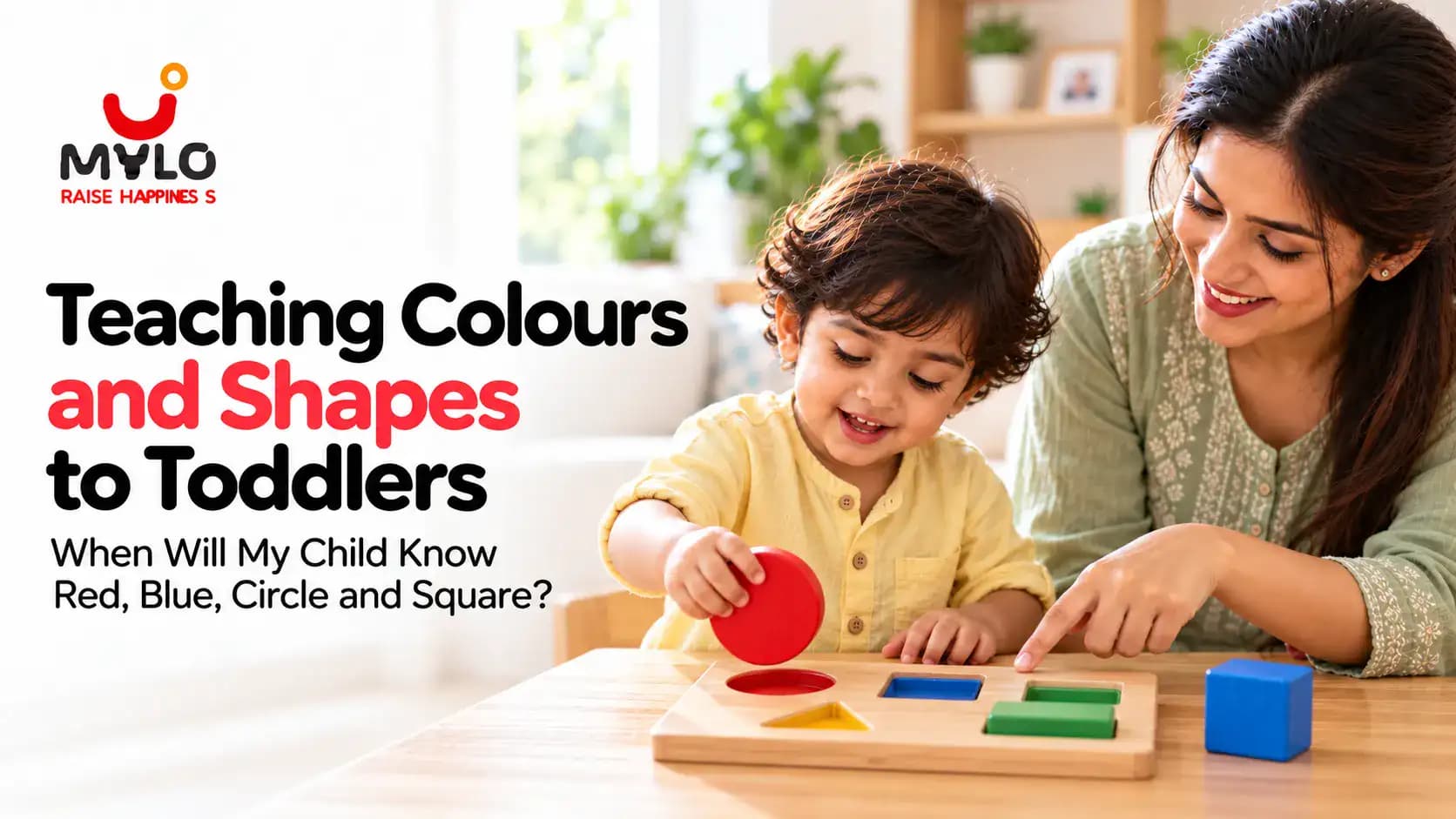
Quick Answer
Toddlers learn colours and shapes step by step: first matching, then pointing when you say the name, and finally saying the name themselves. Most children match colours and simple shapes around 2 years, point to some by 2.5 to 3, and name a few colours by 4. Circle, square and triangle usually come first.
Colours and Shapes by Age at a Glance
Age | Colours | Shapes | Talk to a Doctor If |
|---|---|---|---|
0 to 6 months | Sees black, white and bold contrasts first; full colour vision develops by about 5 months | Looks at faces and simple patterns | Doesn't look at faces or follow objects with the eyes |
12 to 18 months | Notices bright colours, no colour names yet | Puts a circle into a simple shape sorter with help | Shows no interest in toys or pictures |
18 months to 2 years | Starts matching two things of the same colour | Fits a circle, then a square, into a shape sorter | Can't fit any shape into a sorter by 2.5 years |
2 to 3 years | Sorts by colour, points to 1 or 2 colours when you name them | Matches circle, square and triangle; points to a circle when asked | Can't match or sort colours or shapes by 3 years |
3 to 4 years | Names a few colours (CDC: by 4 years) | Names circle, square and triangle; draws a circle | Can't name any colour by 4 years |
4 to 5 years | Names most basic colours, learns light and dark | Names rectangle, star, heart and oval; copies a square | Keeps mixing up red and green, or brown and green, after 4 to 5 years |
5 years | Knows 8 to 10 colours and mixes paints to make new ones | Recognises shapes in everyday objects; draws a triangle | Can't name basic shapes, or has other learning or speech concerns |
Ages are typical ranges. Many children know more, and some know less, and both can be normal.
Key Facts Every Parent Should Know
By about 5 months: Babies can see the full range of colours (AAP)
Matching comes first: Children match and sort colours long before they can name them
By 4 years: Most children name a few colours (CDC)
First shapes: Circle is usually first, then square, then triangle
Colour blindness: It affects about 1 in 12 boys and 1 in 200 girls in some populations, so confusing certain colours after 4 to 5 years is worth an eye check
Language matters: Naming colours and shapes depends on speech, so a child may know colours but not be able to say them yet
When Can Babies See Colours?
Short answer: Newborns see mostly black, white and grey, with bold contrasts. Colour vision develops over the first months, and by about 5 months most babies see colours well, although they won't know colour names for a few more years.
Age | What Your Baby Sees |
|---|---|
Newborn | Black, white and high-contrast patterns; faces up close |
2 to 3 months | Starts seeing bright colours like red |
4 to 5 months | Sees most colours; good depth and colour vision developing |
6 to 12 months | Interested in brightly coloured toys and pictures |
Tip: Black and white picture cards and bold-coloured toys are great for young babies. Your face is still their favourite thing to look at.
How Do Toddlers Learn Colours and Shapes?
Short answer: Children learn in 4 steps: matching, sorting, pointing when you say the name, and finally saying the name. Most children can match and point to colours long before they can say them.
Step | What It Means | Example | Typical Age |
|---|---|---|---|
1. Matching | Putting two of the same together | Puts the red sock with the other red sock | 18 months to 2.5 years |
2. Sorting | Grouping many things by colour or shape | Puts all the yellow blocks in one bowl | 2 to 3 years |
3. Pointing (understanding) | Points to the right one when you say the name | "Show me the blue ball" | 2.5 to 3.5 years |
4. Naming (saying) | Says the colour or shape name | "That's a green car!" | 3 to 4.5 years |
Why is learning colours harder than it looks?
Colours are tricky for young children because:
A "ball" is always a ball, but "red" can be a ball, a bus, a flower or a tomato
Children first need to understand that colour is something separate from the object
Many colours look similar (red and orange, blue and purple)
Colour names are learned through language, so they come later than words like "ball" or "milk"
That's why toddlers often say "blue" for every colour for a while. It means they've learned that colours have names, and the right names will follow.
Which Colours and Shapes Should I Teach First?
Short answer: Start with 2 very different colours, like red and blue, and simple shapes, like a circle and a square. Add new ones only when your child knows the first ones well.
Order | Colours | Shapes |
|---|---|---|
First | Red, blue | Circle |
Next | Yellow, green | Square |
Then | Orange, purple, pink | Triangle |
Later | Black, white, brown, grey | Rectangle, star, heart |
Older children | Light and dark shades, mixing colours | Oval, diamond, 3D shapes like a ball (sphere) and box (cube) |
Avoid teaching similar colours together. Red and pink, or blue and purple, are easy to confuse at first. Teach colours that look very different side by side.
How Can I Teach My Toddler Colours?
Short answer: Use colour words all day in natural talk, teach one colour at a time, and make it a game. Toddlers learn best through everyday moments, not drills.
Tips that work
Name colours all day: "Your red cup", "Papa's blue shirt", "Look, a yellow auto!"
Put the colour after the object sometimes: "The ball is red" as well as "the red ball". Some research suggests this helps toddlers notice the colour.
Focus on one colour at a time: Have a "red day" and find red things around the house
Show what it isn't: "This is red. This is not red."
Ask, then help: "Which one is blue?" If your child points to the wrong one, just say "This one is blue" and move on
Use any language: Laal, peela, hara, neela in Hindi (or your home language) build the same skills as English colour names
Colour activities by age
Age | Activities | Household Items to Use |
|---|---|---|
18 months to 2 years | Match socks, name colours of toys, play with coloured cups | Socks, steel and plastic bowls, coloured blocks |
2 to 3 years | Sort toys by colour into bowls, colour hunt around the house, finger painting | Plastic bowls, toy cars, washable paint |
3 to 4 years | "I spy something red", sort fruits and vegetables by colour, colour of the day | Fruits, vegetables, coloured paper |
4 to 5 years | Mix paints to make new colours, colour-by-number, name shades (light blue, dark blue) | Paints, crayons, a colouring book |
How Can I Teach My Toddler Shapes?
Short answer: Let your child feel, hold and play with shapes. Shape sorters, puzzles and spotting shapes in everyday objects work better than flashcards.
Tips that work
Start with a shape sorter: The circle is easiest because it fits any way you turn it
Trace with a finger: Run your child's finger around the edge of a shape and talk about it: "A circle goes round and round. A square has 4 sides."
Find shapes at home: Rotis are circles, the TV is a rectangle, a samosa is a triangle
Make shapes: Use ice cream sticks, play dough or chalk to make shapes together
Draw shapes: Draw a circle and let your child copy it (see our guide to toddler drawing stages)
Shape activities by age
Age | Activities | Household Items to Use |
|---|---|---|
18 months to 2 years | Shape sorter (circle first), stacking cups, big-piece puzzles | Shape sorter, steel bowls of different sizes |
2 to 3 years | Shape puzzles, find circles in the kitchen, roll dough into balls | Puzzles, rotis, plates, atta dough |
3 to 4 years | Shape hunt around the house, make shapes with sticks, draw circles and lines | Ice cream sticks, chalk, a slate |
4 to 5 years | Copy squares and triangles, make shape pictures (a house from a square and triangle), learn 3D shapes | Paper, crayons, building blocks, a ball and a box |
Fun Indian-style colour and shape games
Rangoli colours: Name the colours as you fill a simple rangoli, and spot circles and triangles in the pattern
Sabzi mandi colour hunt: "Can you find something green? Something red?" while buying vegetables
Traffic light game: Red means stop, green means go, yellow means get ready. Play it while walking or at home
Kitchen shape hunt: Roti and papad (circle), samosa (triangle), barfi (square or diamond), biscuit tin (rectangle)
Kite shapes: A patang is a diamond, which is perfect for Makar Sankranti chats
Bangles and bindis: Older children can sort plastic bangles by colour; keep small bindis away from toddlers
Holi colour talk: Name colours during Holi, using natural, skin-safe colours
What Helps and What Hurts Learning Colours and Shapes?
Short answer: Everyday talk, hands-on play and patience help. Drilling, flashcards for very young toddlers, and too much screen time don't.
Helps | Hurts or Slows It Down |
|---|---|
Naming colours and shapes in daily talk | Drilling flashcards every day |
Matching and sorting games | Testing your child constantly ("What colour is this? And this?") |
Teaching one or two colours at a time | Teaching 10 colours at once |
Shape sorters, puzzles and blocks | Only learning from apps and videos |
Drawing, painting and play dough | Correcting harshly when your child gets it wrong |
Talking with your child often (builds language) | Lots of screen time, which means less talk and play |
Screens and learning: Colour and shape videos don't replace touching, sorting and talking with you. The WHO advises no screen time for children under 2, and no more than 1 hour a day for 2 to 4 year olds.
Could My Child Be Colour Blind?
Short answer: Colour blindness is common, especially in boys. Most often it's trouble telling red and green apart. Consider an eye check if your child keeps mixing up the same colours after 4 to 5 years, even when they know other colours well.
What You See | What It Might Mean |
|---|---|
Mixes up many colours at 2 to 3 years | Normal; your child is still learning colour names |
Says "blue" for every colour | Normal stage of learning colour words |
Always confuses red and green, or green and brown, after 4 to 5 years | Possible colour blindness; get an eye check |
Colours leaves or grass in odd colours repeatedly, and knows other colours | Possible colour blindness; get an eye check |
Squints, tilts the head or holds things very close | Possible vision problem; get an eye check |
Good to know: Colour blindness is usually inherited, can't be cured, and doesn't affect intelligence. Telling your child's teachers helps them use labels and patterns, not just colours, in class.
When Should I Worry?
Short answer: Children learn colours and shapes at different speeds, and naming depends on speech. Talk to your doctor if your child can't match colours or shapes by 3, can't name any colour by 4, can't name basic shapes by 5, or has other speech, vision or learning concerns.
Age | Red Flag |
|---|---|
Any age | Loses skills they once had (see a doctor right away) |
Any age | Doesn't look at faces or follow objects with the eyes, squints or holds things very close |
2.5 years | Can't fit any shape into a shape sorter, shows no interest in matching |
3 years | Can't match or sort colours or shapes |
4 years | Can't name any colour, or says very few words overall |
4 to 5 years | Always mixes up the same colours (like red and green) |
5 years | Can't name basic shapes like a circle or square, can't copy a circle |
Who Can Help?
Professional | How They Help |
|---|---|
Pediatrician | First check-up, checks vision, hearing, speech and overall development |
Pediatric eye specialist (ophthalmologist) | Tests vision and colour vision |
Speech and language therapist | Helps if your child understands colours but can't say them |
Developmental pediatrician | Assesses development if there are several concerns |
Occupational therapist | Helps with shape sorting, puzzles and drawing shapes |
Free government support in India
Service | What It Offers |
|---|---|
Rashtriya Bal Swasthya Karyakram (RBSK) | Free screening for developmental delays and vision problems |
District Early Intervention Centres (DEIC) | Free assessment, speech therapy and early intervention |
Anganwadi centres | Pre-school education with colour and shape activities |
What Should Indian Parents Keep in Mind?
Short answer: Teach colours and shapes through daily life and play. Don't rush your child with flashcards or compare them with other children.
Common Practice | Better Approach |
|---|---|
Flashcards for a 1-year-old | Name colours of real things during the day |
Quizzing all day ("What colour? What shape?") | Talk naturally and ask now and then |
Teaching only in English | Teach in your home language too; both work |
Comparing with cousins who "know all colours" | Every child learns at their own pace |
Colour and shape videos on the phone | Sorting, puzzles and painting with you |
Correcting harshly ("No! That's green!") | "This one is green. Let's find another green!" |
Assuming a child who mixes colours is "slow" | Mixing up colours is normal until about 4; check eyes if it continues |
Myths vs Facts About Teaching Colours and Shapes
Myth | Fact |
|---|---|
"My child should know all colours by 2" | Most children name a few colours only by about 3 to 4 years |
"Flashcards are the fastest way to teach colours" | Everyday talk and play work better for toddlers |
"Teaching many colours at once is faster" | One or two at a time, especially colours that look very different, works better |
"If my child can't name colours, they can't see them" | Many children know colours before they can say the names |
"Mixing up colours at 2 or 3 means colour blindness" | It's normal at this age; check only if it continues after 4 to 5 |
"Shape learning starts in school" | Toddlers learn shapes through sorters, puzzles and play from about 18 months |
"Learning videos are as good as real play" | Touching, sorting and talking with a parent helps more than screens |
Frequently Asked Questions About Teaching Colours and Shapes
When do toddlers learn colours?
Most toddlers match colours around 2 years, point to some colours when named by 2.5 to 3 years, and name a few colours by 4 years.
When do toddlers learn shapes?
Most toddlers fit a circle into a shape sorter by about 2 years, match circles, squares and triangles by 2 to 3 years, and name basic shapes by 3 to 4 years.
Bachcha rang kab pehchanta hai? (Hinglish)
Zyada tar bachche 2 saal ke aas-paas ek jaise rang milana seekhte hain, 2.5 se 3 saal mein naam sunkar rang ki taraf ishara karte hain, aur 4 saal tak kuch rangon ke naam bolne lagte hain.
Which colours should I teach first?
Start with red and blue, then add yellow and green. Avoid teaching similar colours like red and pink at the same time.
Which shape should I teach first?
Start with a circle, then a square, then a triangle.
Why does my toddler call every colour "blue"?
It's a normal stage. Your child has learned that colours have names but hasn't matched each name to the right colour yet.
Mera 3 saal ka bachcha rangon ke naam nahi bol pata, kya yeh normal hai? (Hinglish)
Haan, yeh normal ho sakta hai. Bahut se bachche rang pehchante hain lekin naam 3.5 se 4 saal tak bolte hain. Roz ki baaton mein rangon ke naam lijiye, jaise "laal tamatar" ya "neeli shirt". Agar 4 saal tak bachcha ek bhi rang ka naam nahi bolta, toh doctor se baat karein.
Should I teach colours in English or Hindi?
Either, or both. Learning colour names in your home language builds the same skills.
How do I know if my child is colour blind?
If your child keeps mixing up the same colours, especially red and green, after 4 to 5 years while knowing other colours well, ask your pediatrician for an eye check.
Are colour and shape learning videos good for toddlers?
They don't replace real play. The WHO advises no screen time under 2 and no more than 1 hour a day for 2 to 4 year olds.
When should I worry about my child learning colours and shapes?
If your child can't match colours or shapes by 3, can't name any colour by 4, can't name basic shapes by 5, or has speech or vision concerns, speak to your pediatrician.
Related Reads on Mylo
The A-Z Guide on Yellow Fruits and Yellow Colour Vegetables for Kids
The A-Z Guide on Purple Colour Fruits and Vegetables for Kids
Physical Development in Children: Signs, Milestones and How to Support It
References
Centers for Disease Control and Prevention (CDC). "CDC's Developmental Milestones." https://www.cdc.gov/act-early/milestones/index.html
American Academy of Pediatrics (AAP). "Baby's Vision Development: What to Expect the First Year." HealthyChildren.org. https://www.healthychildren.org/English/ages-stages/baby/Pages/Babys-Vision-Development.aspx
National Eye Institute (NEI). "Color Blindness." https://www.nei.nih.gov/learn-about-eye-health/eye-conditions-and-diseases/color-blindness
World Health Organization (WHO). "Guidelines on Physical Activity, Sedentary Behaviour and Sleep for Children Under 5 Years of Age." https://www.who.int/publications/i/item/9789241550536
Ramscar M, Yarlett D, Dye M, Denny K, Thorpe K. "The Effects of Feature-Label-Order and Their Implications for Symbolic Learning." Cognitive Science, 2010.
Medical Disclaimer
This article is for information only and does not replace professional medical advice. Every child develops at their own pace. If you have concerns about your child's vision, speech or learning, please consult your pediatrician.
Shop Now
Baby Essentials
Article Posted Under
Related Articles

Related Topics
.webp&w=32&q=75)
Medical Disclaimer
This content is for informational purposes only and should not replace professional medical advice. Consult with a physician or other health care professional if you have any concerns or questions about your health. If you rely on the information provided here, you do so solely at your own risk.


AWARDS AND RECOGNITION

Mylo wins Forbes D2C Disruptor award

Mylo wins The Economic Times Promising Brands 2022
AS SEEN IN












- Mylo Care: Effective and science-backed personal care and wellness solutions for a joyful you.
- Mylo Baby: Science-backed, gentle and effective personal care & hygiene range for your little one.
- Mylo Community: Trusted and empathetic community of 10mn+ parents and experts.


Product Categories
Baby Carrier | Baby Soap | Baby Wipes | Stretch Marks Cream | Baby Cream | Baby Shampoo | Baby Massage Oil | Baby Hair Oil | Stretch Marks Oil | Baby Body Wash | Baby Powder | Baby Lotion | Diaper Rash Cream | Newborn Diapers | Teether | Baby Kajal | Baby Diapers Pants | Cloth Diapers | Laundry Detergent | Lactation Granules |