


Orders
.png&w=48&q=75 "login")
Profile


Wallet

How Much Protein Do You Need in Pregnancy? Trimester-Wise Chart (ICMR-Based)
 13 min
TL;DR
Your protein needs rise through pregnancy, and the Indian Council of Medical Research (ICMR-NIN) gives clear, India-specific guidance (ICMR-NIN). The baseline for an adult woman is about 0.83 grams of protein per kg of body weight per day. On top of this, ICMR recommends no extra protein in the first trimester, an additional 9.5 grams a day in the second trimester, and an additional 22 grams a day in the third trimester. For a woman of about 55 kg, that works out to roughly 46 grams before and in early pregnancy, about 55 grams in the second trimester, and about 68 grams in the third, and more if you weigh more. The simplest way to know your exact need is to calculate it by your body weight. Meet it with dal, paneer, eggs, curd, milk, soya and sprouts, and top up with a nutrition drink if meals fall short.
Quick Answer
Per ICMR, your protein need is about 0.83 grams per kg of body weight a day, plus an extra 9.5 grams a day in the second trimester and 22 grams a day in the third (no extra in the first). For a 55 kg woman, that is roughly 46 grams early on, 55 grams in the second, and 68 grams in the third trimester.
Medical Disclaimer: This article is for informational purposes only and is not a substitute for professional medical advice. Protein needs vary with body weight, health and activity. For your exact target, consult your doctor or dietitian.
Author: Mylo Editorial Team, Mylo Parenting Desk Medically reviewed by: Mylo Editorial Board, aligned with ICMR-NIN, ACOG, WHO and FOGSI guidance Last updated: 10 July 2026
Key Takeaways
Protein needs rise through pregnancy, and ICMR gives India-specific guidance (ICMR-NIN)
The baseline for an adult woman is about 0.83 g of protein per kg of body weight a day
ICMR adds no extra protein in the first trimester
It adds about 9.5 g a day in the second trimester
It adds about 22 g a day in the third trimester
For a 55 kg woman, that is roughly 46 g early on, 55 g in the second, 68 g in the third
Heavier women need more; calculate by your own body weight
Meet your target with dal, paneer, eggs, curd, milk, soya and sprouts
How Much Protein Do You Need in Pregnancy?
Featured answer: Per ICMR, your daily protein need is about 0.83 grams per kg of body weight, plus an additional 9.5 grams a day in the second trimester and 22 grams a day in the third trimester, with no extra needed in the first. For a woman of about 55 kg, that means roughly 46 grams before and in early pregnancy, about 55 grams in the second trimester, and about 68 grams in the third. Your exact need depends on your body weight, so calculate it for yourself and meet it with protein-rich foods.
This ICMR-based approach is more precise than a single number, because it accounts for your own body weight and your stage of pregnancy.
What Does ICMR Say About Pregnancy Protein?
The Indian Council of Medical Research, through its National Institute of Nutrition, sets the Recommended Dietary Allowance (RDA) for Indians (ICMR-NIN). For protein in pregnancy, it works in two parts:
A baseline of about 0.83 grams of protein per kg of body weight a day, the same as for a non-pregnant adult woman
An additional amount for pregnancy: no extra in the first trimester, about 9.5 grams a day extra in the second trimester, and about 22 grams a day extra in the third trimester
This staged approach reflects how your baby's growth speeds up later in pregnancy, raising your protein needs most in the third trimester.
Trimester-Wise Protein Chart (ICMR-Based)
Here is the chart, with an example for a woman of about 55 kg. Your total changes with your body weight (ICMR-NIN).
Stage | Additional protein (ICMR) | Approx total for a 55 kg woman* |
|---|---|---|
Pre-pregnancy (baseline) | About 0.83 g per kg | About 46 g |
First trimester | No additional | About 46 g |
Second trimester | Plus 9.5 g a day | About 55 g |
Third trimester | Plus 22 g a day | About 68 g |
*Approximate. A heavier woman needs more, a lighter woman slightly less, because the baseline is per kg of body weight.
How Do You Calculate Your Own Protein Need?
Your exact target is easy to work out (ICMR-NIN).
Calculate Your Daily Protein Target
Follow these simple steps:
Step 1, baseline: Multiply your weight in kg by 0.83 (for a 60 kg woman, that is about 50 g)
Step 2, add for your trimester:
First trimester: add nothing
Second trimester: add about 9.5 g
Third trimester: add about 22 g
Step 3, that is your daily target: For a 60 kg woman, about 50 g early, 60 g in the second, 72 g in the third
Adjust with your doctor: If you are underweight, overweight, very active or unwell
Use your pre-pregnancy or early-pregnancy weight, and let your doctor fine-tune it for you.
Why Do Protein Needs Rise in Pregnancy?
Your body needs more protein because it is building a great deal at once (WHO, ICMR-NIN):
Your baby's organs, tissues and muscles are growing
The placenta is developing and needs protein
Your blood volume expands significantly
Your own tissues, including the uterus and breasts, grow
Protein supports hemoglobin, hormones and repair
Because most of the baby's growth happens later, your needs rise most in the third trimester, which is exactly what the ICMR chart shows.
How Do You Meet Your Protein Target?
Spread protein across meals using these foods (ICMR-NIN). Values are approximate.
Food | Serving | Approx protein |
|---|---|---|
Soya chunks | 30 g dry | About 15 g |
Paneer | 100 g | 14 to 18 g |
Egg | 1 egg | About 6 g |
Milk | 1 glass | 6 to 8 g |
Rajma or chana | 1 katori | 7 to 9 g |
Dal | 1 katori | 4 to 6 g |
Curd | 1 katori | 3 to 4 g |
Nuts or peanuts | Small handful | 5 to 7 g |
What Happens If You Do Not Get Enough Protein?
Falling short over time can affect you and your baby (ICMR-NIN, ACOG). Watch for:
Constant tiredness and weakness
Low hemoglobin, since protein helps build it
Poor or slow weight gain
Muscle weakness and more swelling
Feeling hungry soon after eating
If you notice these, review your protein intake with your doctor.
Where Does Mylo MamaGro Fit In?
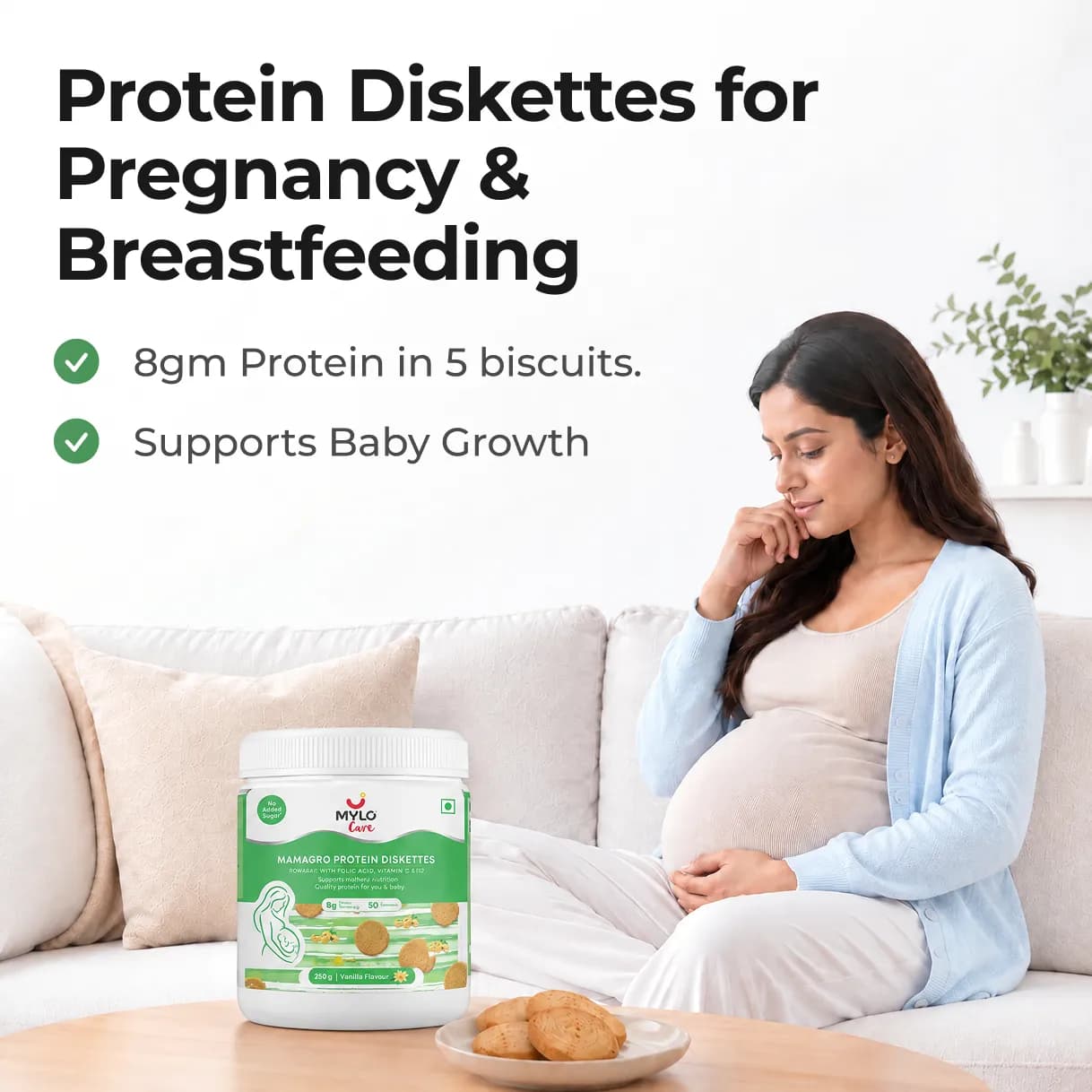
Once you know your ICMR-based target, meeting it every day, especially the higher third-trimester need, can be a challenge with a low appetite or a busy routine. A maternal nutrition drink like Mylo MamaGro provides a measured serving of protein along with key nutrients, giving you an easy way to top up toward your daily target on top of your meals. Used alongside a balanced diet and on your doctor's advice, it can help close protein gaps during pregnancy and breastfeeding. You can explore Mylo MamaGro here: Mylo MamaGro. It supplements a balanced diet, it does not replace nutritious meals.
Myths vs Facts About Pregnancy Protein Needs
Myth | Fact | Source |
|---|---|---|
"Everyone needs the same amount of protein" | It depends on body weight and trimester (ICMR) | ICMR-NIN |
"You need extra protein from day one" | ICMR adds no extra protein in the first trimester | ICMR-NIN |
"Protein needs stay the same all pregnancy" | They rise most in the third trimester | ICMR-NIN |
"Eating for two doubles your protein" | You need a modest, staged increase, not double | ACOG |
"A drink can replace your protein foods" | It supplements, it does not replace, whole foods | WHO |
Indian Context: What Indian Moms Should Know
Use the ICMR method: It is India-specific and accounts for your body weight (ICMR-NIN)
Indian diets often fall short: Especially vegetarian ones, so plan protein at every meal
The third trimester needs most: Add extra protein as your baby grows fastest
Combine cereal and pulse: Dal-rice and khichdi improve protein quality cheaply
Keep up your supplements: IFA and any others from antenatal care support you too
Ask a dietitian: For your exact target and a simple plan
Emergency number: Dial 108 for ambulance services across most states
When Should You See a Doctor or Dietitian?
Consider a check-in with your doctor or dietitian if you (ACOG, FOGSI):
Want your exact protein target calculated for your body weight
Are underweight, overweight or have a medical condition
Follow a strict vegetarian or limited diet
Feel constantly tired or have a low hemoglobin report
Are unsure how to meet your protein needs
They can personalise your target and help you reach it.
FAQs About Protein Needs in Pregnancy
How much protein do I need in pregnancy according to ICMR? About 0.83 grams per kg of body weight a day, plus 9.5 grams extra in the second trimester and 22 grams extra in the third, with no extra in the first (ICMR-NIN). For a 55 kg woman, that is roughly 46, 55 and 68 grams by trimester.
ICMR ke anusaar pregnancy mein kitna protein chahiye? (Hinglish) Baseline lagbhag 0.83 gram protein per kg body weight per day hai. Iske upar, pehle trimester mein extra nahi, doosre mein lagbhag 9.5 gram extra, aur teesre mein lagbhag 22 gram extra chahiye. Ek 55 kg woman ke liye yeh karib 46, 55 aur 68 gram hota hai, trimester ke hisaab se. Aapka weight zyada ho to zyada chahiye.
How do I calculate my own protein need? Multiply your weight in kg by 0.83, then add nothing in the first trimester, 9.5 grams in the second, or 22 grams in the third (ICMR-NIN). That gives your daily target.
Apna protein target kaise nikaalun? (Hinglish) Apne weight (kg) ko 0.83 se guna karein. Phir pehle trimester mein kuch na jodein, doosre mein 9.5 gram, aur teesre mein 22 gram jodein. Jaise 60 kg woman ke liye: lagbhag 50 gram early, 60 gram doosre mein, aur 72 gram teesre trimester mein. Doctor se confirm karein.
Do I need extra protein in the first trimester? Per ICMR, no additional protein is needed in the first trimester, only your baseline of about 0.83 grams per kg (ICMR-NIN). Needs rise in the second and third trimesters.
Why do protein needs rise most in the third trimester? Because your baby grows fastest then, so ICMR adds the most protein (about 22 grams a day) in the third trimester (ICMR-NIN).
How can a nutrition drink like MamaGro help me hit my target? It provides a measured serving of protein plus nutrients, helping you top up toward your daily target when meals fall short, on your doctor's advice (ICMR-NIN). It supplements whole foods, it does not replace them.
What foods help me reach my protein target? Soya chunks, paneer, eggs, milk, rajma, chana, dal, curd and nuts (ICMR-NIN). Spread them across meals and combine cereals with pulses for complete protein.
Final Thoughts: Know Your Number, Then Hit It
Protein in pregnancy is not a guessing game. The ICMR approach gives you a clear, India-specific way to know exactly how much you need: your baseline of about 0.83 grams per kg of body weight, plus 9.5 grams in the second trimester and 22 grams in the third. For most women, that means a gently rising target from around 46 grams early on to nearly 70 grams late in pregnancy.
Once you know your number, meeting it is straightforward: build meals around dal, paneer, eggs, curd, milk, soya and sprouts, combine cereals with pulses, and if you fall short, top up with a nutrition drink like Mylo MamaGro on your doctor's advice. Know your number, then hit it, and give your baby the steady protein supply they need to grow.
References
Indian Council of Medical Research, National Institute of Nutrition (ICMR-NIN). "Recommended Dietary Allowances (RDA) and Estimated Average Requirements for Indians, 2020." https://www.nin.res.in
American College of Obstetricians and Gynecologists (ACOG). "Nutrition During Pregnancy." https://www.acog.org/womens-health/faqs/nutrition-during-pregnancy
World Health Organization (WHO). "Protein and Amino Acid Requirements in Human Nutrition." https://www.who.int
NHS UK. "Healthy Eating in Pregnancy." https://www.nhs.uk/pregnancy/
FOGSI (Federation of Obstetric and Gynaecological Societies of India). https://www.fogsi.org
Mylo MamaGro. https://mylofamily.com/product/mylo-protein-biscuits-for-pregnancy-500gm-4228




Article Posted Under
Related Articles



Related Topics
.webp&w=32&q=75)
Medical Disclaimer
This content is for informational purposes only and should not replace professional medical advice. Consult with a physician or other health care professional if you have any concerns or questions about your health. If you rely on the information provided here, you do so solely at your own risk.


AWARDS AND RECOGNITION

Mylo wins Forbes D2C Disruptor award

Mylo wins The Economic Times Promising Brands 2022
AS SEEN IN












- Mylo Care: Effective and science-backed personal care and wellness solutions for a joyful you.
- Mylo Baby: Science-backed, gentle and effective personal care & hygiene range for your little one.
- Mylo Community: Trusted and empathetic community of 10mn+ parents and experts.


Product Categories
Baby Carrier | Baby Soap | Baby Wipes | Stretch Marks Cream | Baby Cream | Baby Shampoo | Baby Massage Oil | Baby Hair Oil | Stretch Marks Oil | Baby Body Wash | Baby Powder | Baby Lotion | Diaper Rash Cream | Newborn Diapers | Teether | Baby Kajal | Baby Diapers Pants | Cloth Diapers | Laundry Detergent | Lactation Granules |