


Orders
.png&w=48&q=75 "login")
Profile


Wallet

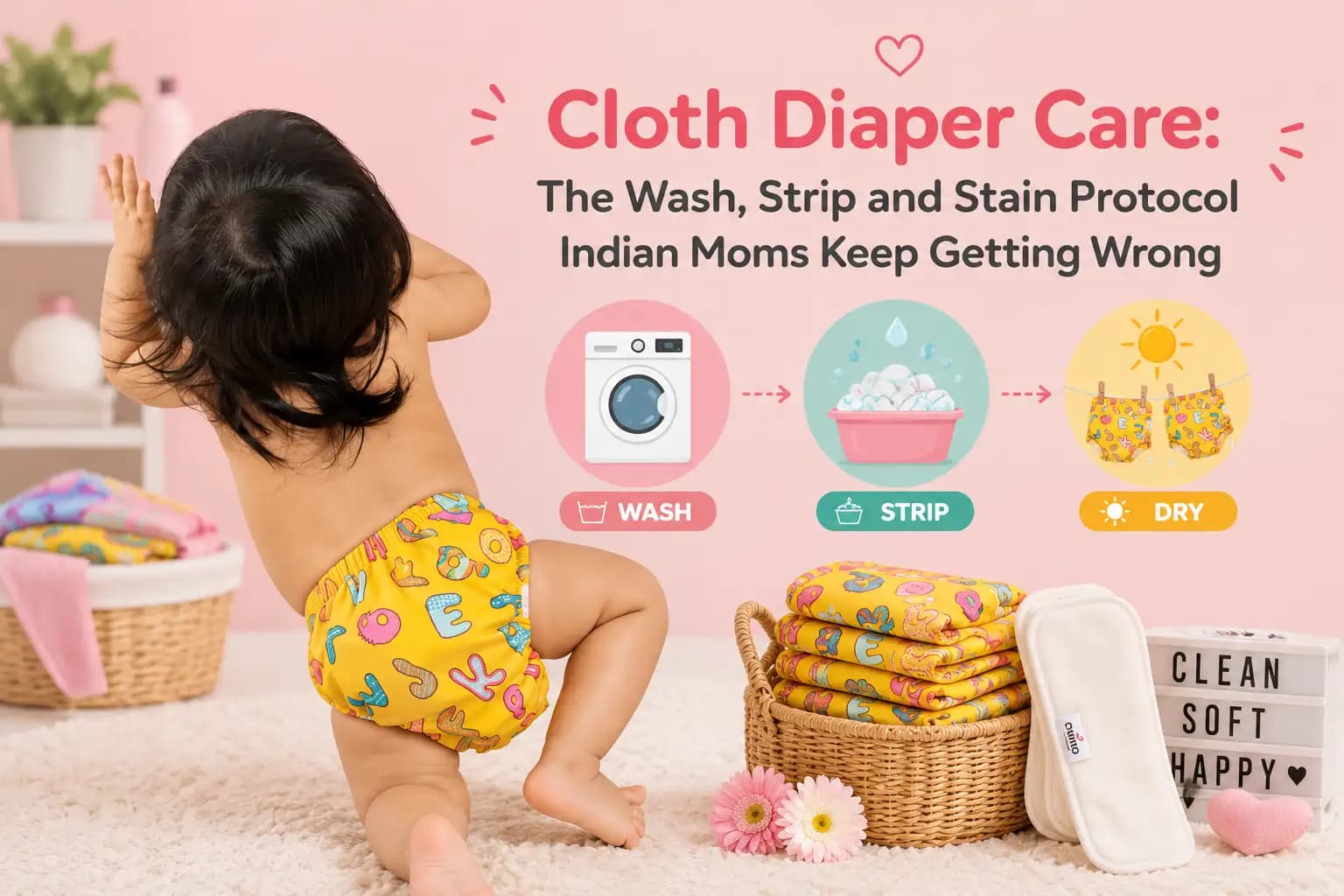
Cloth Diaper Care: The Wash, Strip and Stain Protocol Indian Moms Keep Getting Wrong
 14 min
TL;DR
-
Rinse solids, then run a full wash with a full dose of mainstream detergent and zero fabric softener.
-
Use warm water, not boiling, because heat and chlorine bleach degrade the diaper's TPU waterproof layer and elastics.
-
Hard water is the main reason washes fail in India; use more detergent or a water softener, not less.
-
Stripping is an occasional deep clean for buildup, not a routine step. Fix detergent and water first.
-
Sunlight bleaches stains and reduces surface microbes, but only if the diaper dries fully.
The correct cloth diaper routine is short: knock or rinse the solids into the toilet, run a proper wash cycle with a full dose of mainstream detergent and no fabric softener, use warm rather than boiling water to protect the diaper's waterproof layer, and dry the diaper completely, ideally in the sun. Two things sink most Indian wash routines, and neither is the detergent brand. The first is hard water, which is widespread across India and inhibits lather so the same scoop of detergent cleans far less than it should. The second is incomplete drying in the monsoon, which leaves diapers damp enough to grow odour-causing bacteria. Get those two right and you rarely need to "strip" a diaper at all.
How do you wash cloth diapers correctly, step by step?
A reliable cloth diaper wash is a two-stage process, not a single rinse. The goal is to remove waste and then fully clean the fabric without leaving detergent or mineral residue behind.
|
Step |
What to do |
Why it matters |
|
1. Remove solids |
Knock or rinse poo into the toilet before storing the diaper |
Lifting the bulk of the waste first is what lets the wash actually clean the fibres |
|
2. Pre-rinse |
Run a cold rinse or short cycle before the main wash |
Cold loosens urine and stool without setting protein stains |
|
3. Main wash |
Full cycle, warm water, a full dose of mainstream detergent |
Enough detergent and agitation is what removes ammonia and soil from the absorbent core |
|
4. Extra rinse |
Add a rinse if your machine leaves suds |
Detergent left in the fabric causes buildup, smell, and skin irritation |
|
5. Dry fully |
Sun-dry where possible, and make sure the diaper is bone dry |
Damp fabric grows bacteria and odour, which is the root of most "stinky diaper" problems |
The American Academy of Pediatrics advises keeping a baby's skin clean and dry and changing promptly, since cloth holds less than a disposable, so change cloth diapers more often, roughly every few hours and as soon as they are soiled.
Why does hard water make cloth diaper washing fail in India, and what fixes it?
Hard water is the hidden reason a wash routine that works for one family fails for another. Hard water carries dissolved calcium and magnesium, and a peer-reviewed study of groundwater in the Indo-Gangetic belt found total hardness exceeded the Bureau of Indian Standards acceptable limit of 200 mg/L in 81% of samples, and noted that hard water inhibits lather and makes soap less effective. Water is classed as soft below 75 mg/L, moderately hard at 75 to 150, hard at 150 to 300, and very hard above 300, and much of India, including large parts of the Indo-Gangetic plain, Rajasthan, Gujarat, and Maharashtra, sits in the hard to very hard range.
The fix is counterintuitive: in hard water you use more detergent, not less, because the minerals bind the cleaning agents before they reach the fabric. Adding a water softener such as washing soda to the main wash frees the detergent to work. The warning signs of hard-water buildup are diapers that feel stiff, smell of ammonia as soon as they are wet, or start repelling liquid instead of absorbing it. All three mean minerals and detergent are sitting in the fibres, and the answer is a better main wash, not a softer one.
What is "stripping" a cloth diaper, and when do you actually need it?
Stripping is a periodic deep clean that removes accumulated mineral and detergent buildup and trapped ammonia from the absorbent core. It is not a routine step and should be the exception, because a correct main wash with enough detergent in adequately softened water prevents most buildup in the first place. Reaching for a strip every week usually means the regular wash is too weak, not that the diaper needs rescuing.
You need to strip only when the diapers show clear buildup symptoms: a strong ammonia smell on a freshly wet diaper, persistent repelling where liquid beads off instead of soaking in, or a greasy, residue feel after washing. A strip is typically a long soak followed by an extra-hot wash and several thorough rinses until the water runs clear of suds. Avoid routine chlorine bleach and very hot soaks as a habit, because they shorten the life of the waterproof layer and elastics. After stripping, fix the cause by increasing detergent or softening your water, or you will be back in a month.
How do you remove stains from cloth diapers, and does sunlight really work?
Sunlight genuinely works on stains, and the mechanism is real: ultraviolet light breaks down the chromophore molecules that give a stain its colour, which lightens or removes it without the residue chlorine bleach leaves behind. Sun-drying also lowers the microbial load on fabric. A controlled study of contaminated clothing found that three days of sun exposure significantly reduced fungal contamination compared with items kept indoors, and outdoor line-drying consistently outperforms indoor drying for cutting germ load because of the added UV.
For fresh stains, a cold pre-rinse and a full main wash usually clear most of it, and a damp stained diaper left in direct sun for a few hours does the rest. An enzyme-based detergent helps on protein stains. Two honest limits apply. Sunlight is a surface effect, so it brightens and disinfects the outside of the fabric but does not lift soil embedded deep in the core, which is the job of a proper wash. And the disinfecting benefit only holds if the diaper dries completely, because a diaper that stays damp in humid weather can grow more bacteria, not fewer.
What are the biggest cloth diaper washing mistakes Indian parents make?
The same handful of errors account for most leaking, smelling, and worn-out diapers.
|
Mistake |
Why it harms the diaper |
The fix |
|
Using fabric softener |
Softener coats the fibres with a waxy film that repels liquid and destroys absorbency |
Never use softener on diapers; softness comes from the fabric, not an additive |
|
Too little detergent in hard water |
The minerals bind the detergent, so a small dose leaves the diaper unclean |
Use a full dose and add a water softener such as washing soda |
|
Boiling water or routine bleach |
High heat and chlorine degrade the TPU waterproof layer and the elastics |
Wash warm, save bleach for rare disinfection, never as routine |
|
Not drying fully in the monsoon |
Damp fabric grows odour-causing bacteria and ammonia |
Dry completely with a fan or low dryer heat before storing |
|
Overloading the machine |
Diapers cannot agitate and rinse if the drum is packed |
Wash a moderate load so each diaper moves freely |
Each of these is reversible: fabric softener buildup, for instance, washes out over a few hot cycles once you stop using it, and absorbency returns.
How do you dry cloth diapers in the monsoon and winter without smell or mildew?
Drying is where Indian seasons break the routine, because the sun-drying that works from October to May is unreliable in the monsoon and slow in a damp winter. The principle does not change: the diaper must reach bone dry before you store or reuse it, since incomplete drying is what produces the musty, ammonia smell, not the washing itself.
When the sun is unavailable, dry diapers indoors with good airflow, a ceiling or pedestal fan, and space between items so air circulates. The microfleece top layer on a dry-feel insert dries faster than thick cotton, which helps in humid weather. A low-heat tumble dry or a few minutes of ironing on the cotton layers finishes a stubbornly damp diaper and adds heat that further reduces germs, though high dryer heat used constantly will wear the waterproof layer, so keep it occasional. On any clear day, even a short spell of direct sun helps both stains and odour.
How do Mylo's reusable cloth diapers and inserts factor into this?
Mylo's reusable cloth diapers are built as a waterproof outer shell plus an absorbent insert, and the brand describes them as India's first OEKO-TEX certified cloth diapers, hypoallergenic and rated for up to 300 washes from 3 months to 3 years. OEKO-TEX Standard 100 places baby and toddler textiles in Product Class 1, the strictest class with the tightest limits on harmful substances, which is the certification doing the work behind the "free from harmful chemicals" claim.
The construction explains the care rules above. The Mylo insert pad is a five-layer design with a dry-feel anti-pilling microfleece top, three layers of absorbent micro-terry, and a thermoplastic polyurethane (TPU) waterproof layer underneath. That TPU layer is exactly why you wash warm rather than boiling and skip routine bleach, and the microfleece is why softener is banned, since a waxy coating on it is what kills the dry feel. Because cloth holds less than a disposable, Mylo advises changing when the diaper feels heavy or after about 5 to 6 hours, and sooner once it is soiled, and washing the diapers separately from your other laundry.
FAQ
How do you wash cloth diapers for the first time and every day after? Rinse any solids into the toilet, run a cold pre-rinse, then a full warm wash with a complete dose of mainstream detergent and no fabric softener, and dry the diaper completely before reuse. Skip softener entirely, because it coats the fibres and destroys absorbency, and add an extra rinse if your machine leaves suds. The most common first-time error is using too little detergent or a tiny scoop of a "gentle" one, which leaves the absorbent core unclean and leads to smell and leaks within weeks.
Why do my cloth diapers smell of ammonia even after washing? An ammonia smell on a freshly wet diaper almost always means detergent or mineral buildup in the fibres, usually from too little detergent in hard water. The fix is a stronger main wash, more detergent plus a water softener such as washing soda, and a one-time strip if the buildup is heavy. Because much of India has hard water, which makes soap less effective, under-dosing is the usual culprit, so the answer is more cleaning power, not a gentler wash.
How often do you need to strip cloth diapers? Rarely, and ideally never if your regular wash is doing its job. Stripping is a deep clean reserved for clear buildup symptoms like a strong ammonia smell, repelling, or a greasy residue, not a weekly habit. If you find yourself stripping often, the real problem is a weak main wash or hard water, so increase detergent or soften the water and the need to strip largely disappears.
Does drying cloth diapers in the sun actually disinfect them? Yes, to a degree. Sunlight's ultraviolet light reduces microbes on the fabric surface and bleaches stains by breaking down their colour molecules, and a controlled study found sun exposure significantly cut fungal contamination on clothing versus indoor storage. The limits are that it is a surface effect, not a replacement for a proper wash of a heavily soiled diaper, and it only helps if the diaper dries fully, since a diaper left damp can grow more bacteria rather than fewer.
Can you use Dettol or bleach on cloth diapers? Use them only sparingly and never as routine. Chlorine bleach and harsh disinfectants, along with boiling water, degrade the TPU waterproof layer and the elastics over time, shortening the diaper's life. Reserve a diluted disinfectant soak for occasional deep sanitising, for example after a yeast rash, and rely on a correct warm wash with enough detergent and full drying for everyday hygiene.
Why are my cloth diapers leaking or repelling water? Repelling, where liquid beads off instead of soaking in, is usually fabric-softener residue or mineral and detergent buildup, both of which coat the fibres. Stop using softener immediately, run a few hot wash cycles to strip the coating, and check your detergent dose against your water hardness. If leaks persist after the fibres are clean, the diaper may simply need changing more often, since cloth absorbs less than a disposable.
How should you dry cloth diapers in the monsoon? Dry them fully indoors with strong airflow from a fan and space between items, and finish any stubbornly damp diaper with a short low-heat tumble or a quick iron on the cotton layers. Full drying is what prevents the musty, ammonia smell, so never store or reuse a diaper that is still damp. A dry-feel microfleece insert dries faster than thick cotton, which helps in humid weather, and any brief spell of sun on a clear day adds extra stain and odour benefit.
Disclaimer: This article is general baby-care and laundry guidance, not medical advice. If your baby has a persistent diaper rash, broken skin, or a suspected infection, change diapers more frequently and consult your paediatrician. Always follow the wash-care instructions on your specific cloth diaper, since materials and limits vary by brand.
Medically reviewed by Dr. Shruti Tanwar, MBBS, MD (Obstetrics & Gynaecology) on 27 June 2026
Last updated: 30 June 2026
Sources
-
American Academy of Pediatrics, Changing Diapers, HealthyChildren.org (keep skin clean and dry; change promptly).
-
Groundwater hardness in the Indo-Gangetic belt, peer-reviewed study, PMC (total hardness exceeded the BIS 200 mg/L limit in 81% of samples; hard water inhibits lather and reduces soap effectiveness).
-
Sun exposure and fabric contamination, controlled study, PubMed (three days of sun exposure significantly reduced fungal contamination on clothing versus indoor storage).
-
OEKO-TEX, Standard 100, Product Class 1 (babies and children up to 3 years; strictest limits on harmful substances).
-
Mylo product pages: reusable cloth diapers and the five-layer insert pad with TPU waterproof layer.
Article Posted Under
Related Articles

Related Topics
.webp&w=32&q=75)
Medical Disclaimer
This content is for informational purposes only and should not replace professional medical advice. Consult with a physician or other health care professional if you have any concerns or questions about your health. If you rely on the information provided here, you do so solely at your own risk.


AWARDS AND RECOGNITION

Mylo wins Forbes D2C Disruptor award

Mylo wins The Economic Times Promising Brands 2022
AS SEEN IN












- Mylo Care: Effective and science-backed personal care and wellness solutions for a joyful you.
- Mylo Baby: Science-backed, gentle and effective personal care & hygiene range for your little one.
- Mylo Community: Trusted and empathetic community of 10mn+ parents and experts.


Product Categories
Baby Carrier | Baby Soap | Baby Wipes | Stretch Marks Cream | Baby Cream | Baby Shampoo | Baby Massage Oil | Baby Hair Oil | Stretch Marks Oil | Baby Body Wash | Baby Powder | Baby Lotion | Diaper Rash Cream | Newborn Diapers | Teether | Baby Kajal | Baby Diapers Pants | Cloth Diapers | Laundry Detergent | Lactation Granules |