


Orders
.png&w=48&q=75 "login")
Profile


Wallet

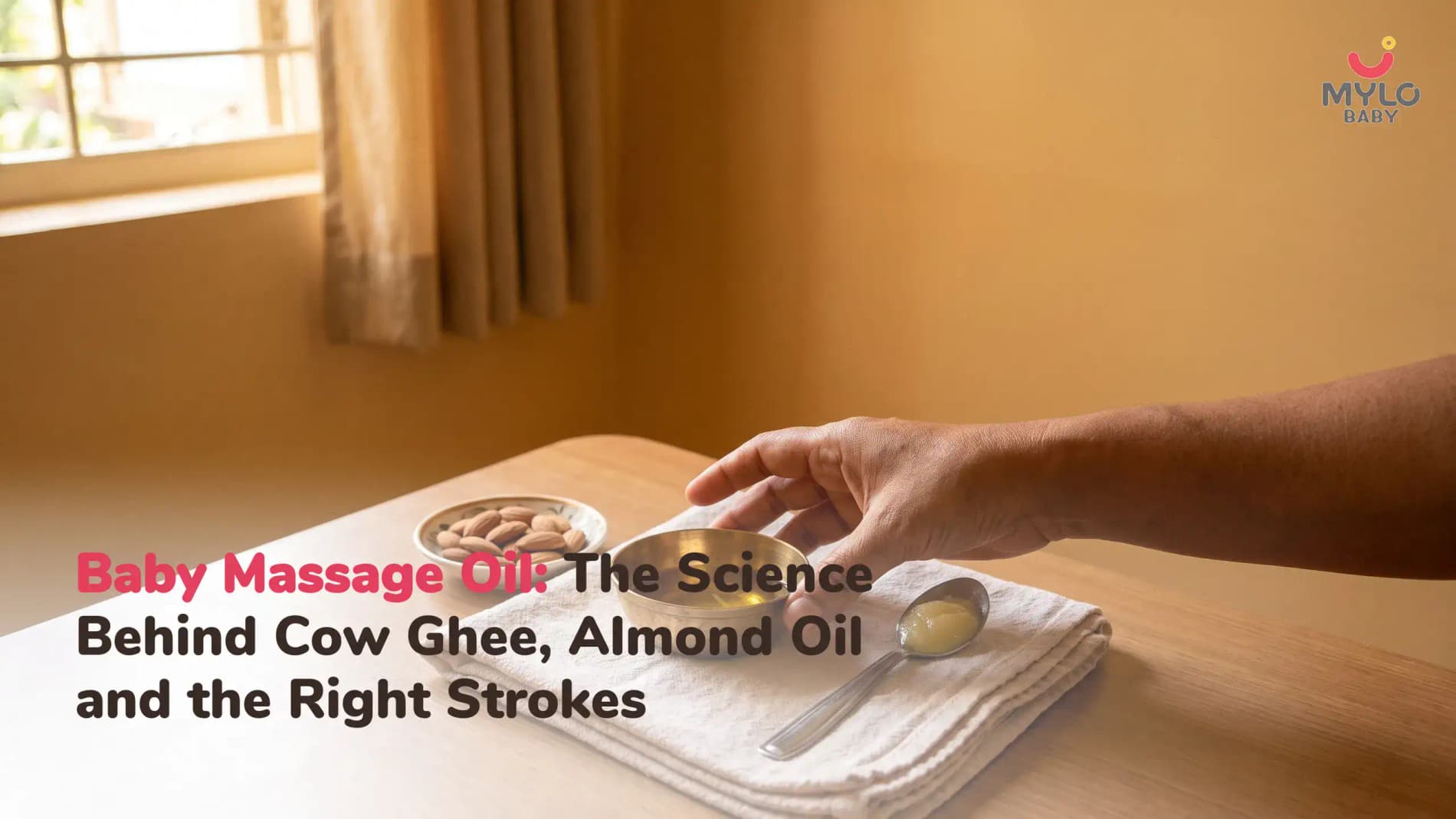
Baby Massage Oil: The Science Behind Cow Ghee, Almond Oil and the Right Strokes
 17 min

RMNCH+A, MCH & Midwifery, Program Management & National Trainer (ToT/ToN), WHO, MoHFW, ECHO Model · 11 years experience
TL;DR
Clinical backing: A 2020 meta-analysis of 15 RCTs and 697 preterm infants found massage improved daily weight gain by an average of 5.07 g/day; moderate-pressure massage outperformed light pressure 5.60 vs 1.08 g/day (Lu et al., 2020).
Cow ghee: Rich in butyric acid, other short-chain fatty acids, oleic acid, fat-soluble vitamins (A, D, E, K). Forms a moisturising occlusive layer; long use in Ayurvedic abhyanga.
Almond oil: Rich in vitamin E, easily absorbed, generally considered safe for baby massage; avoid if there is a confirmed or suspected nut allergy.
What to avoid: Mineral oil and mustard oil. The Bangladesh emollient trials specifically identified mustard oil as potentially toxic to newborn skin, while sunflower-seed oil and other high-linoleate emollients improved skin barrier outcomes (Darmstadt et al., 2008).
Pressure matters: Moderate-pressure massage drives the weight-gain benefit; light still-touch does not.
When to start: Most paediatric guidance suggests 10 days to 1 month after birth, once the umbilical stump has healed, with a 24-hour patch test before regular use.
Quick Answer: Daily infant massage with the right oil has measurable clinical backing, especially in preterm and low-birth-weight babies. A 2020 systematic review and meta-analysis pooling 15 randomised controlled trials across 697 preterm infants found that massage therapy improved daily weight gain by an average of 5.07 grams per day, with the benefit substantially stronger when moderate-pressure technique was used (Lu et al., Complement Ther Clin Pract, 2020). The choice of oil matters: emollients rich in essential fatty acids and antioxidants support the developing skin barrier, while certain traditional oils, including mustard oil, have been flagged in clinical research as potentially harmful to newborn skin (Darmstadt et al., Pediatrics, 2008). Indian baby massage formulations that combine traditional actives like pure cow ghee with modern emollients deliver fatty acids and fat-soluble vitamins to the skin. The right technique is slow, moderate-pressure and rhythmic, following a head-to-toe sequence, because the evidence shows moderate pressure, not light still-touch, is what drives the benefit.
What Does the Evidence Actually Say About Infant Massage?
The evidence base for infant massage has grown substantially over the past two decades, and the strongest signal is in preterm and low-birth-weight infants.
A 2020 systematic review and meta-analysis published in Complementary Therapies in Clinical Practice (Lu LC, Lan SH, Hsieh YP, Lin LY, Chen JC, Lan SJ, PMID 32379694) pooled 15 randomised controlled trials covering 697 preterm infants. It found that massage therapy improved daily weight gain by 5.07 g/day (95% CI 2.19 to 7.94, p=0.0005). Critically, the benefit was substantially larger in trials using moderate-pressure technique (5.60 g/day, 95% CI 2.64 to 8.56) than in light-pressure trials (1.08 g/day, 95% CI 0.29 to 1.86). Weight gain matters in this population because it is closely tied to how quickly a preterm baby reaches feeding and discharge milestones.
A separate 2022 systematic review (Mrljak et al., Int J Environ Res Public Health) covering studies across pain, jaundice, weight gain and parent-infant bonding broadened the picture: massage is associated with reduced procedural pain at venous sampling, lower transcutaneous bilirubin in newborn jaundice, and stronger mother-infant attachment.
The proposed mechanism is physiological rather than mysterious. Tactile stimulation appears to increase vagal nerve activity, support gastric motility, lower cortisol, and improve thermoregulation (Zhang et al., Front Pediatr, 2023).
One important scope note: the dramatic weight-gain figures come from studies of preterm and low-birth-weight infants in clinical settings. A healthy, full-term baby gaining weight normally will not show the same dramatic numbers. For a term baby, the realistic benefits of daily massage are better sleep, easier digestion, and parent-infant bonding, rather than a measurable jump in weight.
What Does Indian Research Say About Oil Massage for Babies?
Oil massage for newborns has been part of Indian and South Asian practice for generations, and several Indian and subcontinent studies have shaped modern guidance.
Sankaranarayanan et al., Indian Pediatrics, 2005. An open randomised controlled study at LTMG Hospital, Mumbai, compared coconut oil massage versus mineral oil massage in neonates. Coconut oil massage was associated with significantly better weight gain than mineral oil. This is one of the clearest Indian RCTs supporting plant-fatty-acid emollients over mineral oil in the newborn period.
Agarwal KN et al., Indian Journal of Medical Research, 2000. Documented that infant massage improved growth, peripheral blood flow and sleep pattern in Indian infants. One of the foundational Indian studies.
Darmstadt et al., Pediatrics, 2008. Conducted in Dhaka, Bangladesh, this skin-barrier-therapy RCT in preterm infants under 33 weeks found that sunflower-seed oil massage reduced nosocomial sepsis and neonatal mortality compared with control. The same research programme explicitly identified mustard oil as potentially harmful to newborn skin, contrasted with high-linoleate sunflower oil as beneficial.
The takeaway: traditional Indian oil-massage practice has real biological grounding, but the specific oil matters. Mustard oil, despite long traditional use in parts of India, is flagged by clinical evidence; mineral oil performs worse than coconut oil in Indian RCT data; and high-essential-fatty-acid formulations support the developing skin barrier.
Why Does Cow Ghee Work as a Baby Massage Oil?
Pure cow ghee, or clarified butter, has been used in Ayurvedic skin care for centuries. Ghee is rich in short-chain fatty acids (notably butyric acid, around 1.7% by composition), medium-chain fatty acids (caproic, caprylic, capric), the dominant monounsaturated oleic acid, and fat-soluble vitamins A, D, E and K (Pena-Serna et al., scientific composition reviews of cow ghee, 2019 to 2024). Those fatty acids and antioxidants make it a moisturising emollient.
In the Ayurvedic practice of abhyanga, ghee is used to nourish dry or sensitive skin and create a temporary occlusive barrier. That traditional rationale aligns with a concept modern dermatology calls transepidermal water loss (TEWL): a layer of lipids on the skin slows the rate at which water evaporates from the stratum corneum, which keeps the outer skin layer hydrated. Topical fatty acids can also be absorbed into the bloodstream in young infants, which is the mechanism underlying the weight-gain trend observed in Darmstadt's sunflower-seed-oil work. The traditional use and the modern mechanism describe the same phenomenon in different language.
Mylo Baby Massage Oil is built on this premise. It combines pure cow ghee with shea butter, murumuru butter and olive oil, in a Made Safe certified, dermatologically tested formulation. It is available in 50 ml, 200 ml, and a 100 ml herb-enriched winter variant for the colder months.
How Do Almond Oil, Olive Oil, Shea Butter and Murumuru Butter Compare?
Each oil and butter in a quality baby massage formulation contributes something specific:
Almond oil. Rich in vitamin E, a potent antioxidant. Easily absorbed and does not leave a heavy greasy residue. Generally considered safe for baby massage. The firm exception: babies with a confirmed or suspected nut allergy should avoid almond oil, and any baby should be patch-tested first.
Olive oil. Carries antioxidants, oleic acid and vitamin E. Note that some dermatology studies have flagged that pure high-oleic olive oil applied to broken or eczematous skin can transiently disrupt the skin barrier in adults, so the standard recommendation is to use olive oil as part of a blended formulation rather than neat on raw or rashy skin in newborns.
Shea butter (Vitellaria paradoxa). Tropical plant butter rich in oleic acid, stearic acid and tocopherols. Provides deep occlusive moisturisation and is widely used in dermatologically tested baby skincare.
Murumuru butter (Astrocaryum murumuru). Amazonian palm butter rich in lauric and myristic acids. Acts as an emollient with a soft, light texture; complements shea butter in baby formulations.
The principle in choosing a baby massage oil: look for a blend dominated by essential fatty acids and natural antioxidants, with a Made Safe or equivalent certification, rather than a single ingredient claim.
Which Oils Should You Avoid for a Newborn?
Not every oil is safe for a newborn's skin barrier, and this is where research has specific warnings.
Mineral oil. In the Mumbai RCT by Sankaranarayanan et al. (2005), mineral oil massage produced significantly lower weight gain than coconut oil massage in Indian neonates. Mineral oil is occlusive but contributes no essential fatty acids the developing skin barrier can use.
Mustard oil. Multiple South Asian neonatal studies including Darmstadt's Bangladesh programme have identified mustard oil as potentially harmful to newborn skin. Mustard oil contains erucic acid and the irritant allyl isothiocyanate, and has been associated with skin barrier disruption in preterm infants.
Heavily fragranced oils. Synthetic fragrance compounds can trigger contact dermatitis in newborns whose skin barrier is still maturing.
Adult body oils. Formulations designed for adults often contain ingredients (fragrance, alcohol, essential oils at adult concentrations) that are not appropriate for infant skin.
The practical takeaway for an Indian parent: choose an oil that is dermatologically tested, fragrance-free, mineral-oil-free, and built around essential fatty acids and antioxidants. A certified, dermatologically tested baby massage oil removes the guesswork of which traditional oils are barrier-safe.
Common Baby Massage Oils: How Do They Compare?
Oil | Key fatty acids / actives | Skin-barrier suitability | Notes |
Cow ghee | Butyric, oleic, palmitic; vitamins A, D, E, K | Good occlusive emollient; long Ayurvedic tradition | Used as base in many Indian baby massage blends |
Almond oil | Oleic, linoleic; vitamin E | Good, when no nut allergy | Always patch-test first |
Olive oil | Oleic, linoleic; polyphenols | Good as part of a blend | High-oleic neat oil can disrupt broken skin |
Shea butter | Oleic, stearic; tocopherols | Excellent occlusive emollient | Common in baby skincare |
Murumuru butter | Lauric, myristic | Light emollient | Pairs well with shea |
Coconut oil | Lauric (~50%) | Good per Indian RCT (Sankaranarayanan 2005) | Solid at <24°C |
Sunflower seed oil (high-linoleate) | Linoleic | Good per Bangladesh RCTs (Darmstadt 2008) | Essential fatty acid source |
Mineral oil | None essential | Poor per Indian RCT data | Occlusive but no biological actives |
Mustard oil | Erucic acid, irritants | Avoid in newborns | Flagged in Darmstadt research |
How Should You Actually Perform the Massage?
The clinical evidence is specific about pressure. The weight-gain benefit of infant massage comes from moderate-pressure massage, firmer than a light stroke but gentler than deep-tissue work. Gentle still-touch, where a hand simply rests on the baby, does not produce the same effect (Lu et al., 2020). Technique is not a detail; it is the active ingredient.
A practical head-to-toe sequence for a term infant from one month onward, lasting 10 to 15 minutes:
Set up. A warm room of roughly 24 to 28°C, a clean towel, and a baby in a calm, alert state. Wait about 30 minutes after a feed.
Warm the oil between your palms for a few seconds before contact.
Start at the head. Light circular motions on the scalp, avoiding the soft fontanelle, then the face, moving outward across the forehead and downward along the jaw.
Move to the chest. Hands flat, sweep outward from the centre of the chest in a heart shape.
Arms and hands. Long downward strokes from shoulder to wrist, then gentle palm and finger massage.
Tummy. Slow clockwise circles around the navel, following the natural direction of digestion. Avoid the navel itself until the umbilical cord stump has fully healed.
Legs and feet. Long downward strokes, then gentle foot and toe massage.
Back. Roll the baby gently onto the tummy and sweep from neck to bottom in slow, rhythmic strokes.
Bathe after 10 to 15 minutes with a gentle, fragrance-free baby wash.
When Should You Start Massaging Your Baby?
Most paediatric guidance is to begin regular massage between 10 days and one month after birth, once the umbilical stump has healed and the skin barrier has stabilised. Before regular use of any oil, do a patch test: apply a small amount to the inner forearm and wait 24 hours to rule out a skin reaction.
Daily massage is the pattern supported by the clinical evidence, with benefits emerging over roughly two weeks of consistent practice. For a healthy term baby, the value is in the daily routine itself, the calmer baby, the easier digestion and the bonding, rather than in chasing the weight-gain figures recorded in preterm studies.
Frequently Asked Questions
When can I start massaging my newborn? Most paediatric guidance is to wait until roughly 10 days to one month after birth, once the umbilical cord stump has healed and the skin barrier has settled. Before regular use of any massage oil, apply a small amount to the inner forearm and wait 24 hours to check for a skin reaction.
Is cow ghee actually safe and effective for baby massage? Pure cow ghee is rich in short-chain fatty acids (notably butyric acid), oleic acid and fat-soluble vitamins, and acts as a moisturising emollient that forms a protective occlusive layer on the skin. It has a long history of use in Ayurvedic abhyanga. Mylo Baby Massage Oil combines pure cow ghee with shea butter, murumuru butter and olive oil in a Made Safe certified, dermatologically tested formulation. Patch test before regular use.
How much weight gain can I expect from regular infant massage? The dramatic figures come from preterm and low-birth-weight studies. A 2020 meta-analysis of 15 RCTs and 697 preterm infants found massage improved daily weight gain by an average of 5.07 g/day (Lu et al., 2020). A healthy, full-term baby gaining weight normally benefits mainly through better sleep, easier digestion and bonding rather than a measurable weight jump.
Is almond oil safe if my baby has sensitive skin? Almond oil is generally well tolerated, easily absorbed and rich in vitamin E. The firm exception is a confirmed or suspected nut allergy, in which case almond oil should be avoided. Always patch test on the inner forearm for 24 hours before regular use.
Which oils should I avoid for newborn massage? Avoid mineral oil and mustard oil. Sankaranarayanan et al.'s Mumbai RCT (2005) found mineral oil produced significantly lower weight gain than coconut oil in Indian neonates. Darmstadt et al.'s Bangladesh research has identified mustard oil as potentially harmful to newborn skin. Also avoid heavily fragranced oils and adult body oils. Choose dermatologically tested baby-specific formulations built around essential fatty acids.
Does the way I massage actually matter, or is any touch fine? Technique matters. The clinical evidence shows that moderate-pressure massage drives the measurable benefit, while light still-touch does not produce the same effect (Lu et al., 2020). The subgroup analysis showed 5.60 g/day weight gain in moderate-pressure trials versus 1.08 g/day in light-pressure trials. Use slow, rhythmic, moderate-pressure strokes in a head-to-toe sequence.
Is it safe to massage with cow ghee in summer? Yes, but adjust the technique to the season. In Indian summers, the conventional recommendation is to massage before the bath rather than after, and to keep the room cool enough that the baby is not sweating. If the baby has heat rash (miliaria rubra), consider skipping the oil massage until the rash resolves, since oil over occluded sweat glands can prolong miliaria.
Can I use the same oil through winter and summer? A heavier blend (with more butters and ghee) makes sense in winter when the skin is drier, and a lighter ratio in summer. Mylo's 100 ml herb-enriched winter variant sits in the heavier-formulation category, while the standard formulation works year-round. The principle: heavier emollients for dry winter skin, lighter for humid Indian summer.
A note from our editorial team: This guide is informational and not a substitute for personalised paediatric advice. If your baby develops a rash, persistent crying during massage, broken skin or any unexpected reaction, stop the oil and consult a paediatrician. The weight-gain data discussed here applies primarily to preterm and low-birth-weight infants under clinical supervision; for full-term healthy infants, daily massage supports sleep, digestion and bonding rather than producing dramatic weight changes. [Reviewed by — paediatric reviewer placeholder].
Sources
Lu L.C., Lan S.H., Hsieh Y.P., Lin L.Y., Chen J.C., Lan S.J. "Massage therapy for weight gain in preterm neonates: A systematic review and meta-analysis of randomized controlled trials." Complementary Therapies in Clinical Practice 2020;39:101168. PMID 32379694, DOI 10.1016/j.ctcp.2020.101168 — https://pubmed.ncbi.nlm.nih.gov/32379694/
Mrljak R., Arnsteg Danielsson A., Hedov G., Garmy P. "Effects of Infant Massage: A Systematic Review." Int J Environ Res Public Health 2022;19(11):6378. PMID 35681968 — https://pubmed.ncbi.nlm.nih.gov/35681968/
Sankaranarayanan K., Mondkar J.A., Chauhan M.M., Mascarenhas B.M., Mainkar A.R., Salvi R.Y. "Oil massage in neonates: an open randomized controlled study of coconut versus mineral oil." Indian Pediatrics 2005;42(9):877-884.
Agarwal K.N., Gupta A., Pushkarna R., Bhargava S., Faridi M., Prabhuy M.K. "Effect of massage and use of oil on growth, blood flow and sleep pattern in infants." Indian Journal of Medical Research 2000;112:212-217.
Darmstadt G.L., Saha S.K., Ahmed A.S.M.N.U., et al. "Effect of Skin Barrier Therapy on Neonatal Mortality Rates in Preterm Infants in Bangladesh: A Randomized, Controlled, Clinical Trial." Pediatrics 2008;121(3):522-529 — https://pmc.ncbi.nlm.nih.gov/articles/PMC3878124/
Darmstadt G.L., Saha S.K., Ahmed A.S., et al. "Effect of topical treatment with skin barrier-enhancing emollients on nosocomial infections in preterm infants in Bangladesh: a randomised controlled trial." Lancet 2005;365(9464):1039-1045.
Zhang Y., Duan C., Cheng L., Li H. "Effects of massage therapy on preterm infants and their mothers: a systematic review and meta-analysis of randomized controlled trials." Frontiers in Pediatrics 2023;11:1198730 — https://pmc.ncbi.nlm.nih.gov/articles/PMC10500070/
Mylo Family, "Baby Massage Oil with Pure Cow Ghee, Shea Butter, Murumuru Butter and Olive Oil" — https://mylofamily.com/product/baby-massage-oil-200ml-improves-complexion-skin-tone-moisturizes-nourishes-skin-aids-in-sun-protecti-2426
Article Posted Under
Related Articles
Right Side Abdominal Pain: Common Causes, Home Care and When to See a Doctor
 14 min
 Growth Scan in Pregnancy: When It Is Done, What It Checks and What Your Report Means
 17 min
 Hair Colour During Pregnancy: Is It Safe? Trimester Guide, Mehndi and Safer Options
 14 min
 Mylo: The Made-in-India Pregnancy and Parenting App Built for Indian Parents
 7 min
7 min
Related Topics
.webp&w=32&q=75)
Medical Disclaimer
This content is for informational purposes only and should not replace professional medical advice. Consult with a physician or other health care professional if you have any concerns or questions about your health. If you rely on the information provided here, you do so solely at your own risk.


AWARDS AND RECOGNITION

Mylo wins Forbes D2C Disruptor award

Mylo wins The Economic Times Promising Brands 2022
AS SEEN IN













- Mylo Care: Effective and science-backed personal care and wellness solutions for a joyful you.
- Mylo Baby: Science-backed, gentle and effective personal care & hygiene range for your little one.
- Mylo Community: Trusted and empathetic community of 10mn+ parents and experts.


Product Categories
Baby Carrier | Baby Soap | Baby Wipes | Stretch Marks Cream | Baby Cream | Baby Shampoo | Baby Massage Oil | Baby Hair Oil | Stretch Marks Oil | Baby Body Wash | Baby Powder | Baby Lotion | Diaper Rash Cream | Newborn Diapers | Teether | Baby Kajal | Baby Diapers Pants | Cloth Diapers | Laundry Detergent | Lactation Granules |