


Orders

Profile

Baby Growth Stages: Month-by-Month Development Guide (0-12 Months)
 100 Likes|
 15 min
The first year of your baby’s life is very eventful and memorable. It is during this first year of infancy that your little bundle of joy begins to crawl and outgrow the cradle. What’s more? It passes in the blink of an eye: the first day you carry them home in your arms and a year later you are holding their hand as they take their first steps. As parents, you get the first-row tickets to all the baby milestones your little one will experience. And as your baby’s first teachers, you must aid in your baby development and growth.
In this article, we have prepared a detailed guide to baby development stages month by month that will prepare you for what’s to come next- all the major milestones and challenges. Also, there’s a baby milestones chart (baby development chart) that will help you glance at all baby development milestones in one place.
What milestones should my baby reach between 1 and 3 months?
Between 1 and 3 months, babies lift their head during tummy time, begin social smiling around 6-8 weeks, track objects with their eyes, coo and gurgle in response to voices, and gain roughly 150-200 grams weekly. They recognise your voice, show alertness for longer stretches, and start bringing hands to their mouth.
Between 1 and 3 months, babies typically gain 150–200g per week, lift their head briefly during tummy time, track moving objects with their eyes, respond to sounds, and produce their first social smiles. Feeding occurs every 2–3 hours, and most infants sleep 14–17 hours daily across short cycles.
1. Baby Development
In the first three months of life, your baby will witness major growth spurts. So, keep watching those baby development stages. Within a few weeks, your little one will begin to notice objects, track objects with their eyes, lifting their head, smiling and turning in the direction of sound.
By the three-month mark, your baby should be able to lift the head 90 degrees, reach out for their favorite toys, laugh out loud, roll over and string together sounds like ‘ah-goo’. If your baby is lagging on most of these milestones, do consult your doctor.
2. Baby Growth
In the first week of arrival, your baby may lose weight. But he/she will soon make up for that initial weight loss by gaining at least 2-4 kgs of weight in the first three months. By the three-month mark, your baby should weigh around 5.8 kgs if a girl and 6.4 kgs if a boy.
When it comes to height, female babies should be about 60 cm or 23.6 inches long whereas male babies should be 61.5 cm or 24.2 inches long.
3. Baby Health
To fuel your little one’s growth, your baby’s feeding demands will increase by the end of the first month. If you’re breastfeeding, expect to feed your little one around 6-10 ten times a day. In case of formula milk, you can expect to feed every 3-4 hours over the day. Your baby will also be sleeping 14-16 hours a day, waking every 2-4 hours.
Keep an eye out for dry and flaky skin as it might be the early symptoms of infant eczema or cradle cap. And if your baby cries unconsolably for hours at end, it might indicate a case of colic. Don’t forget to discuss these symptoms with your doctors when you go for vaccinations.
In the first three months your baby will most likely receive the hepatitis B shot, the DTaP vaccine, Rotavirus vaccine, Pneumococcal conjugate vaccine, Polio vaccine and the Hib vaccine.
You may also like: Baby Milestones: A Week-By-Week Guide to Your Baby’s Development in the First Year
What developmental milestones happen between 4 and 6 months?
From 4 to 6 months, your baby rolls over both ways, sits with support, reaches for toys, laughs out loud, and may double their birth weight by month 5. They babble with consonant sounds like "ba" and "da," recognise familiar faces, and show readiness for solids around 6 months.
From 4 to 6 months, babies usually double their birth weight, roll from tummy to back, sit with support, grasp objects, and babble using consonant sounds. Most are developmentally ready to begin solid foods around 6 months, while continuing 4–6 milk feeds per day and sleeping 12–15 hours.
1. Baby Development
By 4 months, your baby will begin to differentiate between colours, discover voices and laugh out loud. He/she will also be able to track moving objects faster and even grab at them. The major milestone your baby will hit in the 6-month marker is grabbing objects very hard so save your hair and jewelry. Additionally, your little one should be able to rise up on their arms when placed on their tummy and roll over.
Most of the babies in this span like to make the most of their limbs and play with their fingers and toes, probably even mouth them. As your little one aces through these baby development stages month by month, he/she will also babble more sounds like ‘ga-ga-ga' or ‘ba-ba-ba'. Keep those ears open as the sweet calls of ‘Mama’ and ‘Dada’ are not very far away.
You may also like: Understanding Baby Sleep: 4-6 Months
2. Baby Growth
Your tiny munchkin may not seem so tiny by now as they have been gaining weight steadily, strengthening their bones and getting longer. By the 6-month marker, most babies have doubled their weight at birth. So, you can expect your baby girl to weigh around 7.3-7.5 kg and 7.9-8.5 for baby boys.
Whereas, their height is concerned, baby girls are around 25.75 inches or 65.7 cm long and baby boys measure 26.5 inches or 67.6 cm. Remember, if your baby doesn’t fall into this range and your doctor isn’t too concerned then you shouldn’t be either. Your little one may just be one-of-a-kind.
You may also like: Baby Weight Chart: An Indian Parent's Guide to Growth Patterns
3. Baby Health
During these baby development stages, your little one should ideally get at least 5-6 feeds of breastmilk or formula milk. You may notice that while the frequency of feeds may have reduced, the quantity has increased.
Your baby must also be awake for longer durations of the day and sleep around 10-12 hours at night and nap 3-5 hours in the day. Your baby is half way to a year already so if you’re thinking of introducing solid foods, remember your baby doesn’t require more than a tablespoon twice a day. Ideally, you should wait until 6 months before feeding solid foods.
During 4-6 months, your baby will most likely receive the remaining shots of Rotavirus vaccine, Pneumococcal conjugate vaccine and the Polio vaccine. Keep an eye out for sleeplessness, loss of appetite and irritability as some babies start teething during this phase. Additionally, watch out for cold, colic, stomach bugs, infant eczema and cradle cap.
You may also like: Most Important Vaccines for Indian Babies: Here's the Complete Chart
What can my baby do between 7 and 9 months?
Between 7 and 9 months, babies sit without support, start crawling or scooting, use a pincer grasp to pick up small foods, respond to their name, and may say "mama" or "dada" non-specifically. Stranger anxiety peaks, they enjoy peek-a-boo, and many cut their first 2 teeth around 6-8 months.
Between 7 and 9 months, babies typically begin crawling, sitting independently, transferring objects between hands, and responding to their own name. They develop the pincer grasp, eat 2–3 solid meals daily alongside milk, and may show stranger anxiety as object permanence develops.
1. Baby Development
As the second half of your baby’s first year begins, your little one will become a baby on the go. He/she will be rolling back and forth, sit unsupported, pull up, clap and even crawl around the house. Your baby may surprise you with a ‘Mama’ or ‘Dada’ any day now as their communications skills expand.
Facial gestures like loud laughs, squeals and grins will also become a common appearance during your baby development month by month. Although all babies develop at different rates, they must achieve certain key baby development milestones by this stage. If your baby hasn’t started to move at all, grasp objects, babble or turn towards sounds, you may want to check in with your doctor.
2. Baby Growth
On the baby growth month by month front, your little one will continue to gain weight and length. By the nine-month marker, your baby girl should weigh around 8.2 kg and baby boys weigh 8.9 kg. On the length charts, your baby will fall somewhere between 25-30 inches or 63.5-76.2 cm.
Don’t worry if your little one is lagging behind on these baby growth stages as all babies follow their unique growth pattern. You can speak with your doctor just to put your worries to rest.
3. Baby Health
Now that your munchkin has crossed the six-month marker, it’s time to start solids! You can start by introducing 1-2 tablespoons of cereal, fruits or veggies, increasing gradually to 3-9 tablespoons. Try to stay away from cow milk, honey and fruits juice until your little one turns one.
Additionally, you can start giving your baby some water to sip on to reduce the risk of dehydration after checking with your doctor. Don’t forget your baby still needs breastmilk or formula 4-6 times a day. Your tiny one will sleep around 11 hours at night, without waking in the middle at all. He/she will stock up some energy for play time with about 2 naps during the day.
As you introduce solid foods, your baby may present symptoms like hives, skin rashes, sneezing or vomiting in case of a food allergy. So, watch out for those symptoms and consult your doctor instantly. Also keep an eye out for teething as it is most likely to begin within these months.
You may also like: How To Prepare Food For Your Infant/Toddler Safely?
What milestones should my baby hit between 10 and 12 months?
From 10 to 12 months, babies pull to stand, cruise along furniture, and many take their first independent steps near their first birthday. They wave bye-bye, clap, say 1-3 meaningful words, self-feed finger foods, and triple their birth weight by 12 months. They understand simple instructions like "no."
From 10 to 12 months, babies usually pull to stand, cruise along furniture, take their first steps, say simple words like “mama” or “dada,” and feed themselves finger foods. By 12 months, most have tripled their birth weight and transition toward 3 meals plus snacks.
1. Baby Development
With your baby soon gaining the toddler status, you will notice he/she is crawling, standing up, cruising and maybe even taking his/her first steps. As your little one advances through the baby development stages month by month, it may be time to baby-proof your house. Also, on the baby development stages agenda is clapping hands, waving bye-bye, raising arms to be picked-up and blowing kisses.
Around this time, separation anxiety may also kick in full-force. Additionally, you may notice your baby throwing tantrums like banging head, hair pulling, teeth grinding or rocking. Such a behaviour is usually triggered by stress, over-stimulation or a change in routine.
Your soon-to-be toddler may also finally say ‘Mama’ and ‘Dada’ if they haven’t already along with some others words. They are also likely to become copy cats and imitate your sounds and gestures.
2. Baby Growth
When it comes to watching baby growth stages, you will notice that your baby’s growth has begun to slow. As a result, the appetite will also decrease as your baby transitions from a voracious eater to a picky eater.
On the weight front, you can expect your baby girl to weight at max 11.3 kg and baby boy around 11.8 kg. Your baby may fall into the 71.8-80.2 cm length category by this time. Ideally, your baby’s weight should have tripled their birth weight, height should have increased 50% by this stage.
3. Baby Health
As your baby sprouts teeth, you may want to schedule their first dental visit and learn about their dental hygiene. By the time their first birthday approaches, you may want to wean your baby from the bottle and introduce them to a cup. You should feed your baby around half a cup of grains, fruits and veggies, dairy foods and proteins each day.
Do continue breastfeeding or formula milk until the first-year ends. Additionally, keep an eye out for motion sickness, sore throat, cold and hand, foot and mouth disease (HMFD).
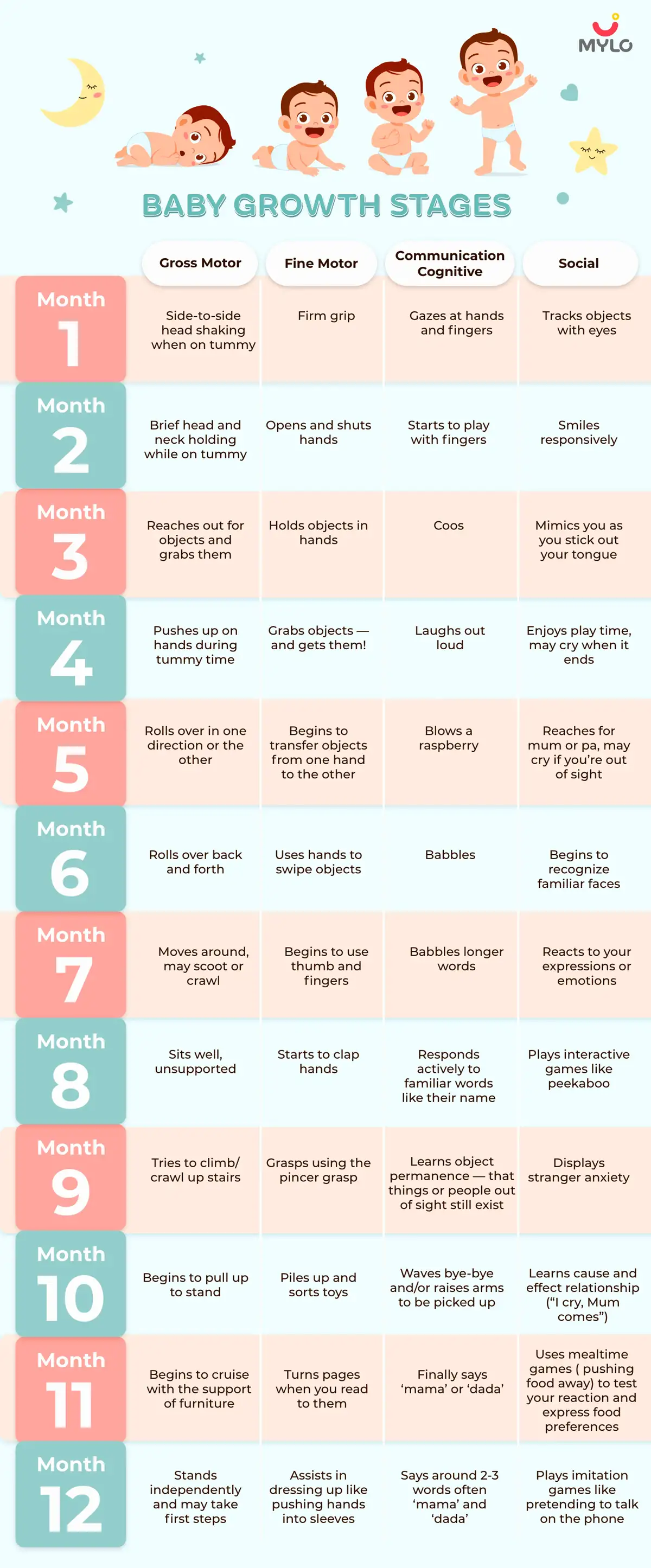
What is the month-by-month baby milestones chart for year one?
A baby milestones chart maps development across 4 domains: physical (head control, rolling, sitting, walking), cognitive (object permanence, cause-effect), social-emotional (smiling, stranger anxiety), and language (cooing, babbling, first words). Indian paediatricians use this 0-12 month chart during WHO growth monitoring visits to track your baby's progress against standard benchmarks.
A first-year baby milestones chart tracks four key domains—physical (weight, height, motor skills), cognitive (object permanence, problem-solving), social-emotional (smiling, stranger anxiety), and language (cooing, babbling, first words)—across four age brackets: 1–3, 4–6, 7–9, and 10–12 months.
To help you track baby milestones by month, here is a baby development chart for you that shows common infant development milestones that babies reach each month during their first year. However, keep in mind that all babies are one-of-a-kind and grow at their own sweet pace. If your baby hasn’t reached a few milestones specified on this chart, he/she may achieve it the next month. Focus on progress, not delays.
Final Thoughts
As you reflect on your baby's incredible journey through the first year of life, it's important to celebrate every milestone achieved. From those first adorable smiles to the wobbly first steps, each moment is a testament to your baby's growth and development. Remember, every baby is unique, and they will reach baby milestones at their own pace. Keep in mind that the love, care, and attention you provide are the most critical factors in your baby's healthy development. So, here's to many more milestones and memories in the years to come!
References
1. Dosman CF, Andrews D, Goulden KJ. (2012). Evidence-based milestone ages as a framework for developmental surveillance. Paediatr Child Health.
2. Misirliyan SS, Boehning AP, Shah M. (2023). Development Milestones. In: StatPearls [Internet]. Treasure Island (FL): StatPearls Publishing
FAQs Related to Baby Milestones
When do babies start crawling?
Most babies crawl between 7-10 months. Some skip crawling entirely. If not crawling by 12 months, consult your pediatrician.
When do babies start walking?
Average age is 12 months, but 9-18 months is normal. Premature babies may take longer. Walking late doesn't mean developmental issues.
What is average baby weight month by month?
Newborns: 2.5-4.5 kg. By 6 months: 6-9 kg. By 12 months: 8-12 kg. Indian babies may be slightly lighter than Western averages.
When should I worry about baby milestones?
See a doctor if baby doesn't hold head up by 4 months, sit by 9 months, or use words by 18 months. Every baby develops differently.
Are premature baby milestones different?
Yes, use corrected age (subtract weeks born early). A baby born 2 months early should hit 6-month milestones at 8 months.
 Yes
Yes
 No
No
Your parenting partner
in your pocket.
supportive community.

Your parenting partner
in your pocket.
supportive community.


Article Posted Under
Helpful Tools & Calculators

.webp&w=32&q=75)














Anupama Chadha, born and raised in Delhi is a content writer who has written extensively for industries such as HR, Healthcare, Finance, Retail and Tech.
Related Articles

Related Videos
![Infant Developmental Milestones [UndergroundMed]](https://images.mylofamily.com/_next/image?url=https%3A%2F%2Fimg.youtube.com%2Fvi%2Fi0fnBTUuRIA%2Fhqdefault.jpg&w=1900&q=75)
Infant Developmental Milestones [UndergroundMed]

16 Facts about Months 4 through 6 | Baby Development
12 - 24 Months Old Baby Development - What To Expect

Your baby - Visual Development
Baby Milestones: 24-36 Months
Questions about this article
- Asked by Mother of 3 Months Old Baby
Hi my baby completed today 3th month n she want to sit what should I do....??
- Asked by Mother of 18 Days Old Baby
My baby scratch on face with own hands
- Asked by Mother of 18 Days Old Baby
Rajaj kymar
Related Topics
.webp&w=32&q=75)
Recently Published Articles
Your body needs extra nutrition this trimester - these can help.
Medical Disclaimer
This content is for informational purposes only and should not replace professional medical advice. Consult with a physician or other health care professional if you have any concerns or questions about your health. If you rely on the information provided here, you do so solely at your own risk.


AWARDS AND RECOGNITION

Mylo wins Forbes D2C Disruptor award

Mylo wins The Economic Times Promising Brands 2022
AS SEEN IN












- Mylo Care: Effective and science-backed personal care and wellness solutions for a joyful you.
- Mylo Baby: Science-backed, gentle and effective personal care & hygiene range for your little one.
- Mylo Community: Trusted and empathetic community of 10mn+ parents and experts.


Product Categories
Baby Carrier | Baby Soap | Baby Wipes | Stretch Marks Cream | Baby Cream | Baby Shampoo | Baby Massage Oil | Baby Hair Oil | Stretch Marks Oil | Baby Body Wash | Baby Powder | Baby Lotion | Diaper Rash Cream | Newborn Diapers | Teether | Baby Kajal | Baby Diapers Pants | Cloth Diapers | Laundry Detergent | Lactation Granules |