


Orders
.png&w=48&q=75 "login")
Profile


Wallet

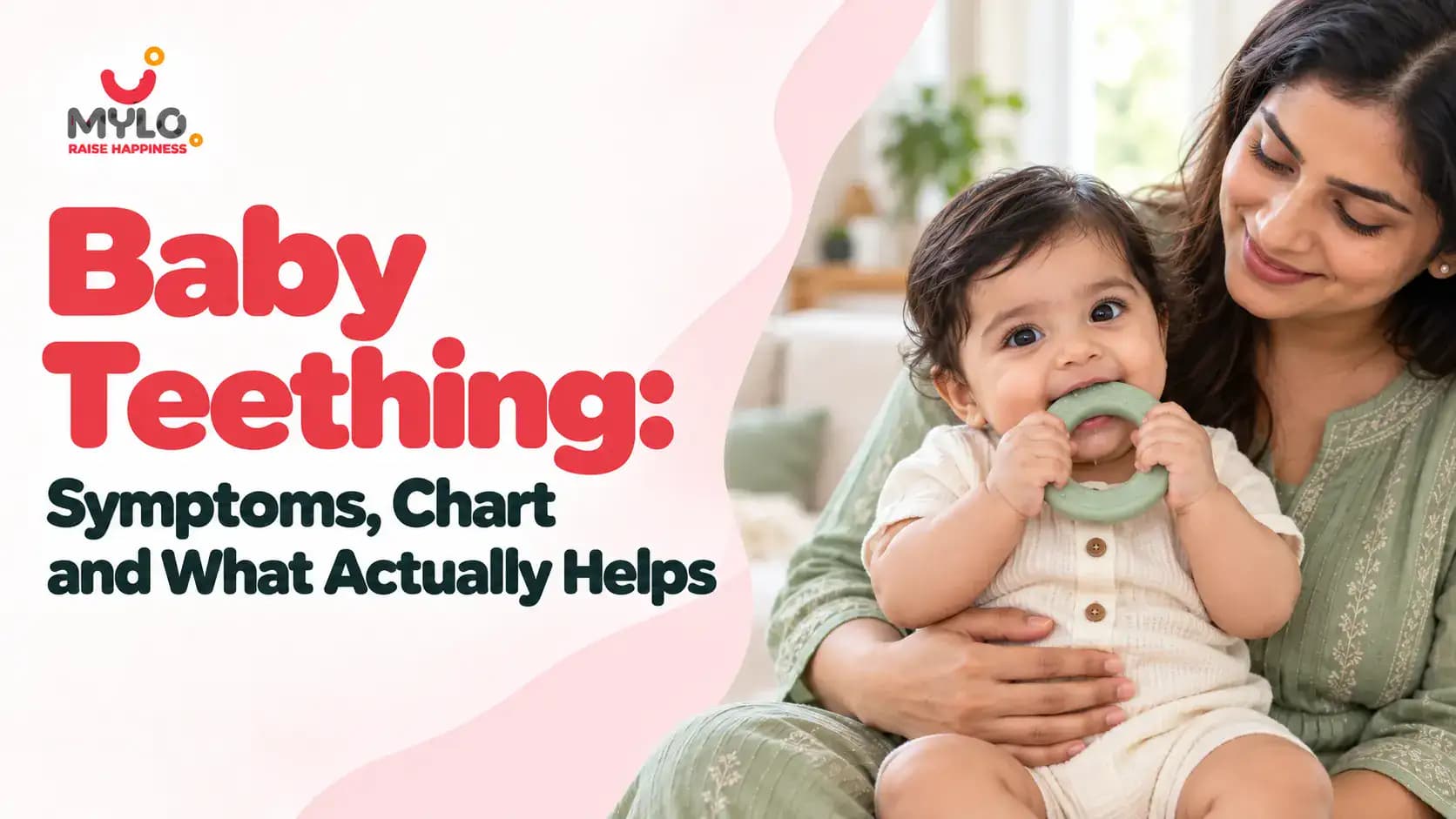
Baby Teething: Symptoms, Chart and What Actually Helps


BDS (Gold Medalist), Certified Lactation Consultant – BPNI Delhi, Maternal & Infant Nutrition Expert · 15 years experience
 1.7K Likes|
 12 min
Quick answer
Most babies get their first tooth between 4 and 10 months, usually around 6 months. Teething causes drooling, gum rubbing, irritability and disturbed sleep. It does not cause fever, diarrhoea, vomiting or a rash on the body. If your baby has those, they are unwell with something else and need to be assessed. Cold, firm teethers and gum pressure help. Gels, necklaces and traditional gum remedies do not.
Key takeaways
Teething does not cause fever. Attributing a fever to teething is the most common and most consequential mistake, because it delays assessment of an actual illness.
Never put anything around a baby's neck or wrist for teething. Amber necklaces and thread bracelets carry strangulation and choking risks and have no proven benefit.
Avoid teething gels containing benzocaine or lidocaine in babies. Regulators have warned against them.
Chill teethers in the fridge, never the freezer. A frozen teether is hard enough to damage gums.
Start brushing as soon as the first tooth appears, twice a day, with a fluoride toothpaste in a rice-grain smear.
When do babies start teething?
Most babies get their first tooth somewhere between 4 and 10 months, with 6 months being the most common. Some get one at 3 months, some not until after their first birthday.
Late teething is usually normal. If there is no tooth by around 18 months, mention it to your paediatrician or a paediatric dentist, but before that it is almost always just variation.
Occasionally a baby is born with a tooth, or one appears in the first weeks. This is called a natal or neonatal tooth. Show it to your paediatrician, since some are loose and need removing while others are left alone.
Tooth eruption chart
Teeth usually come in pairs, and the lower front two are typically first.
Teeth | Usual age |
|---|---|
Lower central incisors (bottom front two) | 6 to 10 months |
Upper central incisors (top front two) | 8 to 12 months |
Upper lateral incisors | 9 to 13 months |
Lower lateral incisors | 10 to 16 months |
First molars | 13 to 19 months |
Canines | 16 to 23 months |
Second molars | 23 to 33 months |
All 20 baby teeth are usually through by around 2 and a half to 3 years.
Considerable variation is normal. What matters is steady progress rather than matching the chart exactly.
Teething symptoms
What teething does cause:
Drooling, sometimes a lot
Chewing and gnawing on hands, toys and anything else
Rubbing the gums, cheeks or ears on the same side
Swollen, red or tender gums
Irritability and fussiness, usually for a few days around each tooth
Disturbed sleep
Reduced appetite, or refusing the breast or bottle briefly
A mild rash or chapping around the mouth and chin from the drool
Sometimes a small bluish swelling appears over an emerging tooth. This is an eruption cyst, it is harmless, and it usually resolves on its own.
What teething does NOT cause
This is the most important section on the page.
Teething does not cause:
Fever. Teething may be associated with a very slight rise in temperature, but not a fever
Diarrhoea
Vomiting
Cough or runny nose
A rash on the body
Prolonged loss of appetite
Convulsions
If your baby has any of these, they are unwell with something else.
Why this matters more than it sounds: babies start teething at around six months, which is exactly when the antibodies passed from their mother are fading and they begin getting infections. The timing overlaps, which is why the two get confused. Attributing a fever to teething is one of the commonest reasons a sick baby is not brought in.
Any fever in a baby under 3 months is an emergency, whatever else is happening.
What actually helps
Remedy | How | Notes |
|---|---|---|
Gum pressure with a clean finger | Rub the gum firmly but gently for a minute or two | Free, effective, and often the thing that works best |
A chilled teether | Refrigerate for 15 to 20 minutes. Never freeze | A frozen teether is hard enough to bruise or damage gums |
A cold, clean washcloth | Dampen, chill in the fridge, let your baby chew it | Supervise. Remove when soggy |
A solid silicone or rubber teether | Choose one-piece, solid, food-grade, with no small parts | See the safety note below on liquid-filled teethers |
Cold food, for babies already on solids | Chilled cucumber sticks or apple in a mesh feeder | Only in a mesh fruit feeder, and only if your baby has started solids. Hard pieces are a choking hazard |
Extra feeding and comfort | Breast or bottle, cuddles, carrying | Sucking is soothing. Some babies feed more, others less |
Wiping the drool | Pat, do not rub, and apply a plain barrier cream on the chin | Prevents the drool rash |
Paracetamol, if your baby is genuinely distressed | Only on your paediatrician's advice, at the correct dose for weight | Not a routine measure |
What to avoid
Avoid | Why |
|---|---|
Amber teething necklaces, and any necklace, bracelet or thread | Strangulation and choking risk. No evidence of benefit. Paediatric bodies and regulators advise against them |
Teething gels containing benzocaine | Regulators have warned against use in babies and young children because of a rare but serious blood disorder |
Teething gels containing lidocaine | Also warned against in infants |
Homeopathic teething tablets and powders | Some have been found to contain belladonna, and regulators have issued warnings |
Frozen teethers, or ice directly on gums | Too hard, and can damage gums |
Liquid or gel-filled teethers | Can break or leak. Solid one-piece teethers are safer. See the note below |
Honey rubbed on gums | Unsafe under 12 months. Infant botulism risk. It also feeds decay |
Brandy, whisky or any alcohol on gums | A traditional practice and a genuinely dangerous one. Alcohol is toxic to infants |
Rock salt, ajwain, ghee or herbal pastes on gums | No benefit, and some are irritating |
Hard rusks, biscuits or raw carrot sticks | Choking hazard, and most are high in sugar |
Anything sweet on a teether or dummy | Causes early decay |
Aspirin, in any form | Never in children |
Adult painkillers, or adult doses | Dosing must be by weight and by a paediatrician |
Oral care from the first tooth
Most teething articles stop at remedies, but this is what prevents problems later.
Before teeth: wipe the gums with a clean damp cloth once a day
From the first tooth: brush twice a day with a soft baby toothbrush
Use fluoride toothpaste. A rice-grain sized smear under 3 years, and a pea-sized amount from 3 to 6 years
Brush the last thing at night, and do not rinse with water afterwards. Spit out only
You do the brushing until your child is around 7 or 8. They can have a turn first, but you finish
Do not put your baby to bed with a bottle of milk or juice. Milk pooling around the teeth overnight is the main cause of early childhood tooth decay, which is very common in India
Move to a cup from around 12 months where possible
No sweetened water, juice in a bottle, or sugar on a dummy
If you live in an area with naturally high fluoride in the water, which occurs in parts of India, ask your dentist about the right toothpaste for your child. Do not simply stop fluoride, since it protects against decay.
When to see a doctor or dentist
See a doctor the same day if your baby has:
Any fever in a baby under 3 months
Fever with drowsiness, poor feeding or a rash
Diarrhoea or vomiting, particularly with fewer wet nappies
Refusing all feeds
Fast or laboured breathing
Unusual drowsiness or floppiness
Swelling of the face or jaw, or a hot tender area on the gum, which may indicate infection
Do not assume any of these is teething.
See a paediatric dentist if:
Your child has reached their first birthday. The recommendation is a first dental visit by age one, or within six months of the first tooth appearing, whichever comes first
No teeth have appeared by around 18 months
A tooth appears discoloured, brown, or with white spots or pitting
Teeth are chipped or damaged after a fall
Your baby was born with a tooth, or one appeared in the first weeks
The gums bleed easily or look swollen beyond the erupting tooth
Frequently asked questions
Does teething cause fever?
No. Teething may cause a very slight rise in temperature but not a fever. A fever means your baby is unwell with something else and should be assessed.
Does teething cause diarrhoea?
No. Diarrhoea in a teething baby is a separate illness and needs attention, particularly if wet nappies reduce.
When do babies start teething?
Usually between 4 and 10 months, most commonly around 6. Some start earlier and some after their first birthday.
My baby is 12 months and has no teeth. Is that a problem?
Usually not. Mention it at your next visit, and see a paediatric dentist if there are still no teeth by around 18 months.
Are amber teething necklaces safe?
No. They carry strangulation and choking risks and have no proven benefit. Nothing should be worn around a baby's neck or wrist.
Can I use a teething gel?
Avoid gels containing benzocaine or lidocaine in babies, as regulators have warned against them. Ask your paediatrician before using any gel or medication.
Should I freeze the teether?
No. Chill it in the fridge for 15 to 20 minutes. A frozen teether is hard enough to damage your baby's gums.
Can I rub honey or brandy on the gums?
No. Honey is unsafe under 12 months because of infant botulism risk, and alcohol is toxic to infants. Neither should be used.
When should I start brushing my baby's teeth?
As soon as the first tooth appears. Twice a day, with a rice-grain smear of fluoride toothpaste.
When is the first dental visit?
By your child's first birthday, or within six months of the first tooth appearing, whichever comes first.
The bottom line
Teething is uncomfortable rather than dangerous, and the things that help are simple: firm gum pressure, a chilled solid teether, a cold washcloth and extra comfort. Skip the gels, the necklaces and the traditional gum remedies, none of which help and several of which carry real risk. And hold on to one rule above all: teething does not cause fever, diarrhoea or vomiting, so if your baby has any of those, they need to be seen rather than soothed.
Sources
American Academy of Pediatrics, teething and dental care for babies
US Food and Drug Administration, safely soothing teething pain in infants and children
American Academy of Pediatric Dentistry, policy on the dental home and first visit
Indian Academy of Pediatrics, infant and child health guidance
Indian Society of Pedodontics and Preventive Dentistry, guidance on early childhood caries and fluoride use
This article is for general information and is not a substitute for professional medical advice. Never attribute fever, diarrhoea or vomiting to teething. Seek care the same day for any fever in a baby under three months.
Article Posted Under
Related Articles
Related Topics
.webp&w=32&q=75)
Medical Disclaimer
This content is for informational purposes only and should not replace professional medical advice. Consult with a physician or other health care professional if you have any concerns or questions about your health. If you rely on the information provided here, you do so solely at your own risk.


AWARDS AND RECOGNITION

Mylo wins Forbes D2C Disruptor award

Mylo wins The Economic Times Promising Brands 2022
AS SEEN IN













- Mylo Care: Effective and science-backed personal care and wellness solutions for a joyful you.
- Mylo Baby: Science-backed, gentle and effective personal care & hygiene range for your little one.
- Mylo Community: Trusted and empathetic community of 10mn+ parents and experts.


Product Categories
Baby Carrier | Baby Soap | Baby Wipes | Stretch Marks Cream | Baby Cream | Baby Shampoo | Baby Massage Oil | Baby Hair Oil | Stretch Marks Oil | Baby Body Wash | Baby Powder | Baby Lotion | Diaper Rash Cream | Newborn Diapers | Teether | Baby Kajal | Baby Diapers Pants | Cloth Diapers | Laundry Detergent | Lactation Granules |