


Orders
.png&w=48&q=75 "login")
Profile


Wallet

Sukanya Samriddhi Yojana (SSY): Returns, Rules and Benefits for Your Girl Child
 12 min
Key Takeaways
Quick overview in 30 seconds.webp&w=32&q=75)
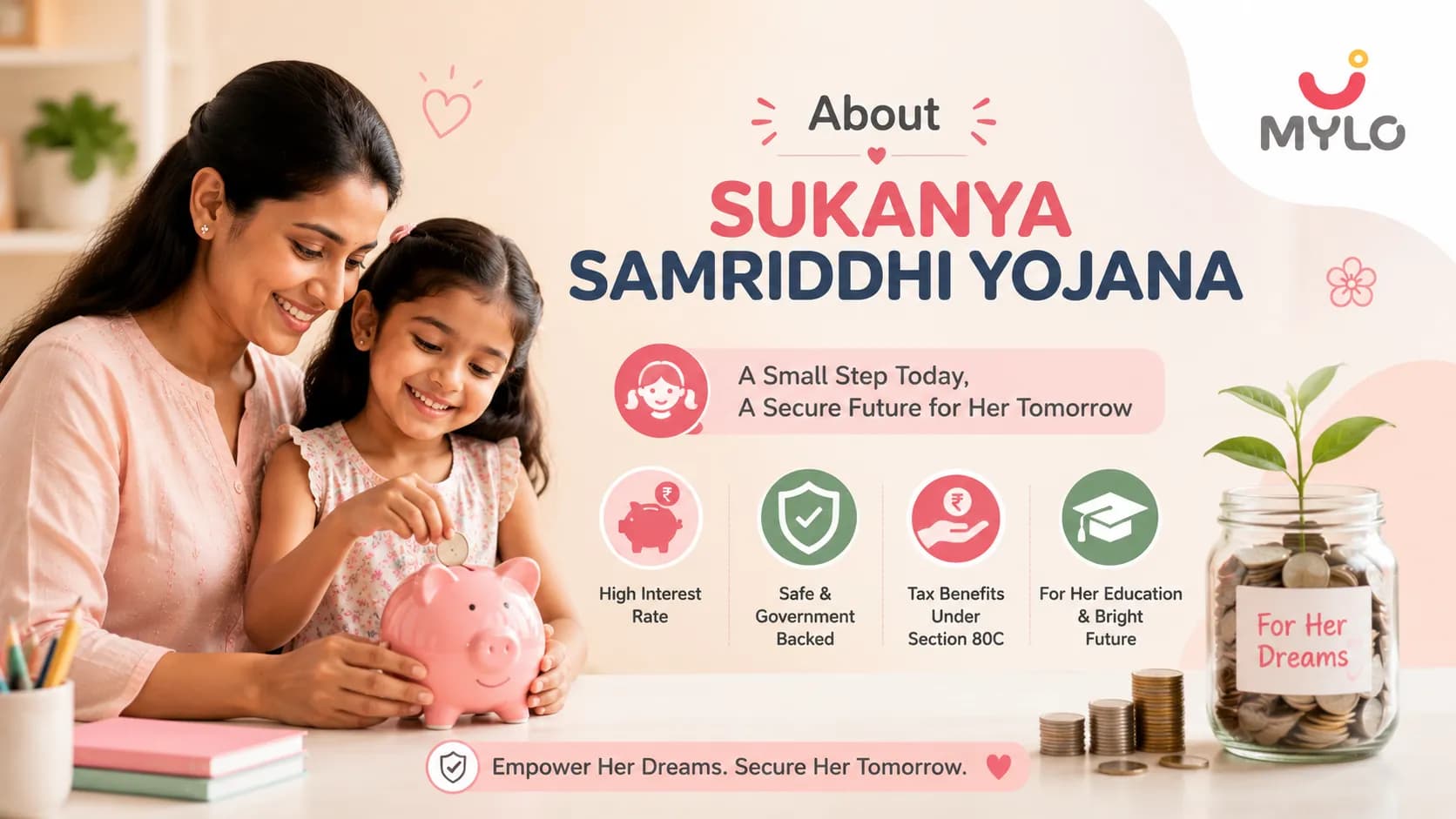
- Sukanya Samriddhi Yojana (SSY) is a government-backed savings scheme for girl children below 10 years, launched under Beti Bachao Beti Padhao to secure their future.
- Parents can deposit between ₹250 and ₹1.5 lakh yearly for 15 years, with the account maturing 21 years after opening at 8.2% annual interest.
- SSY offers full EEE tax benefits under Section 80C, allows 50% withdrawal after age 18 for higher education, and closure for marriage.
- Looking for wholesome nutrition during your pregnancy journey? Explore our MamaGro™ Protein Diskettes - High Protein & No Added Sugar - 250gm (50 Diskettes).

 4.8
4.8Quick Answer
SSY is a safe, long-term, government-guaranteed savings scheme for girls under 10. You deposit for 15 years, the money keeps earning interest until year 21, and then you get a large, fully tax-free lump sum. The current rate is 8.2% (revised every quarter by the Ministry of Finance), the minimum yearly deposit is just ₹250, and the maximum is ₹1.5 lakh. It is ideal if you want a low-risk, disciplined way to save for your daughter's college fees or wedding, and it gives you a Section 80C tax deduction along the way.
Author: Mylo Editorial Team, Mylo Money and Parenting Desk
Reviewed by: Mylo Editorial Board, aligned with India Post and National Savings Institute (Ministry of Finance) guidance
Last updated: 30 July 2026
Disclaimer: This article is for general information only and is not financial advice. SSY interest rates are revised every quarter by the Government of India, so returns will vary over the life of the account. The maturity figures shown here are illustrative, assuming the current rate stays constant. Please confirm the latest rules and rates at your nearest post office or authorised bank before investing.
Key Takeaways
- SSY is a government-backed savings scheme for a girl child, launched under Beti Bachao Beti Padhao.
- The account can be opened from birth until the girl turns 10.
- Minimum deposit is ₹250 a year; the maximum is ₹1.5 lakh a year.
- You deposit for 15 years, and the account matures 21 years after opening.
- Current interest is 8.2% per year, compounded annually (July to September 2026 quarter).
- It has full EEE tax status: deposit, interest and maturity are all tax-free (Section 80C).
- It helps you save for a girl's higher education and marriage, with a 50% early withdrawal allowed after she turns 18.
About SSY
Sukanya Samriddhi Yojana, sometimes called the Girl Child Prosperity Account, is a small savings scheme of the Government of India aimed at parents of girl children. It was launched in January 2015 as part of the Beti Bachao Beti Padhao campaign, with the goal of encouraging families to save early for a daughter's future (India Post). Here is what it offers at a glance:
- Government-backed savings scheme for girl children.
- Account can be opened from birth until 10 years of age.
- Minimum yearly deposit of ₹250.
- Deposits continue for 15 years.
- Matures 21 years after the account is opened.
- Helps you save for higher education and marriage.
- Eligible for tax benefits under Section 80C.
SSY Scheme Snapshot
| Feature | Details |
|---|---|
| Who it is for | A resident Indian girl child below 10 years of age |
| Interest rate | 8.2% per year, compounded annually (July to September 2026; revised quarterly) |
| Minimum deposit | ₹250 per financial year |
| Maximum deposit | ₹1,50,000 per financial year |
| Deposit period | 15 years from the date of opening |
| Maturity | 21 years from the date of opening |
| Accounts per family | Up to 2 girls (3 in case of twins or triplets) |
| Tax status | EEE: deposit, interest and maturity all tax-free (Section 80C) |
| Where to open | Any India Post office or authorised bank |
SSY Returns: How Much You Invest and What You Get
This is the part most parents want to see. The tables below show roughly how your deposits could grow, assuming the current 8.2% rate stays constant for the full term, with deposits made for 15 years and the balance left to grow until maturity at 21 years. Actual returns will differ as the rate is revised each quarter.
Here is a quick view by monthly deposit:
| Monthly deposit | Total deposited (15 years) | Approx. maturity amount (21 years) |
|---|---|---|
| ₹1,000 | ₹1.8 lakh | ~₹5.5 lakh |
| ₹2,000 | ₹3.6 lakh | ~₹11 lakh |
| ₹5,000 | ₹9 lakh | ~₹28 lakh |
| ₹10,000 | ₹18 lakh | ~₹56 lakh |
For a fuller breakdown, including the minimum and maximum deposits, see the detailed table below:
| If you deposit | Per year | Total invested in 15 years | Approx. value at maturity (21 years, at 8.2%) |
|---|---|---|---|
| ₹250 per year (minimum) | ₹250 | ₹3,750 | ~₹11,550 |
| ₹1,000 per month | ₹12,000 | ₹1,80,000 | ~₹5,54,206 |
| ₹2,000 per month | ₹24,000 | ₹3,60,000 | ~₹11,08,412 |
| ₹5,000 per month | ₹60,000 | ₹9,00,000 | ~₹27,71,031 |
| ₹10,000 per month | ₹1,20,000 | ₹18,00,000 | ~₹55,42,062 |
| ₹12,500 per month (maximum) | ₹1,50,000 | ₹22,50,000 | ~₹69,27,578 |
The reason the maturity amount is so much larger than the total invested is compounding: your deposits keep earning interest for 15 years, and then the whole balance keeps growing for another 6 years even after you stop depositing, right up to the 21-year maturity.
Who Can Open an SSY Account (Eligibility)
- The account is for a girl child who is a resident of India from the time the account is opened until it matures or closes.
- It can be opened by a parent or legal guardian any time from the girl's birth until she turns 10.
- Only one account is allowed per girl child.
- A family can open a maximum of two accounts (one for each of two girls). A third account is allowed only if a birth results in twins or triplets (NSI).
Deposits, Tenure and Maturity
- Minimum and maximum: You must deposit at least ₹250 in a financial year, and you can deposit up to ₹1.5 lakh in a year. Deposits can be made as a lump sum or in instalments.
- Deposit period: Deposits are made for 15 years from the date of opening.
- Interest until maturity: After the 15-year deposit period, no further deposits are needed, but the balance continues to earn interest until the account matures.
- Maturity: The account matures 21 years from the date it was opened, and the full balance is then paid out (NSI, India Post).
- If you miss the minimum: An account that does not receive the ₹250 minimum in a year is treated as in default, but it can usually be revived by paying the minimum plus a small penalty for each defaulted year.
Tax Benefits
SSY is one of the most tax-friendly options available to Indian families because it has full EEE (Exempt, Exempt, Exempt) status:
- Deposits qualify for a deduction of up to ₹1.5 lakh a year under Section 80C of the Income Tax Act.
- Interest earned each year is fully tax-free.
- The maturity amount is fully tax-free.
This EEE treatment is a key reason SSY is often compared favourably with other small savings and fixed-income options (Income Tax Department).
Withdrawal and Premature Closure Rules
- Partial withdrawal: Once the girl turns 18, up to 50% of the balance at the end of the previous financial year can be withdrawn, meant for her higher education.
- Closure for marriage: The account can be closed before the 21-year maturity for the girl's marriage, allowed only after she turns 18, and within one month before to three months after the marriage.
- Other premature closure: Early closure may be permitted in specific situations such as the account holder's death, or on compassionate grounds like a life-threatening illness, subject to conditions.
- At maturity: The full balance, including interest, is paid to the girl on maturity (NSI).
How to Open a Sukanya Samriddhi Account
- Visit any India Post office or a branch of an authorised bank.
- Fill in the SSY account opening form.
- Submit the girl child's birth certificate.
- Submit the parent or guardian's identity and address proof (such as Aadhaar and PAN).
- Make the opening deposit (anything from ₹250 up to ₹1.5 lakh in the financial year).
You will receive a passbook for the account, which you use to track deposits and interest.
Myths vs Facts
| Myth | Fact |
|---|---|
| The interest rate is fixed for the whole 21 years | The rate is reviewed and revised every quarter by the government, so it can change over the term. |
| You have to deposit for all 21 years | You deposit only for 15 years; the balance then keeps earning interest until maturity. |
| You can open an account for a girl of any age | The account can only be opened before the girl turns 10. |
| The maturity amount is taxed | SSY is fully EEE, so the deposit, interest and maturity are all tax-free. |
| You can open unlimited accounts for your daughters | A family can open up to two accounts, or three only in the case of twins or triplets. |
Related Reads
If you are exploring government schemes that support mothers and children, these guides pair well with this one:
- Pradhan Mantri Matru Vandana Yojana (PMMVY): Benefits, Eligibility and How to Apply
- What Benefits Would Pregnant Women Receive from Government Schemes
- Janani Suraksha Yojana (JSY): Benefits, Eligibility, Amount and How to Apply
Frequently Asked Questions
What is the current interest rate on Sukanya Samriddhi Yojana?
It is 8.2% per year, compounded annually, for the July to September 2026 quarter. The government reviews and notifies the rate every quarter, so it can change over time.
What is the minimum and maximum I can deposit in SSY?
The minimum is ₹250 in a financial year and the maximum is ₹1.5 lakh in a financial year. You can deposit as a lump sum or in instalments.
Until what age can I open an SSY account for my daughter?
You can open the account any time from her birth until she turns 10 years old.
How long do I need to deposit, and when does the account mature?
You deposit for 15 years from the date of opening. The account matures 21 years from the date of opening, and the balance keeps earning interest in between.
How much will I get at maturity?
It depends on your deposit and the interest rate over time. At the current 8.2% rate, a maximum deposit of ₹1.5 lakh a year can grow to roughly ₹69.27 lakh, while ₹1,000 a month can grow to about ₹5.54 lakh. These figures are illustrative because the rate is revised quarterly.
Is the SSY maturity amount taxable?
No. SSY has full EEE status, so your deposits get a Section 80C deduction, and the interest and the maturity amount are both tax-free.
Can I withdraw money before maturity?
Yes, up to 50% of the previous year's balance can be withdrawn after the girl turns 18, mainly for higher education. The account can also be closed for her marriage after she turns 18.
How many SSY accounts can a family open?
Up to two accounts, one for each of two girls. A third account is allowed only if a birth results in twins or triplets.
Where can I open a Sukanya Samriddhi account?
At any India Post office or an authorised bank branch, with the girl's birth certificate and the guardian's ID and address proof.
What happens if I miss a year's deposit?
The account is treated as in default, but you can usually revive it by paying the ₹250 minimum plus a small penalty for each missed year.
References
- National Savings Institute (NSI), Ministry of Finance. Sukanya Samriddhi Account Scheme. nsiindia.gov.in
- India Post, Department of Posts. Sukanya Samriddhi Account. indiapost.gov.in
- Ministry of Finance, Department of Economic Affairs. Small Savings Schemes interest rates (revised quarterly). dea.gov.in
- Income Tax Department, Government of India. Deductions under Section 80C. incometax.gov.in
Trusted By Mamas Planning Their Little Girl's Future
While you secure her tomorrow financially, nourish yourself today with wholesome essentials made for every stage of motherhood.



Article Posted Under
Related Articles




Medical Disclaimer
This content is for informational purposes only and should not replace professional medical advice. Consult with a physician or other health care professional if you have any concerns or questions about your health. If you rely on the information provided here, you do so solely at your own risk.


AWARDS AND RECOGNITION

Mylo wins Forbes D2C Disruptor award

Mylo wins The Economic Times Promising Brands 2022
AS SEEN IN












- Mylo Care: Effective and science-backed personal care and wellness solutions for a joyful you.
- Mylo Baby: Science-backed, gentle and effective personal care & hygiene range for your little one.
- Mylo Community: Trusted and empathetic community of 10mn+ parents and experts.


Product Categories
Baby Carrier | Baby Soap | Baby Wipes | Stretch Marks Cream | Baby Cream | Baby Shampoo | Baby Massage Oil | Baby Hair Oil | Stretch Marks Oil | Baby Body Wash | Baby Powder | Baby Lotion | Diaper Rash Cream | Newborn Diapers | Teether | Baby Kajal | Baby Diapers Pants | Cloth Diapers | Laundry Detergent | Lactation Granules |