


Orders
.png&w=48&q=75 "login")
Profile


Wallet

Pre-Writing and Fine-Motor Skills in Children: A Complete Guide for Indian Parents (2026 Complete Guide)
 13 min

BDS (Gold Medalist), Certified Lactation Consultant – BPNI Delhi, Maternal & Infant Nutrition Expert · 15 years experience
TL;DR
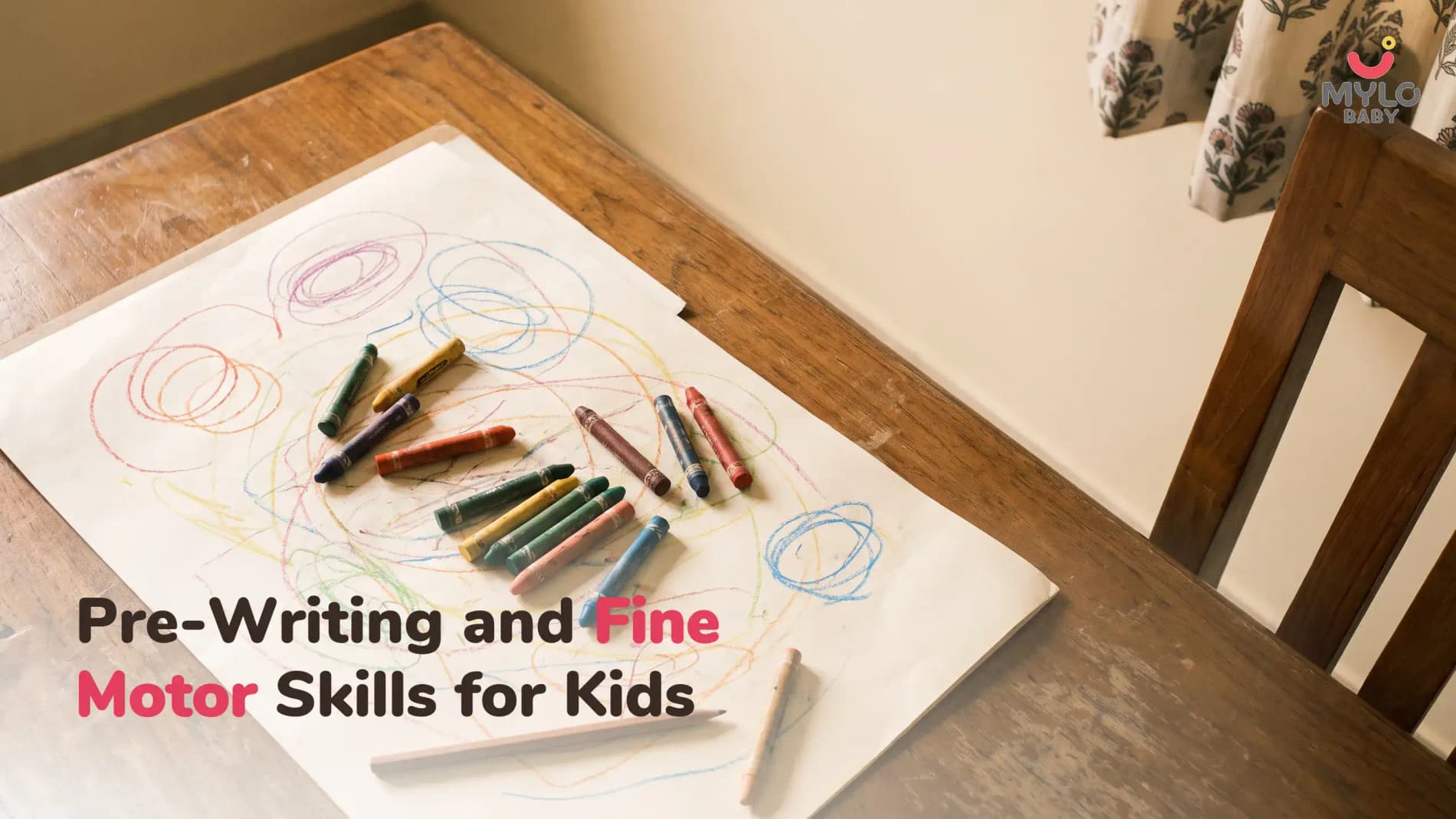
Pre-writing and fine-motor skills are the hand and finger abilities a child needs before they can write, built mainly through play, not early formal writing (AAP, AOTA). Fine-motor skills are the small movements of the hands, while pre-writing skills include hand strength, coordination and drawing basic shapes like lines and circles. Children develop these in a natural order, and a mature pencil grasp usually appears only around ages 4 to 6. The best preparation is playdough, threading, building, scribbling, cutting and self-care, rather than pushing your child to write letters too soon. Build the foundation through play, support left-handers, and see an occupational therapist if your child struggles significantly or avoids these tasks.
Quick Answer
Pre-writing and fine-motor skills are the hand abilities children need before writing, built through play. They include hand strength, coordination and drawing shapes like lines and circles. A mature pencil grasp usually appears around ages 4 to 6. Build them with playdough, threading, building and scribbling, not early letter writing.
Author: Mylo Editorial Team, Mylo Parenting Desk Medically reviewed by: Mylo Editorial Board, aligned with AAP, AOTA, NEP 2020 and IAP guidance Last updated: 23 June 2026
Medical Disclaimer: This article is for informational purposes only and is not a substitute for professional advice. Children develop fine-motor and pre-writing skills at different rates. If your child struggles significantly, avoids these activities, or is not meeting milestones, speak to your pediatrician or an occupational therapist.
Key Takeaways
Pre-writing and fine-motor skills are the hand abilities a child needs before writing (AOTA)
They are built mainly through play, not early formal writing
Fine-motor skills are the small movements of the hands and fingers
Pre-writing skills include hand strength, coordination and drawing basic shapes
Children draw shapes in a natural order, from lines to circles to more complex shapes
A mature pencil grasp usually appears only around ages 4 to 6
Playdough, threading, building, scribbling and self-care build these skills best
See an occupational therapist if your child struggles significantly or avoids these tasks
What Are Pre-Writing and Fine-Motor Skills?
Fine-motor skills are the small, precise movements of the hands and fingers, used for everything from picking up a pea to doing up a button (AOTA, CDC). Pre-writing skills are the foundations a child needs before they can write, including hand strength, hand-eye coordination, and the ability to draw basic strokes and shapes like lines and circles. Together, these skills prepare the hand for the complex job of writing, which is why building them through play matters far more than pushing a pencil early.
Featured answer: Pre-writing and fine-motor skills are the hand and finger abilities children need before they can write, developed mainly through play. Fine-motor skills are small hand movements, while pre-writing skills include hand strength, coordination and drawing shapes like lines and circles. A mature pencil grasp usually appears around ages 4 to 6, so the best preparation is play like playdough, threading and building, not early letter writing.
What Are the Fine-Motor Milestones by Age?
Fine-motor skills grow step by step. The table below is a general guide, and children vary (CDC, AAP).
Age | Fine-motor skills |
|---|---|
12 to 18 months | Pincer grasp, scribbles, stacks 2 blocks |
18 to 24 months | Stacks 3 to 4 blocks, holds a crayon, turns pages |
2 to 3 years | Imitates lines and a circle, strings large beads, snips with scissors |
3 to 4 years | Draws a circle and a cross, cuts along a line, builds towers |
4 to 5 years | Draws shapes and a simple person, uses a tripod grasp, cuts shapes |
5 to 6 years | Writes some letters and their name, with a mature pencil grasp |
In What Order Do Pre-Writing Shapes Develop?
Children master the basic strokes and shapes of writing in a predictable order, and these shapes are the building blocks of letters (AOTA).
Shape | Usually by age |
|---|---|
Vertical line | About 2 years |
Horizontal line | About 2.5 years |
Circle | About 3 years |
Cross (+) | About 3.5 to 4 years |
Square | About 4 to 4.5 years |
Diagonal lines and X | About 4.5 to 5 years |
Triangle | About 5 years |
A child who cannot yet copy a triangle is simply not ready for that stage, and that is perfectly normal.
How Does Pencil Grasp Develop?
A mature, comfortable pencil grasp develops gradually as the hand grows stronger. There is no need to force a "correct" grip too early (AOTA, NHS).
Grasp | Typical age |
|---|---|
Fisted (palmar) grasp | About 1 to 1.5 years |
Digital pronate grasp | About 2 to 3 years |
Static tripod grasp | About 3.5 to 4 years |
Dynamic tripod (mature) grasp | About 4.5 to 6 years |
The mature dynamic tripod, holding the pencil with the thumb and first two fingers, usually appears only by ages 4 to 6, once hand strength is ready.
How Can You Build These Skills Through Play?
The best preparation for writing is hands-on play that strengthens the fingers and builds coordination, not worksheets (AAP, NAEYC).
✏️ Play Activities to Build Fine-Motor and Pre-Writing Skills
These fun, everyday activities do more than any early writing drill:
Playdough or atta: Rolling, pinching and squeezing build hand strength
Threading and lacing: Stringing beads or pasta builds precision
Building blocks and puzzles: Strengthen grip and coordination
Scribbling and colouring: Crayons and chalk prepare the hand for writing
Tearing and crumpling paper: Simple, great for little fingers
Tongs and tweezers: Picking up small objects builds a pincer grip
Cutting with safety scissors: Builds hand strength and control
Self-care: Buttons, zips and pouring all count as great practice
Drawing on a wall or easel: Vertical surfaces strengthen the wrist and shoulder
Keep it playful and pressure-free. Strong, coordinated hands make writing far easier when your child is truly ready.
Why Should You Not Rush Formal Writing?
Pushing a child to write letters before their hands are ready can cause frustration, an awkward grip and a dislike of writing (NAEYC, NEP 2020). Writing is a complex skill that depends on strength, coordination and posture that develop over years. It also helps to build the bigger muscles first, since core, shoulder and arm stability support steady hand movements, which is why climbing, crawling and active play matter too. Let the pre-writing foundation form through play, and formal writing will come more easily and happily.
When Should You See a Doctor or Occupational Therapist?
Most children build these skills naturally with play and time. But speak to your pediatrician or an occupational therapist if your child (AOTA, CDC):
Has a very weak grasp or drops things often
Strongly avoids drawing, building or other fine-motor play
Cannot hold a crayon or make marks by the expected age
Is well behind the milestones for their age
Seems very clumsy or has poor hand-eye coordination
Gets unusually frustrated with fine-motor tasks
Loses skills they once had
Early support from an occupational therapist can make a big difference.
What Do These Activities Cost in India?
Building fine-motor skills costs almost nothing, since everyday household items work beautifully.
Item | Typical cost (₹) | Note |
|---|---|---|
Household play (atta dough, dal, containers) | Free | Excellent for hand strength |
Crayons and paper | ₹50 to ₹300 | For scribbling and drawing |
Beads, blocks or puzzles | ₹100 to ₹1,000 | Build grip and coordination |
Safety scissors | ₹50 to ₹200 | For supervised cutting practice |
Occupational therapy (if advised) | ₹500 to ₹2,000 a session | Only if recommended |
Indian Context: What Indian Parents Should Know
Avoid early writing pressure: Many schools and families push letter writing too soon, but NEP 2020 supports play-based, age-appropriate learning, and forcing early writing can harm grip and confidence (NEP 2020)
Use low-cost materials: Atta or playdough, dal and rice for scooping, clothes pegs, old containers and newspaper make wonderful fine-motor toys
Do not force right-handedness: If your child is left-handed, support it; forcing the right hand is unnecessary and can cause difficulty (AOTA)
Let them play before they print: Strong hands from play make writing easier later, so resist replacing play with worksheets
Use Anganwadi and play groups: These offer early stimulation and play-based activities (NHM)
Be patient and encouraging: Praise effort and creativity, not neat letters, especially in the early years
Emergency number: Dial 108 for ambulance services across most states
Myths vs Facts About Pre-Writing Skills
Myth | Fact | Source |
|---|---|---|
"Children should write letters by age 3" | Pre-writing shapes and hand strength come first; writing comes later | NAEYC |
"Worksheets are the best way to prepare for writing" | Play like playdough and threading builds skills better | AOTA |
"Forcing a correct pencil grip early helps" | A mature grasp develops naturally by ages 4 to 6 | AOTA |
"Left-handed children should be switched to the right" | Forcing handedness is unnecessary and can cause difficulty | AOTA |
"Messy scribbling is a waste of time" | Scribbling is essential practice for writing | AAP |
FAQs: Pre-Writing and Fine-Motor Skills
What are pre-writing skills? Pre-writing skills are the foundations a child needs before writing, including hand strength, coordination and the ability to draw basic shapes like lines and circles (AOTA). They are built through play, not early letter writing.
Pre-writing skills kya hote hain? (Hinglish) Pre-writing skills woh buniyadi kshamtaayein hain jo bachche ko likhne se pehle chahiye, jaise haath ki taakat, coordination, aur lines aur circle jaise shapes banana. Ye skills khel ke through banti hain, na ki jaldi letters likhwane se. Strong haath baad mein likhne ko aasan banate hain.
At what age should my child hold a pencil correctly? A mature tripod pencil grasp usually develops by ages 4 to 6, once the hand is strong enough (AOTA). There is no need to force a correct grip early; it develops naturally with play and practice.
Bachche ko pencil sahi se pakadna kab aata hai? (Hinglish) Mature tripod grasp (angootha aur do ungliyon se pencil pakadna) aksar 4 se 6 saal ki umar mein aata hai, jab haath kaafi mazboot ho jata hai. Isse jaldi force karne ki zaroorat nahi. Playdough, beads aur scribbling jaise khel haath ko taiyaar karte hain.
Should I make my toddler practise writing letters? No, not in the toddler years (NAEYC). Toddlers should build hand strength and coordination through play. Pushing early writing can cause frustration and an awkward grip. Formal writing comes when your child is ready, usually around ages 5 to 6.
What activities improve fine-motor skills? Playdough, threading beads, building blocks, puzzles, scribbling, cutting with safety scissors, and using tongs all build fine-motor skills (AAP). Self-care like buttoning and pouring helps too. These everyday activities prepare the hand for writing.
My child is left-handed. Should I change this? No. Forcing a left-handed child to use their right hand is unnecessary and can cause difficulty (AOTA). Support your child's natural handedness and provide left-friendly tools where helpful.
When should I worry about my child's fine-motor skills? See a doctor or occupational therapist if your child has a very weak grasp, strongly avoids fine-motor play, cannot hold a crayon by the expected age, is very clumsy, or is well behind milestones (CDC). Early support helps a lot.
References
American Academy of Pediatrics (AAP). "Healthy Children: Fine Motor and Development." https://www.healthychildren.org
American Occupational Therapy Association (AOTA). "Fine Motor and Handwriting Readiness." https://www.aota.org
Centers for Disease Control and Prevention (CDC). "Developmental Milestones." https://www.cdc.gov
National Association for the Education of Young Children (NAEYC). "Play-Based Early Learning." https://www.naeyc.org
Ministry of Education, Government of India. "National Education Policy (NEP) 2020." https://www.education.gov.in
NHS UK. "Help with Your Child's Development." https://www.nhs.uk
Indian Academy of Pediatrics (IAP). "Child Development Guidance." https://www.iapindia.org
Article Posted Under


Medical Disclaimer
This content is for informational purposes only and should not replace professional medical advice. Consult with a physician or other health care professional if you have any concerns or questions about your health. If you rely on the information provided here, you do so solely at your own risk.


AWARDS AND RECOGNITION

Mylo wins Forbes D2C Disruptor award

Mylo wins The Economic Times Promising Brands 2022
AS SEEN IN













- Mylo Care: Effective and science-backed personal care and wellness solutions for a joyful you.
- Mylo Baby: Science-backed, gentle and effective personal care & hygiene range for your little one.
- Mylo Community: Trusted and empathetic community of 10mn+ parents and experts.


Product Categories
Baby Carrier | Baby Soap | Baby Wipes | Stretch Marks Cream | Baby Cream | Baby Shampoo | Baby Massage Oil | Baby Hair Oil | Stretch Marks Oil | Baby Body Wash | Baby Powder | Baby Lotion | Diaper Rash Cream | Newborn Diapers | Teether | Baby Kajal | Baby Diapers Pants | Cloth Diapers | Laundry Detergent | Lactation Granules |