


Orders
.png&w=48&q=75 "login")
Profile


Wallet

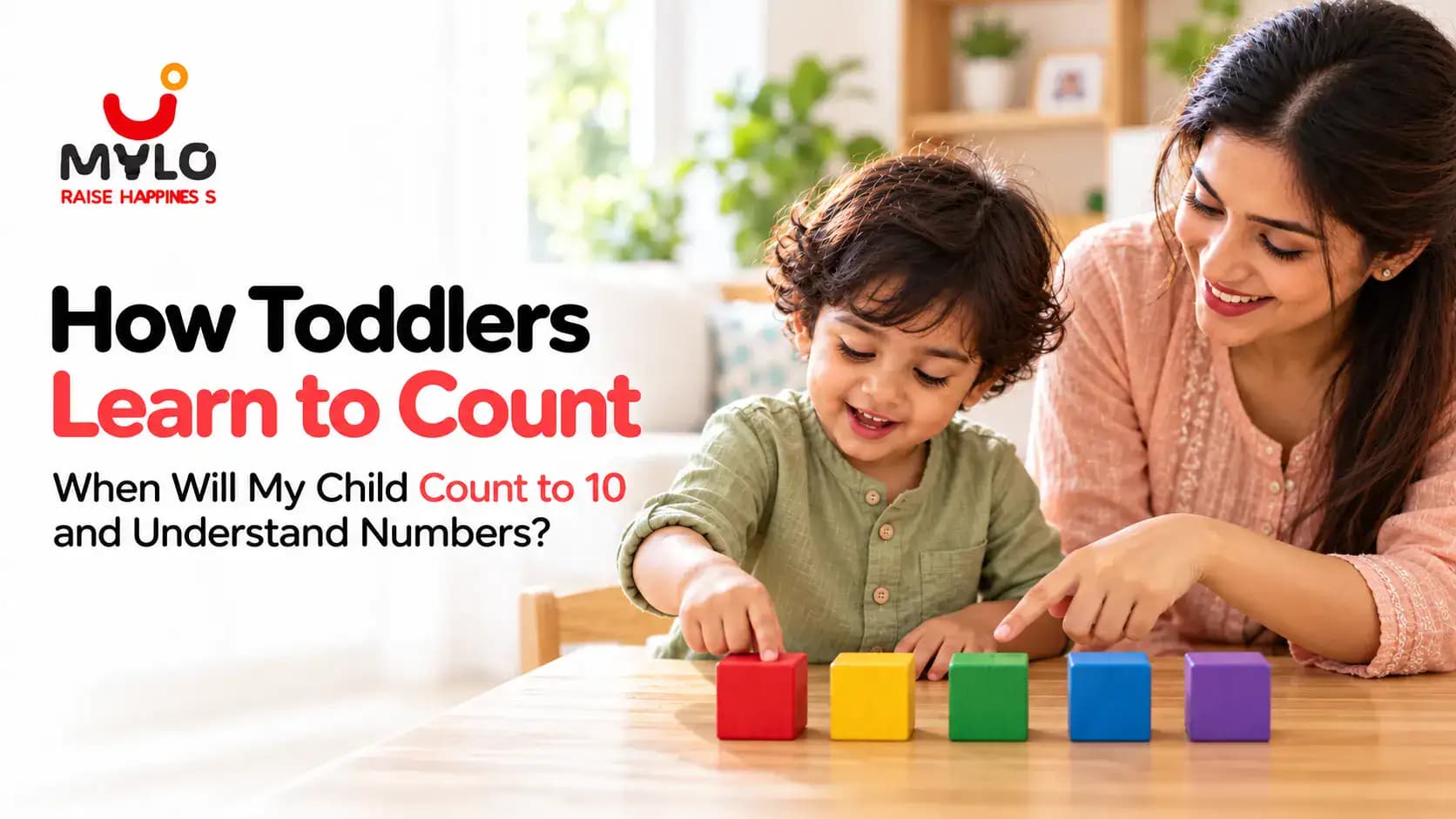
How Toddlers Learn to Count: When Will My Child Count to 10 and Understand Numbers? An Age-by-Age Guide for Indian Parents (2026)
 18 min
Quick Answer
Toddlers learn to count in steps. First they say number words like a song (around 2 years), then they point to one object for each number (around 3), and then they understand that the last number tells "how many" (around 3.5 to 4). By 5, most children count to 10 and name numbers 1 to 5.
Counting Milestones at a Glance
Age | What Your Child Can Usually Do | Talk to a Doctor If |
|---|---|---|
12 to 18 months | Understands "more" and "all gone", notices when a toy is missing | Doesn't understand simple words like "more" |
18 months to 2 years | Says a few number words, may hold up a finger for "one" | Says very few words of any kind |
2 to 2.5 years | "Counts" 1, 2, 3 like a rhyme (often skipping numbers), understands "one" vs "many" | Doesn't use any number words by 2.5 years |
3 years | Says numbers up to 5 or 10 in order, counts 3 to 5 objects by pointing at each, knows 1, 2 and 3 at a glance | Can't count 2 or 3 objects |
3.5 to 4 years | Knows the last number counted means "how many", compares "more" and "less" for small groups | Can't count 3 objects correctly by 4 |
4 to 5 years | Counts 10 or more objects, recognises some written numbers, counts out a number of things when asked ("give me 4 laddoos") | Can't count 5 objects or say numbers to 10 by 5 |
5 years | Counts to 10 and often to 20, names numbers 1 to 5 when you point (CDC), understands "one more" | Can't name any written numbers, or loses skills |
Ages are typical ranges. Children learn counting at different speeds, and talking about numbers at home makes a big difference.
Key Facts Every Parent Should Know
Babies notice amounts: Even young babies can tell the difference between 1, 2 and 3 objects, long before they know number words
Around 2 years: Many toddlers say number words but don't yet know what they mean
3.5 to 4 years: Most children understand that the last number they count tells "how many"
By 5 years: Most children count to 10 and name some numbers between 1 and 5 when you point to them (CDC)
Number talk helps: Children whose parents talk about numbers in daily life tend to understand counting earlier (research)
Language matters: Counting is built on words, so speech and language delays can also slow down counting
What Does "Learning to Count" Really Mean?
Short answer: Real counting is more than saying "1, 2, 3, 4, 5". Children need to learn the number words in order, match one number to each object, and understand that the last number tells how many there are. These skills develop between about 2 and 5 years.
There are two kinds of counting:
Type | What It Means | Example | Typical Age |
|---|---|---|---|
Rote counting | Saying numbers in order from memory, like a song | "Ek, do, teen, char..." | 2 to 3 years |
Meaningful counting | Counting real objects and knowing how many there are | Counts 4 bananas and says "4 bananas!" | 3.5 to 5 years |
A 3-year-old who can say "1 to 10" may still not be able to give you exactly 3 spoons. That's normal. Rote counting comes first, and meaningful counting catches up later.
The 5 Steps of Counting (and When Children Learn Them)
Short answer: Researchers describe 5 basic counting principles. Children learn them gradually, mostly between 2 and 5 years.
Counting Principle | What It Means | What You'll See | Typical Age |
|---|---|---|---|
1. Stable order | Number words always go in the same order | Says "1, 2, 3" the same way every time | 2 to 3 years |
2. One-to-one | Each object gets exactly one number | Touches each block once while counting | 3 to 3.5 years |
3. Cardinality ("how many") | The last number said tells how many there are | Counts 5 cars and says "5 cars" without counting again | 3.5 to 4 years |
4. Anything can be counted | You can count toys, claps, jumps or sounds | Counts claps or steps, not just toys | 4 to 5 years |
5. Order doesn't matter | You get the same answer whichever object you start with | Counts from left or right and gets the same number | 4 to 5 years |
Seeing small numbers at a glance
Before they can count, toddlers learn to recognise very small amounts (1, 2 and sometimes 3) just by looking. This is called subitising. You can practise it by showing 1, 2 or 3 fingers and asking "How many?" Dice and dominoes help older children see bigger groups like 4, 5 and 6 at a glance.
Counting Milestones by Age
12 to 24 months: Early number sense
Short answer: Toddlers don't count yet, but they're learning the ideas behind numbers, like "more", "all gone" and "one".
What you'll see:
Asking for "more" with a word or sign
Noticing when one of their toys is missing
Understanding "one" (holding up one finger, taking one biscuit)
Enjoying counting rhymes and songs
2 to 3 years: Number words and rote counting
Short answer: Toddlers start saying number words, usually like a rhyme. They may count "1, 2, 5, 9!" while pointing at objects. That's a normal first step.
What you'll see:
"Counting" to 3, 5 or 10, often skipping numbers
Using "two" for anything more than one
Pointing at objects while saying numbers, but not one number per object
Knowing 1 and 2 at a glance
3 to 4 years: Real counting begins
Short answer: Children learn to point to each object once and say one number for each. Around 3.5 to 4 years, they understand that the last number they say tells "how many".
What you'll see:
Counting 5 to 10 objects by touching each one
Answering "How many?" with the last number counted
Saying which group has "more" when the difference is easy to see
Counting in their mother tongue and in English, which is completely fine
4 to 5 years: Using numbers
Short answer: Children count bigger groups, recognise written numbers and start using counting to solve simple problems, like "If you have 3 laddoos and get 1 more, how many?"
What you'll see:
Counting to 20 or more
Counting out a set number of objects ("Give me 5 spoons")
Recognising some written numbers, usually 1 to 10
Understanding "one more" and "one less"
Starting to write some numbers (usually after they can copy lines and circles)
How Can I Help My Toddler Learn to Count?
Short answer: Count during everyday routines, like climbing stairs, serving rotis and buttoning a shirt. Short, playful moments every day work better than worksheets or flashcards.
Age | Everyday Counting Ideas | Household Items to Use |
|---|---|---|
12 months to 2 years | Count steps as you climb, say "one, two" while putting on socks, sing counting rhymes | Socks, stairs, a toy box |
2 to 3 years | Count fingers and toes, count rotis on the plate, count cars on the road | Rotis, toy cars, building blocks |
3 to 4 years | Count fruits while shopping, set the table ("one spoon for each person"), count jumps or claps | Fruits, steel spoons and plates, a ball |
4 to 5 years | Play dice games, count money while playing shop (with play money), count out snacks | Dice, play money, buttons (supervised), a calendar |
Fun Indian-style counting games
Saanp-seedhi and Ludo: Rolling a dice and moving the right number of steps is excellent counting practice for 4 to 5 year olds
Stapu (hopscotch): Draw numbers in chalk boxes and hop while saying each number
Sabzi mandi counting: Ask your child to count tomatoes or bananas into the bag
Roti and laddoo counting: "How many rotis are on papa's plate? Let's count!"
Counting rhymes: Hindi and English counting rhymes help children learn number words in order
Diwali diyas: Count diyas as you light them, and count rangoli dots
Festival and birthday countdowns: "3 more days to your birthday!" with a simple calendar
Tips that make counting stick
Touch and count: Help your child touch or move each object as they count
Ask "How many?": After counting, ask "So how many are there?" to build the "how many" idea
Use small numbers first: Start with 1 to 3, then 5, then 10
Talk about numbers all day: "You have 2 shoes", "We need 3 tomatoes", "Your bus is number 5"
Count in any language: Counting in Hindi, Tamil, Bengali or any home language builds the same skills
Praise effort: "You counted so carefully!" works better than correcting every mistake
What Helps and What Hurts Counting Skills?
Short answer: Everyday number talk, hands-on play and board games help. Pressure, too many worksheets and lots of screen time don't.
Helps | Hurts or Slows It Down |
|---|---|
Counting real objects during daily routines | Only memorising "1 to 100" without objects |
Board games with dice | Long worksheet sessions for toddlers |
Asking "How many?" after counting | Correcting every mistake harshly |
Talking with your child often (builds language) | Lots of screen time, which means less talk and play |
Building blocks, sorting and matching toys | Pressure to write numbers too early |
Cooking and shopping together | Comparing with other children |
Screens and counting apps: Some apps can be fun, but they don't replace counting real objects with a parent. The WHO advises no screen time for children under 2, and no more than 1 hour a day for 2 to 4 year olds.
When Should I Worry About My Child's Counting?
Short answer: Children learn counting at different speeds, so a slow start is usually not a problem. Talk to your doctor if your child doesn't use any number words by 3, can't count 3 objects by 4, can't count 5 objects or say numbers to 10 by 5, or has other delays in speech, learning or attention.
Age | Red Flag |
|---|---|
Any age | Loses skills they once had (see a doctor right away) |
2.5 to 3 years | Doesn't use any number words, or very few words overall |
4 years | Can't count 3 objects correctly, doesn't understand "more" and "less" |
5 years | Can't count 5 objects, can't say numbers to 10, doesn't recognise any written numbers |
5 years and older | Finds numbers much harder than other learning, gets very upset with number tasks |
Remember: Counting depends on language, hearing and attention. If your child has a speech delay or hearing concern, getting help for those often improves counting too. Number learning difficulties (like dyscalculia) are usually only diagnosed after a child starts school.
Who Can Help?
Professional | How They Help |
|---|---|
Pediatrician | First check-up, checks hearing, speech and overall development |
Developmental pediatrician | Assesses development if there are several concerns |
Speech and language therapist | Helps if language delays are affecting counting and number words |
Child psychologist or special educator | Assesses and supports learning difficulties at school age |
Preschool or Anganwadi teacher | Notices patterns in group learning and play |
Free government support in India
Service | What It Offers |
|---|---|
Rashtriya Bal Swasthya Karyakram (RBSK) | Free screening for developmental delays |
District Early Intervention Centres (DEIC) | Free assessment, speech therapy and early intervention |
Anganwadi centres | Pre-school education with play-based number and counting activities |
What Should Indian Parents Keep in Mind?
Short answer: Focus on counting real things in daily life, not on memorising 1 to 100 or writing numbers early. Every child learns at their own pace.
Common Practice | Better Approach |
|---|---|
Making a 3-year-old recite 1 to 100 | Count real objects to 5 or 10 and ask "How many?" |
Writing 1 to 50 for nursery admission | Counting with objects first; writing numbers comes around 4 to 5 years |
Abacus or maths classes at age 3 | Play-based counting at home is enough for under-5s |
Teaching only in English | Count in your home language too; it builds the same skills |
Comparing with cousins who "know 1 to 100" | Understanding "how many" matters more than reciting |
Flashcards and worksheets every day | Board games, cooking, shopping and play |
"You're wrong, it's 4!" | "Let's count again together" |
Myths vs Facts About Toddlers and Counting
Myth | Fact |
|---|---|
"If my child can say 1 to 20, they can count" | Saying numbers in order isn't the same as counting objects and knowing how many |
"Children should learn to count in English only" | Counting in any language builds the same skills |
"Early abacus classes make children smarter" | There's no need for formal maths classes before school; play-based counting is enough |
"Worksheets are the best way to teach numbers" | Hands-on counting with real objects works better for young children |
"Some children are just bad at maths" | Number skills grow with practice and everyday number talk |
"Counting apps teach numbers better than parents" | Talking and counting with a parent helps more than apps |
"Toddlers are too young to learn anything about numbers" | Even babies notice small amounts; number talk can start very early |
Frequently Asked Questions About How Toddlers Learn to Count
At what age do toddlers start counting?
Most toddlers start saying number words around 2 years, usually like a rhyme. Real counting of objects usually develops between 3 and 4 years.
When should a child be able to count to 10?
Many children can say numbers to 10 by 3 to 4 years. Counting 10 objects correctly usually comes around 4 to 5 years. By 5, most children count to 10 (CDC).
Bachcha ginti kab seekhta hai? (Hinglish)
Zyada tar bachche 2 saal ke aas-paas ek, do, teen bolna shuru karte hain, jaise koi kavita ho. 3 se 4 saal ke beech woh cheezon ko ek-ek karke ginna seekhte hain, aur 5 saal tak zyada tar bachche 10 tak gin lete hain.
Why does my toddler skip numbers when counting?
It's completely normal. Toddlers learn number words like a song before they understand them. Keep counting together and they'll learn the order.
My child can say 1 to 20 but can't give me 3 spoons. Is that normal?
Yes. Saying numbers (rote counting) comes before understanding "how many". Most children understand this between 3.5 and 4 years.
Mera 3 saal ka bachcha 10 tak nahi gin pata, kya yeh normal hai? (Hinglish)
Haan, yeh normal ho sakta hai. 3 saal ki umar mein bahut se bachche 3 se 5 tak hi sahi tarike se ginte hain. Roz ki cheezein jaise roti, seedhiyan aur khilone saath mein giniye. Agar 4 saal tak bachcha 3 cheezein bhi nahi gin pata, toh doctor se baat karein.
Should I teach counting in English or Hindi?
Either, or both. Counting in your home language builds the same skills, and many children happily learn both.
When do children recognise written numbers?
Most children recognise some written numbers between 4 and 5 years. By 5, most can name some numbers between 1 and 5 when you point to them.
When should my child start writing numbers?
Usually around 4 to 5 years, after they can copy lines and circles. Counting real objects is more important than writing numbers early.
Are counting apps good for toddlers?
They can be an occasional extra for older preschoolers, but they don't replace counting real objects with you. The WHO advises no screen time under 2.
When should I worry about my child's counting?
If your child doesn't use any number words by 3, can't count 3 objects by 4, or can't count 5 objects and say numbers to 10 by 5, speak to your pediatrician.
Related Reads on Mylo
References
Centers for Disease Control and Prevention (CDC). "CDC's Developmental Milestones." https://www.cdc.gov/act-early/milestones/index.html
Michigan State University Extension. "Counting With Infants and Toddlers." https://www.canr.msu.edu/news/counting-with-infants-and-toddlers
World Health Organization (WHO). "Guidelines on Physical Activity, Sedentary Behaviour and Sleep for Children Under 5 Years of Age." https://www.who.int/publications/i/item/9789241550536
Gelman R, Gallistel CR. "The Child's Understanding of Number." Harvard University Press, 1978.
Wynn K. "Children's Understanding of Counting." Cognition, 1990.
Levine SC, Suriyakham LW, Rowe ML, Huttenlocher J, Gunderson EA. "What Counts in the Development of Young Children's Number Knowledge?" Developmental Psychology, 2010.
Medical Disclaimer
This article is for information only and does not replace professional medical advice. Every child develops at their own pace. If you have concerns about your child's counting, language or learning, please consult your pediatrician.

Article Posted Under
Related Articles
How Toddlers Learn to Count: When Will My Child Count to 10 and Understand Numbers? An Age-by-Age Guide for Indian Parents (2026)
 18 min
 What Are the Developmental Red Flags From 1 to 3 Years? An Age-by-Age Checklist for Parents (2026)
17 min Punjabi Baby Boy Names: The Complete Guide With Meanings (ਪੰਜਾਬੀ ਮੁੰਡਿਆਂ ਦੇ ਨਾਮ)
 8 min
8 min Malayalam Baby Names: The Complete Guide With Meanings (മലയാളം കുഞ്ഞുങ്ങളുടെ പേരുകൾ)
 10 min
Related Topics
.webp&w=32&q=75)
Medical Disclaimer
This content is for informational purposes only and should not replace professional medical advice. Consult with a physician or other health care professional if you have any concerns or questions about your health. If you rely on the information provided here, you do so solely at your own risk.


AWARDS AND RECOGNITION

Mylo wins Forbes D2C Disruptor award

Mylo wins The Economic Times Promising Brands 2022
AS SEEN IN













- Mylo Care: Effective and science-backed personal care and wellness solutions for a joyful you.
- Mylo Baby: Science-backed, gentle and effective personal care & hygiene range for your little one.
- Mylo Community: Trusted and empathetic community of 10mn+ parents and experts.


Product Categories
Baby Carrier | Baby Soap | Baby Wipes | Stretch Marks Cream | Baby Cream | Baby Shampoo | Baby Massage Oil | Baby Hair Oil | Stretch Marks Oil | Baby Body Wash | Baby Powder | Baby Lotion | Diaper Rash Cream | Newborn Diapers | Teether | Baby Kajal | Baby Diapers Pants | Cloth Diapers | Laundry Detergent | Lactation Granules |