


Orders
.png&w=48&q=75 "login")
Profile


Wallet

Does Baby Kajal Contain Lead? How to Check Before You Buy
 15 min
TL;DR
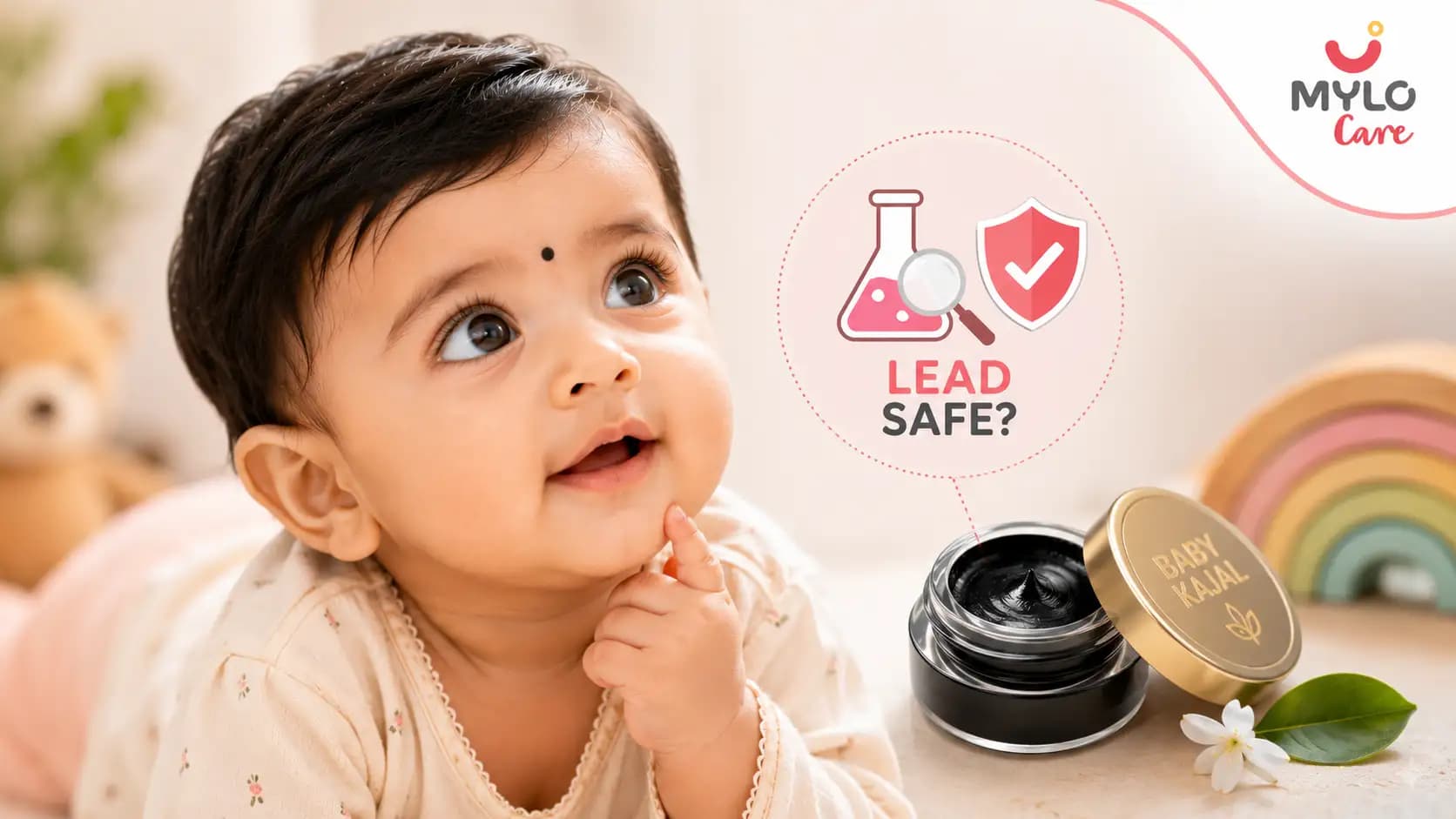
Yes, many baby kajals, especially traditional surma and unbranded or homemade ones, can contain lead, a toxic metal with no safe level for children (US FDA) (WHO). Lead can cause developmental delays, anaemia and poisoning in babies (CDC). You cannot tell if kajal has lead just by looking at it, so before buying, check for a full ingredient list, a batch number and manufacturing details, a "lead-free" declaration backed by lab testing, and proper certification (in India, look for CDSCO/BIS compliance) (CDSCO). Avoid loose, imported "surma," products with no ingredient label, and homemade lamp-soot kajal. If you do choose to use a kajal, pick a transparent, tested, branded product like Mylo Baby Kajal, and remember that the safest option of all is to avoid applying any kajal in a baby's eyes (AAP).
Quick Answer
Many baby kajals do contain lead, particularly traditional surma and unbranded or homemade versions. Lead cannot be seen or smelled, so you must check the label: look for a full ingredient list, batch and manufacturing details, a lab-tested "lead-free" claim, and CDSCO/BIS compliance. Avoid loose surma and no-label products. If you use one, choose a tested, transparent brand such as Mylo Baby Kajal; safest of all is not to use kajal in a baby's eyes.
Author: Mylo Editorial Team, Mylo Parenting Desk
Medically reviewed by: Mylo Editorial Board, aligned with AAP, WHO and IAP guidance
Last updated: 11 June 2026
Medical Disclaimer: This article is for informational purposes only and is not a substitute for professional medical advice. If your baby has been exposed to kajal and shows symptoms like poor feeding, constipation, irritability, pale skin or eye redness, contact your paediatrician promptly and ask whether a blood lead test is needed.
Key Takeaways
- Many baby kajals, especially surma and unbranded ones, can contain lead (US FDA)
- There is no known safe level of lead for babies (WHO)
- You cannot detect lead by colour, smell or texture; only lab testing confirms it
- Before buying, check the ingredient list, batch details and lead-free lab certification
- In India, look for CDSCO/BIS compliance on the packaging (CDSCO)
- Avoid loose surma, no-label products and homemade lamp-soot kajal
- "Herbal," "natural" and "kohl" labels do not guarantee it is lead-free
- If you use a kajal, prefer a transparent, tested brand like Mylo Baby Kajal
- The safest choice is to avoid kajal in a baby's eyes entirely (AAP)
Why Is Lead in Kajal a Concern for Babies?
Lead is a heavy metal that is toxic to the developing brain and body, and babies are far more vulnerable than adults (CDC):
- No safe level: Health authorities confirm there is no known safe blood lead level in children (WHO)
- High absorption: A baby's body absorbs lead far more easily than an adult's
- Easy entry: Kajal near the eye can drain through the tear duct or be rubbed into the mouth
- Cumulative: Daily application means small doses add up over weeks and months
- Hard to spot: Early lead poisoning has vague symptoms and is often missed
This is why checking a product before you buy, rather than after, matters so much.
Which Types of Baby Kajal Are Most Likely to Contain Lead?
Lead risk varies sharply by the type and source of the kajal (US FDA):
| Type of Kajal | Lead Risk | Why |
|---|---|---|
| Traditional surma/kohl (loose) | Very high | Often based on lead sulphide (galena); no testing |
| Imported "surma" from unregulated markets | High | May bypass local safety limits and labelling |
| Homemade lamp-soot kajal | Medium to high | Contamination from ingredients or utensils; no testing |
| Unbranded/local kajal (no label) | High | No ingredient disclosure, no quality control |
| Transparent, tested branded kajal | Lower | Full ingredient list, lead-free testing, regulated |
Important: "lower risk" does not mean risk-free, and any kajal is meant for external application, not for placing inside an infant's eye (AAO).
Can You Tell if Kajal Has Lead Just by Looking at It?
No. This is the most important thing to understand (WHO):
- Lead has no colour, smell or taste that you can detect
- Texture, shininess or "smoothness" tell you nothing about lead content
- A "black and natural" appearance does not mean it is pure or safe
- Homemade does not mean lead-free; contamination is invisible
- Only a certified laboratory test can confirm whether lead is present and how much
Because you cannot judge safety by the product itself, you have to rely on the label, certification and source.
How to Check Before You Buy: Label Red Flags vs Green Flags
Reading the packaging carefully is your best protection (CDSCO):
| Green Flags (Safer Sign) | Red Flags (Avoid) |
|---|---|
| Full, clear ingredient list printed | No ingredient list at all |
| Batch number and manufacturing/expiry date | No batch number or dates |
| Manufacturer name and address | "Loose," package-less or repackaged product |
| "Lead-free" claim backed by lab test/report | Vague claims like "safe" with no proof |
| CDSCO/BIS compliance mentioned | No regulatory or certification marks |
| Sealed, tamper-proof packaging | Broken seal or open tins |
| Sold by a reputable, traceable brand | Sold loose at markets or by street vendors |
A transparent brand such as Mylo Baby Kajal is designed to tick the green-flag column, with a listed formulation, sealed packaging and a lead-free claim, whereas loose surma typically fails on almost every point. If a product hits even one or two red flags, treat it as unsafe for a baby.
How Is Mylo Baby Kajal Different from Others?
Unlike loose surma or unbranded kajal, Mylo Baby Kajal is positioned as a transparent, tested product made specifically with babies in mind. According to Mylo, it is differentiated on the following points:
| Feature | Mylo Baby Kajal | Typical Loose/Unbranded Kajal |
|---|---|---|
| Lead content | Made to be lead-free | Often contains lead; untested |
| Ingredient transparency | Full ingredient list disclosed | Usually no ingredient list |
| Formulation | Made with skin-friendly, nourishing ingredients | Unknown pigments and fillers |
| Harmful additives | Free from harmful chemicals/parabens (as stated by brand) | Often unregulated additives |
| Testing and packaging | Sealed, tested, batch-labelled packaging | Loose, unsealed, no batch info |
| Traceability | Named manufacturer and customer support | No traceable source |
These are the practical "green flags" this article recommends looking for, brought together in a single branded product. That said, even with a safer, tested kajal, health authorities still advise against placing any kajal inside a baby's eyes; if you use it, keep application away from the eye area and check with your paediatrician (AAP) (AAO).
What Certifications and Details Should You Look For?
Before you pay, scan the pack for these (CDSCO):
- Ingredient transparency: A complete list, not just "herbs" or "natural extracts"
- Lead-free declaration: Ideally with a reference to laboratory testing or a certificate of analysis
- CDSCO compliance: Cosmetics in India are regulated by the CDSCO, which sets limits on heavy metals like lead
- BIS standards: Look for adherence to Bureau of Indian Standards norms where applicable
- Manufacturer traceability: A real company name, address and customer-care contact
- Clear labelling of "for external use": And never place any kajal inside the eye, regardless of the label
Remember: words like "herbal," "ayurvedic," "natural" or "kohl" are marketing terms, not proof of being lead-free (US FDA).
Is Homemade Kajal a Safe, Lead-Free Alternative?
Not reliably. Many families believe "ghar ka kajal" made from lamp soot and ghee is automatically pure, but (WHO):
- Lead can come from the wick, oil, utensils or storage container
- Homemade kajal is non-sterile, adding a risk of eye infection (AAO)
- There is no testing, so you have no way to know what is in it
- Soot particles themselves can irritate and scratch a baby's delicate eye
Homemade preparation removes the label problem but not the lead or infection risk, so it is not a safe substitute for a baby's eyes. A tested, transparent product like Mylo Baby Kajal at least removes the guesswork around ingredients and lead.
What Are the Signs Your Baby May Have Been Exposed to Lead?
If kajal has already been used, watch for these signs and speak to your doctor (CDC):
| Sign | What It May Indicate |
|---|---|
| Poor appetite, refusing feeds | Possible lead effect on the gut |
| Constipation or stomach pain | Common in lead exposure |
| Irritability or unusual fussiness | Nervous-system effect |
| Tiredness, low energy, pale skin | Possible anaemia from lead |
| Delayed milestones | Effect on brain development |
| Persistent eye redness or discharge | Local irritation/infection from kajal |
These signs are non-specific, so they are easy to miss. If you are worried, ask your paediatrician whether a blood lead test is appropriate.
When Should You See a Doctor?
Contact your paediatrician promptly if your baby (CDC) (AAO):
- Has used kajal regularly and shows poor feeding, constipation or irritability
- Has pale skin or unusual tiredness (possible anaemia)
- Shows delayed development or loss of previously gained skills
- Has persistent eye redness, watering, swelling or discharge
- Has a white or cloudy spot on the eye surface
- Has any symptom that worries you, it is always okay to get checked
Myths vs Facts: Lead in Baby Kajal
| Myth | Fact | Source |
|---|---|---|
| "You can tell lead-free kajal by its look or smell" | False. Lead is undetectable by sight, smell or touch | WHO |
| "Homemade kajal is always lead-free" | False. It can be contaminated and is non-sterile | WHO |
| "Herbal or ayurvedic means no lead" | False. These are marketing terms, not lab proof | US FDA |
| "A little lead is harmless for babies" | False. There is no safe level of lead for children | CDC |
| "All branded kajal is the same" | False. Transparency and testing vary widely; check the label | CDSCO |
| "Imported surma is higher quality" | False. It may bypass safety limits and testing | CDSCO |
| "If it says lead-free, it is guaranteed safe" | Only trust it if backed by lab testing/certification | US FDA |
Indian Context: What Indian Parents Should Know
- Loose surma is common and risky: Traditional surma sold loose in local markets is among the highest-lead products and escapes any testing (US FDA)
- Regulation exists but has gaps: Cosmetics in India are regulated by the CDSCO with legal limits on lead, but unbranded and homemade kajal falls outside this net (CDSCO)
- Check for compliance marks: Prefer sealed, branded products such as Mylo Baby Kajal that reference proper testing over loose or repackaged ones
- Anaemia is already widespread: Indian infants often have anaemia; added lead exposure makes it worse, so cutting any lead source matters (CDC)
- Talk to elders gently: Grandparents often buy traditional surma out of love; explain the lead risk with your paediatrician's support
- When in doubt, test: If kajal has been used regularly, ask your doctor about a blood lead test for your baby (IAP)
- Emergency number: For any serious symptom, dial 108 for ambulance services in most states
FAQs: Lead in Baby Kajal
Does all baby kajal contain lead?
Not all, but many do, especially traditional surma, unbranded products and homemade lamp-soot kajal (US FDA). Because you cannot tell by looking, you must rely on the ingredient list, certification and source. Choosing a transparent, tested product like Mylo Baby Kajal lowers ingredient uncertainty, and the safest choice of all is to avoid kajal in a baby's eyes.
Kya baby kajal mein lead hota hai? (Hinglish)
Haan, bahut se baby kajal, khaas kar traditional surma, bina label wale aur ghar ka kajal, mein lead ho sakta hai. Lead ko dekh kar ya soongh kar pehchana nahi ja sakta, isliye kharidne se pehle ingredient list, batch number, lead-free lab certification aur CDSCO/BIS compliance zaroor check karein. Agar kajal use karna hi hai to Mylo Baby Kajal jaise tested, transparent brand chunein, aur sabse safe option hai baby ki aankh mein kajal bilkul na lagana.
How can I check if a kajal is lead-free before buying?
Look for a full ingredient list, a batch number with manufacturing and expiry dates, a manufacturer name and address, a "lead-free" claim backed by laboratory testing, and CDSCO/BIS compliance (CDSCO). Avoid loose surma and any product without a proper label. Products like Mylo Baby Kajal are built to meet these transparency checks.
Can I detect lead in kajal at home?
No reliable home test exists for lead in cosmetics; lead is invisible and odourless, and only a certified laboratory can measure it accurately (WHO). This is why label transparency and certification are your main tools before buying.
Kya "herbal" ya "ayurvedic" kajal lead-free hota hai? (Hinglish)
Zaroori nahi. "Herbal," "ayurvedic" ya "natural" sirf marketing words hain, ye lead-free hone ka proof nahi hain. Sirf lab-tested aur certified "lead-free" claim par bharosa karein, aur phir bhi baby ki aankh mein kajal lagane se bachein.
Is imported or foreign surma safer than local kajal?
No, it can be riskier. Imported surma from unregulated markets may bypass local safety limits and labelling requirements, and has been specifically flagged for high lead content (US FDA).
What makes Mylo Baby Kajal different from ordinary kajal?
Mylo Baby Kajal is a transparent, tested and sealed product with a disclosed ingredient list and a lead-free claim, unlike loose surma or unbranded kajal that offer no ingredient information or testing. It is designed around the exact green-flag checks this article recommends. Even so, no kajal should be placed inside a baby's eyes; keep application away from the eye and check with your paediatrician (AAP).
What should I do if I already used a kajal that may contain lead?
Stop using it, keep the product for reference, and contact your paediatrician (CDC). Watch for signs like poor feeding, constipation, irritability or pale skin, and ask whether a blood lead test is advisable, especially if it was applied regularly.
Is there any truly safe lead-free kajal for a baby's eyes?
No cosmetic kajal is medically endorsed for placement in a baby's eyes, even lead-free ones, because any substance in the eye can cause irritation and infection (AAP) (AAO). If you must follow tradition, choose a tested product like Mylo Baby Kajal, apply a tiny dot away from the eyes, and check with your doctor.
References
- American Academy of Pediatrics (AAP) / HealthyChildren.org. https://www.healthychildren.org/
- World Health Organization (WHO). "Lead Poisoning and Health." https://www.who.int/news-room/fact-sheets/detail/lead-poisoning-and-health
- Centers for Disease Control and Prevention (CDC). "Childhood Lead Poisoning Prevention." https://www.cdc.gov/lead-prevention/
- US Food and Drug Administration (FDA). "Kohl, Kajal, Al-Kahal, Surma, Tiro, Tozali, or Kwalli: Dangers of Lead Poisoning." https://www.fda.gov/cosmetics/cosmetic-products/kohl-kajal-al-kahal-surma-tiro-tozali-or-kwalli-dangers-lead-poisoning
- American Academy of Ophthalmology (AAO). https://www.aao.org/
- Central Drugs Standard Control Organisation (CDSCO), India. https://cdsco.gov.in/
- Indian Academy of Pediatrics (IAP). https://iapindia.org/
- Mylo. "Mylo Baby Kajal (5g)." https://mylofamily.com/product/mylo-baby-kajal-5g-3498
Article Posted Under
Related Articles


Medical Disclaimer
This content is for informational purposes only and should not replace professional medical advice. Consult with a physician or other health care professional if you have any concerns or questions about your health. If you rely on the information provided here, you do so solely at your own risk.


AWARDS AND RECOGNITION

Mylo wins Forbes D2C Disruptor award

Mylo wins The Economic Times Promising Brands 2022
AS SEEN IN











- Mylo Care: Effective and science-backed personal care and wellness solutions for a joyful you.
- Mylo Baby: Science-backed, gentle and effective personal care & hygiene range for your little one.
- Mylo Community: Trusted and empathetic community of 10mn+ parents and experts.


Product Categories
Baby Carrier | Baby Soap | Baby Wipes | Stretch Marks Cream | Baby Cream | Baby Shampoo | Baby Massage Oil | Baby Hair Oil | Stretch Marks Oil | Baby Body Wash | Baby Powder | Baby Lotion | Diaper Rash Cream | Newborn Diapers | Teether | Baby Kajal | Baby Diapers Pants | Cloth Diapers | Laundry Detergent | Lactation Granules |