


Orders
.png&w=48&q=75 "login")
Profile


Wallet

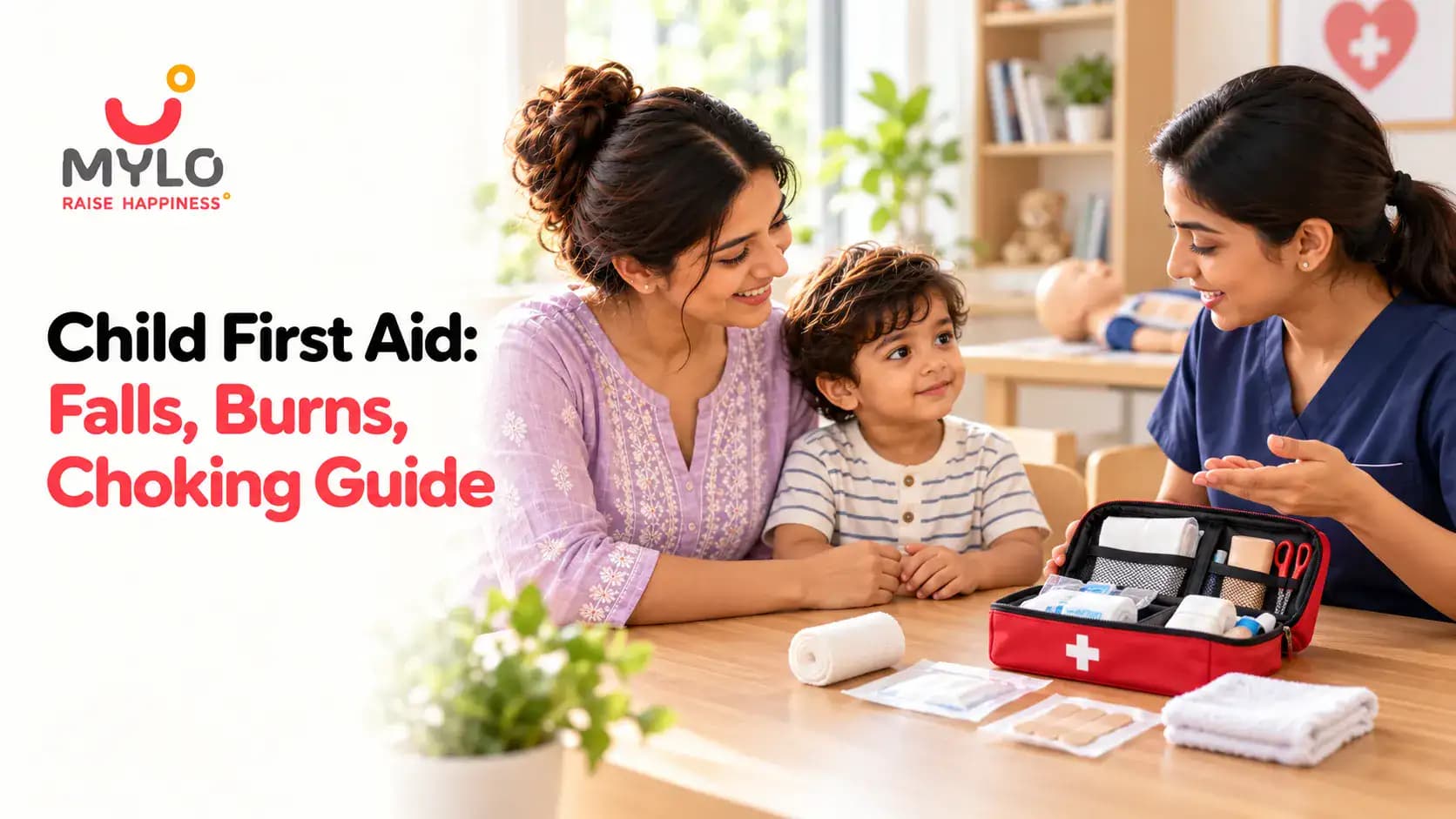
Child First Aid: Falls, Burns, Choking Guide
 18 min

BDS (Gold Medalist), Certified Lactation Consultant – BPNI Delhi, Maternal & Infant Nutrition Expert · 15 years experience
Quick Answer
Child first aid is the quick help you give a child after an injury or sudden illness, before a doctor takes over. Stay calm, keep your child safe, and call 108 or 112 for serious problems. Know how to handle choking, burns, falls, bleeding and poisoning, and which illness signs need a hospital.
Child First Aid at a Glance
Injury or Problem | What to Do First | Get Urgent Help If |
|---|---|---|
Minor fall or bump | Comfort your child, apply a cold compress | Knocked out, vomiting, seizure, very sleepy |
Burn | Cool under running water for 20 minutes, cover loosely | Large or deep burn, or on the face, hands, feet or private parts, or in a baby |
Choking | Back blows and thrusts, depending on age | Can't breathe, cough or cry, or becomes unconscious |
Cut or bleeding | Press firmly with a clean cloth, raise the area | Deep, gaping, or bleeding won't stop |
Nosebleed | Lean forward, pinch the soft part of the nose for 10 minutes | Won't stop after 20 minutes |
Swallowed poison or medicine | Call emergency help, keep the container | Always get help. Never make your child vomit |
Swallowed button battery | Go to hospital immediately | Always, even if your child seems fine |
Dog or animal bite | Wash with soap and running water for 15 minutes | Always see a doctor the same day for rabies vaccine |
Illness warning signs | See the illness section below | Breathing trouble, very sleepy, dehydration, non-fading rash |
Key Facts Every Parent Should Know
Most childhood injuries happen at home: Falls, burns and poisoning are the most common
The first few minutes matter: Quick, correct first aid can prevent serious harm
Stay calm: Your calm helps your child stay still and helps you think clearly
Some home remedies make things worse: Toothpaste, ghee or ice on burns, or making a child vomit, can cause more damage
Choking first aid is different for babies: Babies under 1 need back blows and chest thrusts, not abdominal thrusts
A first aid course is worth it: Hands-on training builds confidence
Why Should Every Parent Know Basic First Aid?
Short answer: Children explore, climb and put things in their mouths, so accidents happen fast. Knowing basic first aid helps you act quickly and correctly while help is on the way.
Basic first aid helps you:
Stop a small injury from becoming serious
Keep your child safe until an ambulance or doctor takes over
Know when an injury or illness needs a hospital
Stay calm in a frightening moment
The 4 golden rules:
Stay calm and check that the area is safe for you and your child
Check your child: Are they awake, breathing and responding?
Give simple first aid for the injury
Call 108 or 112 if the problem is serious
How Do You Help a Choking Child?
Short answer: If your child can cough, cry or speak, let them keep coughing. If they can't breathe, cough or cry, give back blows and thrusts right away, and call 108 or 112.
Signs of choking
Can't breathe, cry, speak or cough
Weak, high-pitched sounds or no sound at all
Clutching at the throat
Lips or face turning blue
Choking first aid for babies under 1 year
Lay your baby face down along your forearm, with their head lower than their chest, supporting the head and jaw.
Give 5 firm back blows between the shoulder blades with the heel of your hand.
If the object doesn't come out, turn your baby face up on your thigh.
Give 5 chest thrusts with two fingers on the centre of the breastbone, just below the nipple line.
Repeat until the object comes out or your baby becomes unconscious.
Never give abdominal thrusts to a baby under 1.
Choking first aid for children over 1 year
Lean your child forward and give 5 firm back blows between the shoulder blades.
If that doesn't work, stand or kneel behind your child and give 5 abdominal thrusts: place a fist just above the belly button and pull sharply inwards and upwards.
Repeat back blows and abdominal thrusts until the object comes out.
If your child becomes unconscious
Call 108 or 112 immediately
Start CPR if you're trained
Don't put your fingers in the mouth to search for the object unless you can clearly see it
For foods that commonly cause choking, read our guide on foods to avoid for toddlers.
What Should You Do for a Burn?
Short answer: Cool the burn under cool running water for 20 minutes, remove jewellery or clothing near the burn unless it's stuck, and cover it loosely with cling film or a clean cloth.
Step by step
Move your child away from the heat source.
Cool the burn under cool, gently running water for 20 minutes.
Remove clothing and jewellery near the burn, unless stuck to the skin.
Cover loosely with cling film or a clean, non-fluffy cloth.
Keep your child warm while cooling the burn.
Give pain relief only if your doctor advises.
Don't do this
Don't apply toothpaste, butter, ghee, haldi, oil, ice or ointments
Don't burst blisters
Don't use very cold or iced water
Go to hospital if the burn:
Is larger than your child's palm
Is on the face, hands, feet, joints or private parts
Looks white, charred or leathery (deep burn)
Was caused by electricity or chemicals
Is in a baby
What Should You Do After a Fall or Head Injury?
Short answer: Most falls cause only minor bumps. Comfort your child, apply a cold compress, and watch closely for 24 to 48 hours. Get emergency help if you see any warning signs.
First aid for a minor bump
Comfort your child and let them rest.
Apply a cold compress or ice wrapped in a cloth for 10 to 15 minutes.
Watch closely for the next 24 to 48 hours.
Head injury warning signs: get emergency help if your child:
Was knocked out, even briefly
Vomits more than once
Has a seizure
Has unequal pupils, blurred vision or confusion
Has blood or clear fluid coming from the nose or ears
Is unusually sleepy or hard to wake
Has weakness, trouble walking or is behaving strangely
Fell from a height, like a balcony, stairs or a high bed
If you think there's a neck or back injury, don't move your child unless they're in danger. Call 108 or 112.
What About Bleeding, Nosebleeds and Poisoning?
Short answer: Press firmly on cuts to stop bleeding, lean forward and pinch the nose for nosebleeds, and never make a child vomit after swallowing poison.
Cuts and bleeding
Wash your hands if you can.
Press firmly on the wound with a clean cloth or gauze.
Raise the injured part above the heart if possible.
Keep pressing for several minutes without lifting to check.
For minor cuts, clean with clean running water and cover with a sterile dressing.
Go to hospital if the cut is deep, gaping, on the face, has something stuck in it, or the bleeding won't stop.
Nosebleeds
Sit your child upright and lean them slightly forward.
Pinch the soft part of the nose firmly for 10 minutes.
Ask your child to breathe through their mouth.
Never tilt the head back. Blood can run down the throat.
See a doctor if the bleeding doesn't stop after 20 minutes, or nosebleeds happen often.
Poisoning
Remove anything still in your child's mouth.
Don't make your child vomit.
Call 108 or 112, or a poison centre.
Keep the container or packet to show the doctor.
Common poisons in Indian homes: Medicines, kerosene, phenyl, toilet cleaners, pesticides, mosquito repellents, button batteries and naphthalene balls.
Swallowed button batteries and magnets
Go to hospital immediately, even if your child seems fine. Button batteries can burn the food pipe within hours. Swallowing two or more magnets is also an emergency.
When Should You Call Emergency Help Immediately?
Short answer: Call 108 or 112 right away for any life-threatening problem.
Call 108 or 112 if your child:
Is choking and can't breathe, or becomes unconscious
Isn't breathing, or is breathing with great difficulty
Has heavy bleeding that won't stop
Has a seizure, especially a first one or one lasting more than 5 minutes
Has a serious head, neck or spine injury
Has a large, deep burn, or a burn on the face or hands
Has swallowed poison, medicine, chemicals or a button battery
Is very drowsy, unresponsive or turning blue
Was found in water, even if they seem fine
When Should You Take Your Child to Hospital for Illness?
Short answer: Not every illness needs a hospital, but some warning signs do. Go to hospital immediately for trouble breathing, unusual sleepiness, severe dehydration, a rash that doesn't fade when pressed, or a swallowed button battery or poison.
When to go: quick guide
Level | What to Do | Examples |
|---|---|---|
🔴 Call 108 or 112 now | Life-threatening | Not breathing, turning blue, unconscious, seizure over 5 minutes, severe allergic reaction |
🟠 Go to hospital now | Urgent care within the hour | Breathing fast or hard, very sleepy or floppy, severe dehydration, non-fading rash with fever, swallowed a battery or poison |
🟡 See a doctor today | Check within 24 hours | Fever for more than 3 days, ear pain, painful urination, vomiting for over 24 hours |
🟢 Home care, watch closely | Usually safe at home | Mild cold, low fever but playful, a small bump with no other signs |
Illness warning signs
Problem | Go to Hospital Now If | Read More |
|---|---|---|
Breathing | Breathing very fast (40 or more breaths a minute at ages 1 to 5), skin pulling in between the ribs, grunting, wheezing, or blue lips | |
Fever | Very sleepy, seizure, stiff neck, non-fading rash, or signs of dehydration | |
Vomiting and loose motions | No urine for 6 to 8 hours, no tears, sunken eyes, green or bloody vomit, blood in stool | |
Rash | Spots that don't fade when pressed with a glass, especially with fever | |
Allergic reaction | Swelling of the lips, tongue or face, trouble breathing, or floppiness |
Bites that need a hospital
Bite | What to Do |
|---|---|
Dog or animal bite | Wash with soap and running water for 15 minutes, don't apply chilli, haldi or oil, then go to hospital the same day for rabies vaccine (free at government hospitals) |
Snake or scorpion bite | Keep your child still, remove tight bangles or anklets, don't cut, suck or tie the bite, and rush to hospital. Call 108 |
Trust your instinct: If you feel something is seriously wrong, go to hospital. Don't wait until morning.
🧰 First Aid Kit Essentials
Short answer: Keep a first aid kit at home and in the car, out of children's reach, and check it every few months.
Item | Use |
|---|---|
Sterile gauze and adhesive bandages (different sizes) | Cuts and grazes |
Antiseptic liquid or wipes, medical tape | Cleaning and dressing wounds |
Digital thermometer | Checking for fever |
Small scissors and tweezers | Cutting dressings, removing splinters |
Disposable gloves | Hygiene |
Crepe or elastic bandage | Sprains and support |
Cling film | Covering burns |
ORS sachets | Loose motions and vomiting |
Your child's prescribed medicines | As your doctor advises |
Emergency numbers and your child's medical details | Weight, allergies, medicines, blood group |
Emergency numbers in India
108: Ambulance and emergency
112: National emergency number
102: Ambulance in some states
1098: Childline
What Does First Aid Preparedness Cost in India?
Short answer: Emergency helplines are free, and a basic first aid kit and course cost very little compared with the confidence they give.
Item | Approximate Cost |
|---|---|
Emergency helplines (108, 112) | Free |
Basic first aid kit | ₹300 to ₹1,500 |
Digital thermometer | ₹150 to ₹500 |
ORS sachets | ₹10 to ₹30 each |
First aid or CPR course | ₹500 to ₹3,000 |
Prices vary by city and brand.
Indian Context: What Indian Parents Should Know
Short answer: Some common home remedies in India can make injuries worse. Lock away household chemicals, avoid harmful remedies, and learn first aid from a trusted course.
Save 108 and 112 in your phone and on the fridge
Avoid harmful remedies: Toothpaste, ghee, haldi or ice on burns, and chilli or oil on bites
Lock away dangerous items: Kerosene, phenyl, pesticides, cleaners, naphthalene balls and medicines
Childproof the home: Guard stoves and hot vessels, fit stair gates, cover plug points
Dog bites: Common in Indian streets. Every bite needs rabies vaccine, free at government hospitals
Snake bites in villages: Go to hospital for anti-venom, not to a traditional healer
Don't wait until morning: If your child has warning signs at night, go to hospital
Take a first aid course: The Indian Red Cross Society and St John Ambulance offer courses
For more on preventing accidents, read our toddler safety guide and the ultimate guide to childproofing your home.
Myths vs Facts About Child First Aid
Myth | Fact |
|---|---|
Apply toothpaste or butter to burns | Use only cool running water for 20 minutes |
Tilt the head back for a nosebleed | Lean forward and pinch the nose |
Make a child vomit after swallowing poison | Never make a child vomit |
Use abdominal thrusts on choking babies | Babies under 1 need back blows and chest thrusts only |
A child is fine after a minor head bump | Watch for warning signs for 24 to 48 hours |
If a child seems fine after swallowing a battery, it's okay | Button batteries can cause serious burns within hours |
A dog bite only needs care if it bleeds | Every animal bite needs a doctor for rabies prevention |
Tying a snake bite stops the poison | Tying can cause more harm. Keep still and rush to hospital |
FAQs: Child First Aid
1. What should I do first in a child emergency?
Stay calm, check that the area is safe, check if your child is breathing and responding, and call 108 or 112 if it's serious.
2. How do I help a choking baby under 1?
Give 5 back blows with your baby face down on your forearm, then 5 chest thrusts with two fingers on the breastbone. Never give abdominal thrusts to a baby.
3. What is the first aid for burns in children?
Cool the burn under running water for 20 minutes, remove nearby jewellery or clothing, and cover loosely with cling film. Don't apply toothpaste, ghee or ice.
4. When should I take my child to hospital after a head injury?
If they were knocked out, vomit more than once, have a seizure, are very sleepy, confused, or have fluid coming from the nose or ears.
5. How do I stop a nosebleed?
Sit your child upright, lean them slightly forward and pinch the soft part of the nose for 10 minutes. Don't tilt the head back.
6. What should I do if my child swallows something poisonous?
Don't make them vomit. Call 108 or 112, and keep the container to show the doctor.
7. When should I take my child to hospital for fever?
If the fever comes with sleepiness, breathing trouble, a seizure, a non-fading rash, a stiff neck or dehydration. See a doctor if it lasts more than 3 days.
8. What should I do if a dog bites my child?
Wash the wound with soap and running water for 15 minutes, then go to a hospital the same day for rabies vaccine.
9. What should be in a child's first aid kit?
Gauze, bandages, antiseptic, a digital thermometer, scissors, tweezers, gloves, a crepe bandage, cling film, ORS, prescribed medicines and emergency numbers.
10. Bacche ko turant hospital kab le jayein?
Agar baccha saans lene mein takleef mein ho, bahut sust ho jaye, peshab band ho, daane glass se dabane par na mitein, ya koi battery ya zehreeli cheez nigal le, to turant hospital jaiye ya 108 par call kijiye.
11. Jalne par bacche ko kya first aid dein?
Jale hue hisse ko 20 minute tak thande behte paani ke neeche rakhiye, phir saaf kapde ya cling film se dhakiye. Toothpaste, ghee, haldi ya barf bilkul mat lagaiye.
Related Reads on Mylo
References
American Academy of Pediatrics (AAP). "Choking Prevention and First Aid" and "Button Battery Injuries." HealthyChildren.org. https://www.healthychildren.org
NHS (UK). "Burns and scalds," "Nosebleed" and "Choking." https://www.nhs.uk
World Health Organization (WHO). "Integrated Management of Childhood Illness (IMCI): Chart Booklet." 2014.
National Institute for Health and Care Excellence (NICE). "Head injury: assessment and early management." NG232, 2023.
Indian Red Cross Society. "First Aid Manual." https://www.indianredcross.org
Ministry of Health and Family Welfare, Government of India. "National Rabies Control Programme" and "Standard Treatment Guidelines: Snakebite."
Medical Disclaimer
This article is for general awareness only and does not replace hands-on first aid or CPR training or professional medical care. In an emergency, call 108 or 112 immediately. Consider taking an accredited first aid course.


Article Posted Under
Related Articles




Related Topics
.webp&w=32&q=75)
Medical Disclaimer
This content is for informational purposes only and should not replace professional medical advice. Consult with a physician or other health care professional if you have any concerns or questions about your health. If you rely on the information provided here, you do so solely at your own risk.


AWARDS AND RECOGNITION

Mylo wins Forbes D2C Disruptor award

Mylo wins The Economic Times Promising Brands 2022
AS SEEN IN













- Mylo Care: Effective and science-backed personal care and wellness solutions for a joyful you.
- Mylo Baby: Science-backed, gentle and effective personal care & hygiene range for your little one.
- Mylo Community: Trusted and empathetic community of 10mn+ parents and experts.


Product Categories
Baby Carrier | Baby Soap | Baby Wipes | Stretch Marks Cream | Baby Cream | Baby Shampoo | Baby Massage Oil | Baby Hair Oil | Stretch Marks Oil | Baby Body Wash | Baby Powder | Baby Lotion | Diaper Rash Cream | Newborn Diapers | Teether | Baby Kajal | Baby Diapers Pants | Cloth Diapers | Laundry Detergent | Lactation Granules |