


Orders

Profile

Baby's Mouth Thrush (Oral Thrush in Babies): Symptoms, Causes, Treatment and Home Care Guide (2026)
 3 Likes|
 16 min
AI-Generated Summary
Quick overview in 30 seconds.webp&w=32&q=75)
Summary
- Baby's mouth thrush is a fungal infection caused by Candida albicans, showing white patches on the tongue, cheeks, and roof of the mouth, sometimes with redness and soreness.
- Common causes include antibiotic use, dirty pacifiers or bottles, a weakened immune system in newborns, and contact with someone who has thrush, including breastfeeding mothers.
- Treatment usually involves antifungal gels or medication, and prevention includes sterilising pacifiers and bottles, washing baby clothes regularly, and keeping breasts dry after nursing.
- How can you keep baby's feeding items germ-free? Explore our Anti Colic Slow (S) Flow Grooved Baby Nipple - Pack of 2.
 4.0
4.0TL;DR
Baby's mouth thrush (oral thrush or oral candidiasis) is a common fungal infection caused by Candida albicans that produces creamy white patches on the tongue, gums, inner cheeks and roof of the mouth (Mayo Clinic) (Cleveland Clinic). It commonly affects babies under 6 months because their immune systems are still developing (AAP / HealthyChildren.org). Most cases clear up within 1 to 2 weeks with antifungal treatment such as nystatin oral suspension or miconazole gel prescribed by a pediatrician (NHS). Treat the mother's nipples simultaneously if breastfeeding, sterilise bottles and pacifiers, and see your pediatrician if symptoms persist beyond 7 days.
Quick Answer
Baby's mouth thrush is a fungal infection caused by Candida that creates white, cottage cheese-like patches on the tongue, gums and cheeks. It is common in infants under 6 months. Treatment includes antifungal medication (nystatin or miconazole) prescribed by a pediatrician. Sterilise bottles and pacifiers, treat the mother's nipples if breastfeeding, and consult a doctor if symptoms persist beyond 7 days.
Author: Parul Sachdeva, Senior Baby Care Editor, Mylo Parenting Desk Medically reviewed by: Mylo Pediatric Editorial Board, aligned with Indian Academy of Pediatrics (IAP) and American Academy of Pediatrics (AAP) guidelines Last updated: 11 June 2026
Medical Disclaimer: This article is for informational purposes only and not a substitute for professional medical advice. If your baby has white patches in the mouth, refuses to feed or shows discomfort, please consult your pediatrician immediately for proper diagnosis and treatment.
Key Takeaways
- Oral thrush is caused by Candida albicans, a yeast naturally present in the body (Mayo Clinic)
- Most common in babies under 6 months due to developing immune systems (AAP)
- Look for white, cottage cheese-like patches that do NOT wipe off easily (Cleveland Clinic)
- Standard treatment is nystatin oral suspension or miconazole gel (NHS)
- Most cases resolve in 1 to 2 weeks with treatment
- Sterilise bottles, pacifiers and teats daily to prevent recurrence
- Treat breastfeeding mother's nipples simultaneously to break the infection cycle
- See pediatrician immediately if baby refuses to feed, has fever or symptoms persist beyond 7 days
What Is Baby's Mouth Thrush?
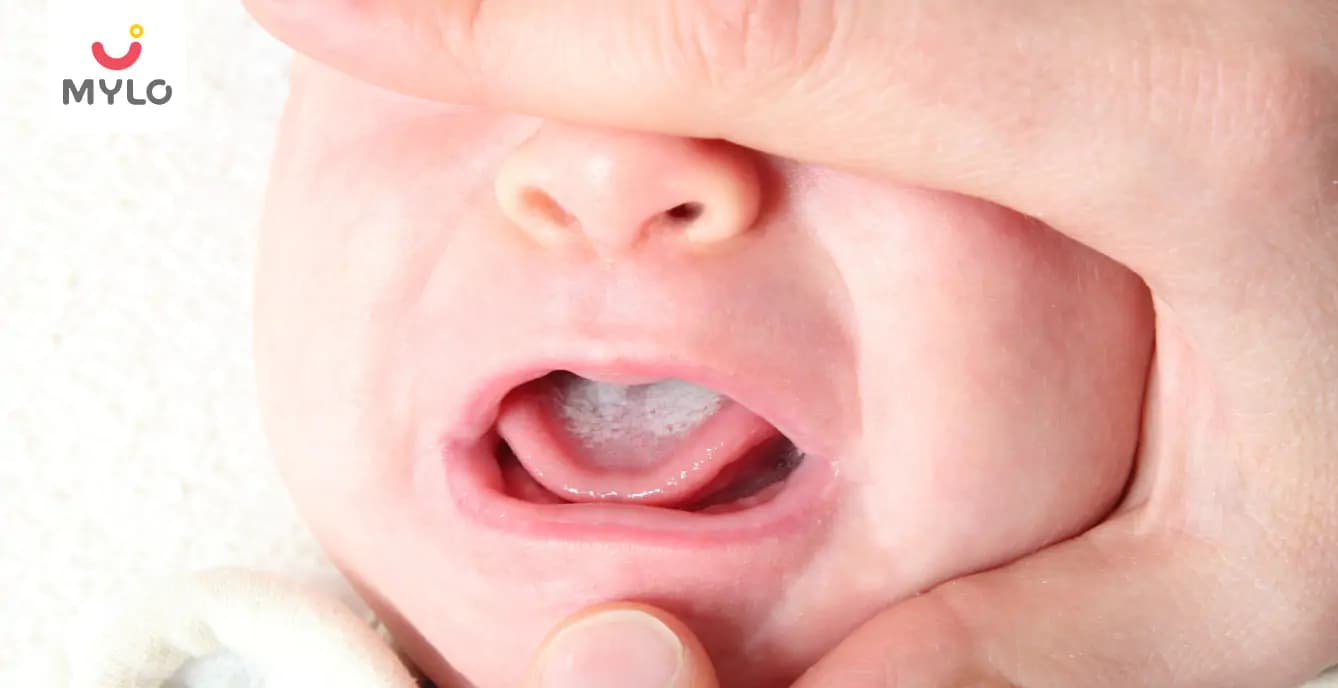
Oral thrush in babies (also called oral candidiasis) is a fungal infection of the mouth caused by the overgrowth of Candida albicans, a yeast that lives naturally on the skin and in the digestive tract (Mayo Clinic).
In healthy babies, the immune system and friendly bacteria keep Candida in check. But when the balance is disturbed (by antibiotics, immune development or environmental factors), Candida multiplies and produces white, raised patches on the inside of the mouth (Cleveland Clinic).
Thrush is:
- Very common in babies under 6 months
- Not dangerous in healthy infants
- Easily treatable with antifungal medicine
- Mildly contagious (especially during breastfeeding)
What Are the Symptoms of Mouth Thrush in Babies?
Watch for these signs (NHS) (Cleveland Clinic):
Most Common Symptoms
- Creamy white patches on the tongue, gums, inner cheeks or roof of mouth
- Cottage cheese-like appearance that does NOT wipe off easily
- Red, inflamed tissue under the white patches
- Mild bleeding if patches are scraped
- Cracking at the corners of the mouth (angular cheilitis)
- White coating on the tongue that looks thicker than milk residue
Behavioural Signs
- Fussiness during feeding (mouth pain)
- Refusing to breastfeed or bottle-feed
- Pulling away from breast or bottle
- Crying during feeds
- Reduced appetite
- Drooling
Linked Symptoms in Breastfeeding Mothers
If the baby has thrush, the mother may also develop (AAP):
- Sore, cracked, itchy nipples
- Sharp, shooting pain during or after feeding
- Pink, shiny or flaky nipple skin
- Pain that persists between feeds
How to Tell the Difference: Thrush vs Milk Residue
Many parents confuse milk residue with thrush. Here is how to differentiate (AAP):
| Feature | Milk Residue | Oral Thrush |
|---|---|---|
| Wipes off easily | Yes, with a soft cloth | No, sticks firmly |
| Location | Mainly on tongue surface | Tongue, cheeks, gums, palate |
| Underneath the patch | Pink, healthy tissue | Red, inflamed tissue |
| Baby's comfort | Baby is calm and feeds well | Baby is fussy, refuses feeds |
| Texture | Smooth, milky | Thick, cottage cheese-like |
| Appears after | Each feed | Persistent, gets worse over days |
Quick test: Gently wipe the white patch with a clean, damp cloth. If it comes off easily and the tissue underneath looks pink and healthy, it is milk residue. If it sticks or leaves red, raw tissue, it is likely thrush.
What Causes Oral Thrush in Babies?
Several factors trigger Candida overgrowth (Mayo Clinic) (CDC):
| Cause | How It Triggers Thrush | Source |
|---|---|---|
| Immature immune system | Newborns under 6 months are most vulnerable | AAP |
| Antibiotic use | Antibiotics kill good bacteria that keep Candida balanced | CDC |
| Mother's antibiotic use during pregnancy or breastfeeding | Affects baby's gut and mouth flora | Cleveland Clinic |
| Vaginal yeast infection in mother during delivery | Baby may be exposed to Candida during birth | Mayo Clinic |
| Contaminated pacifiers, bottles, teats | Reinfects baby's mouth | NHS |
| Breastfeeding mother with nipple thrush | Passes back and forth between mother and baby | AAP |
| Diabetes in mother | Higher Candida in breast milk and skin | CDC |
| Premature birth | Underdeveloped immune system | NCBI |
| Inhaled corticosteroids (for baby with asthma) | Suppress local immunity | Mayo Clinic |
How Is Oral Thrush Diagnosed in Babies?
Diagnosis is usually clinical, based on visual examination (Cleveland Clinic):
- Visual examination of the baby's mouth by a pediatrician
- Mouth swab and culture (in rare cases) to confirm Candida species
- Review of feeding history (any antibiotic use, mother's nipple condition)
- Examination of mother's nipples if breastfeeding
In most cases, no laboratory tests are needed because thrush has a distinctive appearance.
What Is the Treatment for Baby's Mouth Thrush?
Treatment is highly effective. Standard options include (NHS) (Mayo Clinic):
1. Nystatin Oral Suspension (Most Common)
- Liquid antifungal applied directly to the inside of the baby's mouth
- Usually given 4 times a day for 7 to 14 days
- Apply with a clean fingertip or dropper to white patches
- Continue for 2 days after symptoms disappear to prevent recurrence
2. Miconazole Oral Gel
- Applied as a small dab on the affected areas
- Generally for babies over 4 months (NHS)
- Used 4 times a day after feeds
- Not recommended for newborns due to choking risk in some products
3. Fluconazole (Oral)
- Used in severe or recurrent cases under pediatric supervision
- Prescribed by a doctor only
4. Treating the Mother Simultaneously (If Breastfeeding)
- Apply prescribed antifungal cream (miconazole or nystatin) to mother's nipples after each feed
- Wipe off before next feed (if instructed)
- Treats nipple thrush and stops the back-and-forth cycle
Important: Never give home remedies like honey, gentian violet or unproven medications without your pediatrician's approval. Honey is unsafe for babies under 1 year due to risk of infant botulism (AAP).
What Home Care Measures Help With Baby's Oral Thrush?
Alongside medical treatment, these steps help (NHS) (CDC):
For the Baby
- Sterilise pacifiers, bottles, teats and feeding equipment daily
- Use a separate set of feeding items during treatment
- Avoid reusing pacifiers without sterilisation
- Wash baby's hands and toys frequently
- Keep mouth area clean and dry after feeds
- Replace toothbrush, soothers and bottles after recovery
For the Breastfeeding Mother
- Wash hands thoroughly before and after feeds
- Air-dry nipples after each feed
- Use disposable nursing pads and change frequently
- Wash bras in hot water daily
- Apply prescribed antifungal cream to nipples
- Avoid storing breast milk pumped during active thrush (Candida can survive freezing)
For the Household
- Wash baby's clothes, bibs and towels in hot water
- Boil bottles, teats and pacifiers for at least 5 minutes
- Sterilise plastic toys baby puts in mouth
- Replace toothbrushes and dental items after recovery
How Long Does Oral Thrush Last in Babies?
With proper antifungal treatment, oral thrush usually resolves in 7 to 14 days (Cleveland Clinic). Without treatment:
- Mild cases may resolve on their own in 1 to 2 weeks
- Moderate to severe cases can persist or worsen
- Untreated thrush can spread to the diaper area (causing diaper rash) or the digestive tract
Always complete the full prescribed course of antifungal even if symptoms appear to clear within a few days. Stopping early increases the chance of recurrence (NHS).
How Can You Prevent Baby's Mouth Thrush?
Prevention focuses on hygiene and reducing Candida exposure (AAP) (CDC):
| Action | Why It Helps |
|---|---|
| Sterilise bottles, pacifiers, teats daily | Kills lingering Candida spores |
| Wash hands before handling baby's feeding items | Prevents fungal transfer |
| Treat any maternal vaginal yeast infection before delivery | Reduces birth exposure |
| Wipe baby's mouth with clean damp gauze after feeds | Removes milk residue Candida thrives on |
| Air-dry nipples after each feed | Reduces moist environment for Candida |
| Use breast pads and change frequently | Keeps nipple area dry |
| Limit use of antibiotics to what is necessary | Maintains good bacteria balance |
| Probiotic supplementation for mother (if advised) | Restores healthy flora |
| Replace pacifier and toothbrush every 1 to 2 months | Reduces fungal reservoir |
| Avoid sharing utensils with adults | Adults can transmit Candida |
When Should You See a Pediatrician?
Consult your baby's pediatrician immediately if (Mayo Clinic) (NHS):
- White patches in the mouth do not wipe off (likely thrush)
- Baby refuses to feed or shows signs of mouth pain
- Baby has fewer wet nappies than usual (sign of dehydration)
- Symptoms persist beyond 7 days despite treatment
- Thrush keeps coming back repeatedly
- Baby is under 1 month old (always consult doctor for newborns)
- Baby has fever or seems unusually tired
- Patches spread to throat or cause swallowing difficulty
- Baby has weight loss or poor weight gain
- Mother has severe nipple pain suggesting nipple thrush
Indian Context: What Indian Parents Should Know
- Common in Indian babies: Oral thrush is one of the most frequent infant infections in India, especially in babies under 3 months (Indian Academy of Pediatrics)
- IAP recommendation: Avoid home remedies like honey, gentian violet, or applying ghee, oil or borax to the baby's mouth, which are unsafe (IAP)
- Hot, humid Indian climate can promote fungal growth; keep baby's mouth and feeding area clean and dry
- Common Indian myth: Applying "kajal" or any home preparation to a baby's mouth is NOT recommended and may worsen infection
- Sterilisation in Indian homes: Boil bottles, pacifiers and teats in clean water for at least 5 minutes daily; steam sterilisers are widely available
- Cost in India: Nystatin oral suspension typically costs INR 80 to INR 200 per bottle; miconazole gel INR 120 to INR 250
- Insurance: Most Indian health insurance plans cover pediatric consultation and prescribed antifungal medication
Myths vs Facts About Baby's Mouth Thrush
| Myth | Fact | Source |
|---|---|---|
| "Honey clears thrush in babies" | NEVER give honey to babies under 1 year, it can cause infant botulism | AAP |
| "Thrush only affects unhealthy babies" | Healthy babies can also get it; it is very common | Cleveland Clinic |
| "Wiping the tongue clears thrush" | False. White patches stick; only antifungal treats them | NHS |
| "Thrush goes away on its own" | Sometimes, but treatment prevents complications and recurrence | Mayo Clinic |
| "Apply gentian violet at home" | Not recommended without medical advice; can stain and irritate | IAP |
| "Stop breastfeeding during thrush" | DO NOT stop. Treat both mother and baby simultaneously | AAP |
| "Thrush spreads to family members" | Rarely. Healthy adults usually have immune defence against it | CDC |
FAQs: Baby's Mouth Thrush
How can I tell if my baby has thrush or just a milk-coated tongue?
Try gently wiping the white patch with a clean damp cloth. If it comes off easily and the tongue looks pink underneath, it is milk residue. If it stays stuck, looks thick and cottage cheese-like, or leaves a red, inflamed area when removed, it is likely thrush (AAP).
Baby ke muh mein thrush kaise pehchanein? (Hinglish)
Agar aap bachche ke jeeb par halki damp cloth se gently rub karein aur safed parat nahi nikalti, ya nikalne par neeche red aur sore area dikhe, toh wo thrush ho sakta hai. Milk residue easily nikal jata hai aur neeche pink tissue hota hai. Confirmation ke liye pediatrician ko dikhayein.
Is oral thrush contagious between baby and mother?
Yes. During breastfeeding, thrush can pass between baby's mouth and mother's nipples in a back-and-forth cycle. That is why doctors recommend treating both mother and baby simultaneously with antifungal medication (NHS).
Can I continue breastfeeding if my baby has thrush?
Yes, you should continue breastfeeding (AAP). Stopping breastfeeding deprives the baby of nutrition and antibodies. Both mother and baby should be treated with antifungal medication at the same time to break the infection cycle.
Can my baby get thrush from a pacifier?
Yes. Unwashed or improperly sterilised pacifiers can carry Candida and reinfect the baby's mouth. Always sterilise pacifiers, bottles and teats daily by boiling for at least 5 minutes (CDC).
Is gentian violet safe for treating baby's thrush?
Not recommended. While historically used, gentian violet is no longer routinely recommended due to staining, mucosal irritation and possible cancer concerns at high doses. Use only under medical supervision (Mayo Clinic).
Can I use coconut oil or ghee for baby's thrush?
No. While coconut oil has some antifungal properties in lab studies, there is insufficient clinical evidence for treating infant thrush. Ghee, honey or oil application is NOT recommended and may worsen the infection. Always use doctor-prescribed antifungal medicine (IAP).
Bachche ki thrush ke liye kya home remedy safe hai? (Hinglish)
Sabse important home care hai sterilisation aur hygiene: bottles, pacifiers, teats ko daily boil karein, mother apne nipples ko clean aur dry rakhein, aur baby ke muh ko feed ke baad clean damp gauze se gently wipe karein. Lekin honey, gentian violet, oil ya ghee bachche ke muh par NA lagayein. Hamesha pediatrician se prescribed medicine hi use karein.
How long should I sterilise bottles when baby has thrush?
Boil bottles, teats and pacifiers for at least 5 minutes daily during active infection. Continue daily sterilisation for at least 1 week after symptoms resolve to prevent recurrence (NHS).
Can thrush spread to other parts of baby's body?
Yes. Candida can spread from the mouth to the digestive tract and cause diaper rash (Candida diaper rash, which looks red with satellite spots at the edges). Treating mouth thrush helps prevent this (CDC).
When should I worry that thrush is serious?
See a doctor immediately if your baby (Mayo Clinic):
- Refuses to feed for more than a few hours
- Has fewer wet nappies than usual (dehydration)
- Has fever above 38°C (100.4°F)
- Is younger than 1 month old
- Has thrush that does not improve within 7 days of treatment
- Has recurrent thrush despite proper treatment (may suggest immune issues)
Can thrush come back after treatment?
Yes, recurrence is common if hygiene measures are not maintained. To prevent (NHS):
- Complete the full antifungal course (do not stop early)
- Sterilise all feeding equipment daily
- Treat mother's nipples simultaneously if breastfeeding
- Replace pacifiers and toothbrushes after recovery
- Limit unnecessary antibiotic use
Do probiotics help with baby's thrush?
Possibly for older babies. Some studies suggest probiotics may help restore healthy flora and reduce Candida overgrowth, especially after antibiotic use (NCBI). However, probiotic use in babies should be done only under pediatrician guidance, and probiotics do NOT replace antifungal medication.
References
- Mayo Clinic. "Oral Thrush." https://www.mayoclinic.org/diseases-conditions/oral-thrush/symptoms-causes/syc-20353533
- Cleveland Clinic. "Thrush (Oral Candidiasis)." https://my.clevelandclinic.org/health/diseases/10956-thrush
- American Academy of Pediatrics (AAP) / HealthyChildren.org. "Thrush." https://www.healthychildren.org/English/health-issues/conditions/mouth-teeth/Pages/Thrush.aspx
- NHS UK. "Oral Thrush (Mouth Thrush)." https://www.nhs.uk/conditions/oral-thrush-mouth-thrush/
- Centers for Disease Control and Prevention (CDC). "Candidiasis (Thrush)." https://www.cdc.gov/fungal/diseases/candidiasis/thrush/index.html
- NCBI / StatPearls. "Oral Candidiasis." https://www.ncbi.nlm.nih.gov/books/NBK545282/
- AAP. "Starting Solid Foods (Honey safety guidance)." https://www.healthychildren.org/English/healthy-living/nutrition/Pages/Starting-Solid-Foods.aspx
- Indian Academy of Pediatrics (IAP). https://iapindia.org/
Trusted by mamas caring for tiny mouths
Gentle hygiene essentials to keep your baby's pacifiers, bottles, and feeding items clean and infection-free.
Baby Wellness Kit | Skincare Gift Set for Newborns


Related Articles
Is Onion Oil Safe During Breastfeeding: What We Know and What We Do Not
12 min 200+ Adorable Nicknames for Baby in 2026: Indian Parent's Pet Name Guide
17 min 200+ Adorable Nicknames for Baby: The Indian Parent's Guide (2026 Edition)
16 min Is Onion Oil Safe During Breastfeeding: What We Know and What We Do Not
12 min
Medical Disclaimer
This content is for informational purposes only and should not replace professional medical advice. Consult with a physician or other health care professional if you have any concerns or questions about your health. If you rely on the information provided here, you do so solely at your own risk.


AWARDS AND RECOGNITION

Mylo wins Forbes D2C Disruptor award

Mylo wins The Economic Times Promising Brands 2022
AS SEEN IN












- Mylo Care: Effective and science-backed personal care and wellness solutions for a joyful you.
- Mylo Baby: Science-backed, gentle and effective personal care & hygiene range for your little one.
- Mylo Community: Trusted and empathetic community of 10mn+ parents and experts.


Product Categories
Baby Carrier | Baby Soap | Baby Wipes | Stretch Marks Cream | Baby Cream | Baby Shampoo | Baby Massage Oil | Baby Hair Oil | Stretch Marks Oil | Baby Body Wash | Baby Powder | Baby Lotion | Diaper Rash Cream | Newborn Diapers | Teether | Baby Kajal | Baby Diapers Pants | Cloth Diapers | Laundry Detergent | Lactation Granules |